


This post is also available in:  Français
One of the objectives of the measures announced last week by the European Central Bank (ECB) was to weaken the
euro. At the moment, this appears to be working to plan: everything points to the single currency becoming a
financing currency (the weak volatility in the foreign exchange markets is obviously propitious for carry trade
strategies).
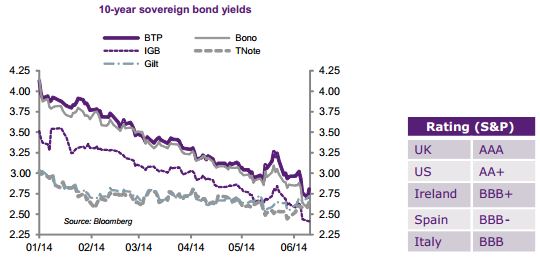
As regards sovereign debts, what is perhaps most startling is that the yield for the 10-year Bono is more or less level
with that of the 10-year TNote, while the yield for the IGB is in fact lower than for the TNote and Gilt.

Italian, Spanish and Irish debts have been assigned triple-B ratings by S&P. By comparison US debt is rated AA+ and British debt AAA by this agency. Needless to say the liquidity of the US debt is nothing like the liquidity of the Eurozone’s peripheral debts, notably that of Irish debt, which offers the lowest yield.
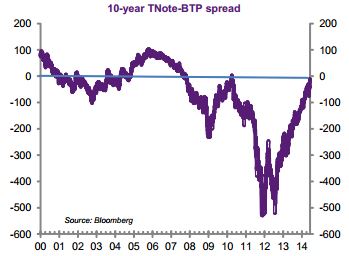
In the past, however, there have been similar episodes. The TNote-BTP spread has been positive on several occasions since 2000, in some cases for extended periods.

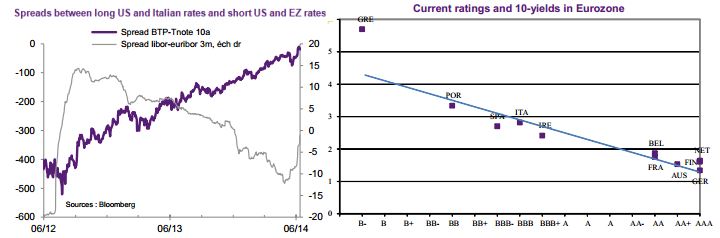
Until mid-2012, the spread between the TNote and BTP was relatively highly correlated to the spread between short
US and EZ rates. Since then, however, these two spreads have clearly been negatively correlated. Everything is
happening as if a “superior force” has suddenly gotten the better of this correlation. This “invisible hand” is obviously
the threat of an intervention by the ECB, the market having been totally won over by the view that the central bank
has the resources (and the resolve should this be necessary) to prop up Eurozone sovereign debts. Of course, this
analysis also applies to Bonos and IGB.
The measures announced last week by the ECB are obviously not going to upset this phenomenon, on the contrary.
However, the question is whether the protection now enjoyed by peripheral debts is not leading to a new mispricing.
Contrary to what is often being said, this is not a certainty, at least not at this point in time. Before the sovereign
debt crisis, the credit risk had just about vanished in the Eurozone, which clearly was an anomaly, as national debts
in fact did not benefit from any protection at European level. Unless underlying fundamentals were good, there was
no compelling reason for yields to be level with those offered by Bund. Yet this was the case. The credit risk reared its head once again with the crisis, with spreads against Bund still considerably wider than before 2008. Furthermore,
sovereign debts now enjoy some protection in different, albeit imperfect guises. That is a big difference compared
with the situation pre-crisis.

The curve charting ratings against yields has undergone a significant flattening, as underlined by the spread between
the 10-year PGB and BTP, which has been divided by four since the start of the year, but once again the situation is
a far cry from what it was pre-crisis when ratings failed to capture risks and the slope of this curve was near enough
flat.
In short, right now, intra-EMU spreads are not aberrant (as yet). If one considers the TNote-Bund spread to be
reasonable, then there is no major anomaly in the fact that yields for peripheral debts are less than or equal to yields
for Gilts and TNotes.
There remains that, at global level, there is no one yield for a specific rating. One need look no further than yields for
triple-A debts to see this, as the 10-year AGB yields 3.82% when the 10-year Bund yields only 1.38%…

Add Comment