


This post is also available in:  Français
It is a new, modern-sounding name, and carries with it the positive
connotations of ‘smart’ technology currently popular in consumer electronics.
Who would admit to not having a smartphone or aspiring to a smart TV? The
marketing implication of the term is that products labeled ‘smart’ seem to do
what the users require of them almost intuitively, and without the requirement
for skilled operation.
So it is certainly a new, 21st century name – but is it really a new idea?
In short, the answer is clearly ‘no’ – systematic alternatives to weighting
schemes based on market capitalisation have, in fact, been around for more
than thirty years.
Dumb Beta?
Of course, the unspoken implication of the term ‘Smart Beta’
is that good old-fashioned traditional beta is not so smart. The
original idea of a market’s ‘beta’ has been around since the
1960s. Over the years, it has become industry shorthand for
exposure to the market as measured by a capitalisationweighted
portfolio. Such portfolios, despite the fact that they
represent just one of many possible systematic ways of
weighting stocks in a portfolio, have themselves become the
accepted proxy for the return of the market as a whole. They
have the advantage of low cost, utter simplicity and limitless
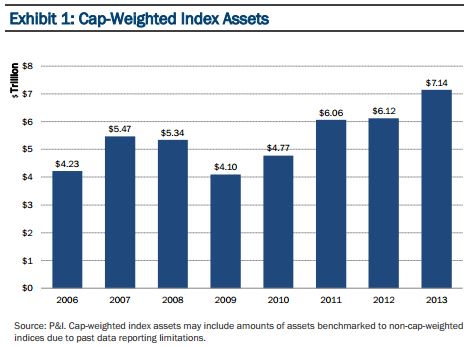
capacity. As a cheap, quick and easy way of investing vast
sums in the stock market, cap-weighted index portfolios have
attracted trillions of dollars from investors all over the world.
Academic fuel to the cap-weighting fire was provided from the
very beginning by the Capital Asset Pricing Model, which
argues that (as long as you accept a whole range of oversimplifying
and unrealistic assumptions) the cap-weighted
index is, in fact, an efficient portfolio. This cornerstone of
Modern Portfolio Theory spawned the belief, still widely held by
many, that the cap-weighted index portfolio offers the highest
achievable return for the level of risk associated with it. Capweighted
index funds continue to attract large volumes of
asset flows from all types of investors, all over the world, who
still cling to this long-discredited notion.

When did the first ‘Smart Beta’ ideas emerge?
Although the term ‘Smart Beta’ was 30 years from being
coined, systematic investment strategies designed to improve upon the inherent flaws of cap-weighted index portfolios began
to emerge already in the 1980s. For example, Dr. E. Robert
Fernholz, founder of INTECH and a creator of enhanced equity
portfolio construction methods, published a seminal paper as
early as 1982 in which he demonstrated that not only is the
cap-weighted index NOT an efficient portfolio, but that a higher
return can be generated with similar risk by simply better
diversifying the holdings and rebalancing. At INTECH, we have
been pursuing such an investment strategy for over 25 years,
and today manage in excess of $40 billion according to such
principles.
Subsequent further attempts by practitioners and academics
in the investment management industry to identify their own
persistently successful portfolio ‘tilts’ are well-documented.
There has been a plethora of various alternative weighting
schemes proposed over the years: equal-weighted, revenue-weighted,
dividend-weighted, earnings-weighted, liquidity-weighted,
beta-weighted, wealth-weighted and GDP-weighted,
to name but a few. Various blends of these ‘factors’ and
others formed the basis for a succession of competing
‘Enhanced Indexation’ products offered by quantitative
managers throughout the 1990s and beyond. They, too, may
have been thrown into the ‘Smart Beta’ bucket at the time had
the term been available.
However, a small number of these individual ‘factors’ stand
out from the crowd; they are ‘Size’ (1981), ‘Value’ (1992) and
‘Momentum’ (1997). They have attracted such a following over
the last three decades that they have achieved celebrity status
and become named ‘effects.’ Some might add to this list
‘Volatility,’ with the ‘Low Volatility Anomaly’ currently knocking
on the door of the “Risk Factor Hall of Fame.” Portfolios
constructed according to these measures have become
immortalised as winning investment strategies that just ‘work.’
Whether or not this is true is open to doubt and the subject of
a later paper. However, suffice it to say, that investment
management firms have built entire businesses and manage
hundreds of billions of dollars based upon offering products
designed to exploit these effects. And furthermore, along with
beta, they have become enshrined in both the literature,
practice and faith system of our industry as the basic
components of portfolio performance: risk factors that can be
used to explain the performance of other portfolios.
Smart Beta – a Name in Search of a Category?
So why the sudden emergence of ‘Smart Beta’ as a category, if
the constituents of that category have been around for over 30 years? The answer lies most likely in some investment
industry themes that have risen to heightened prominence in
the last five years: how to achieve better returns, how to
reduce risk and how to control costs.
Two major stock market crashes since the turn of the century
have left investors bruised, pension funds in deficit and
everyone in need of more return. At the same time, there has
been a heightened focus by plan sponsors, regulators and
investment committees on risk – how to diversify exposure,
and thereby reduce it. And achieving both of these things in a
highly cost-effective way is at the forefront of investors’ minds
at a time of global economic austerity and modest expected
future returns from the capital markets as a whole. The
concept of ‘Smart Beta’ has been pushed forward to meet
these challenges.
As previously noted, the term ‘beta’ is synonymous with
passive management, of which a key benefit is its very low
cost. However, for about 50 years, the only passive option on
the menu was cap-weighted indexation, which, though
inexpensive, has a number of shortcomings. Chief amongst
these are: overexposure to overvalued stocks, overexposure
to large stocks and lack of downside protection. Even in an
index fund there’s a reasonable chance you might lose half
your money in a 12-month period.
‘Smart Beta’ approaches purport to offer the same low-cost,
passive approach enjoyed by cap-weighted index portfolios,
but designed to exploit many of the favourite risk factors
highlighted above, to generate a higher return at the same or
less risk. They are sometimes called ‘alternative’ index
portfolios, as they employ weighting schemes based on
measures other than market capitalisation, such as
fundamental valuation metrics or stock volatility. So accepted
and mainstream have these ‘effects’ now become that they
are considered commoditised exposures that can be
accessed mechanistically and passively through rules-based
processes as part of one’s ‘Smart Beta’ allocation – a
diversifying alternative to traditional cap-weighted portfolios.
Although such factor-based strategies have been around for
over 30 years, ‘Smart Beta’ index portfolios aim to remove
the need to employ skilled active managers to access them.
What was previously sold as alpha has been re-packaged as
beta and offered to investors in generic ‘index’ form.
But are these strategies really indices? And are they truly
passive? Is ‘Smart Beta’ genuinely smart, and is it really
beta? The answers to these questions and others are the
topic of the second article in this series.

Add Comment