


This post is also available in:  Français
In recent years, long-held ideas on portfolio construction have been called into question. Investors
can now choose from a range of “smart beta” strategies, offering exposure to market risk premia
in a systematic, transparent fashion. Where does the dividing line between active and passive
fund management now lie? What is the likely future role of active managers? And as indices
evolve, how should standard, capitalisation-weighted benchmarks be used? In this Expert
Opinion, Nicolas Gaussel, Chief Investment Officer at Lyxor Asset Management and Arnaud
Llinas, Lyxor’s Head of ETFs and Indexing, share their views on these important questions.
TRADITIONAL “CORE” ACTIVE MANAGEMENT IS SHRINKING
[Nicolas Gaussel] One trend that has dominated asset management since
the turn of the millennium is the shift of assets away from traditional “core”
active mandates.
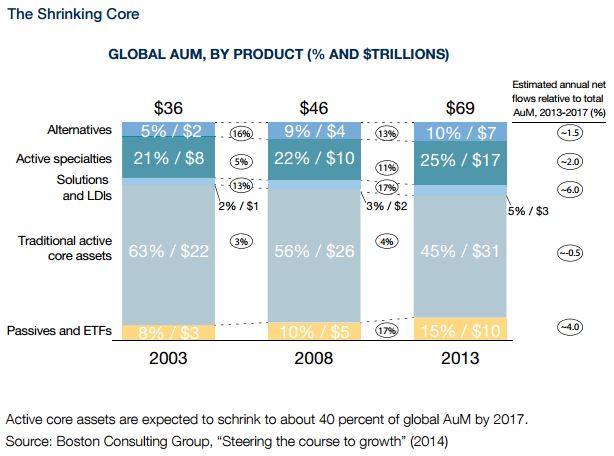
According to a 2014 study by Boston Consulting Group (BCG), active core
assets represented 63% of global assets under management in 2003, but
this figure is likely to fall to 40% by 2017. Investors worldwide have been
moving away from traditional active management into alternatives, dedicated
active mandates, solutions and liability-driven investment (LDI) schemes.
There is also a big rise of passive funds in allocations, including exchangetraded funds (ETFs).

So we are witnessing a bipolarisation of the asset management market:
increased demand for specialist active management, on the one hand, and
for passive mandates on the other. Traditional active managers are under
increasing pressure to justify their roles.
PASSIVE FUNDS ARE GROWING
[Arnaud Llinas] In its study, BCG noted that passive
mandates and ETFs had grown from $3 trillion to $10 trillion
in assets under management between 2003 and 2013,
and BCG expects this market segment to continue to grow
healthily. We think there are four reasons for this trend.
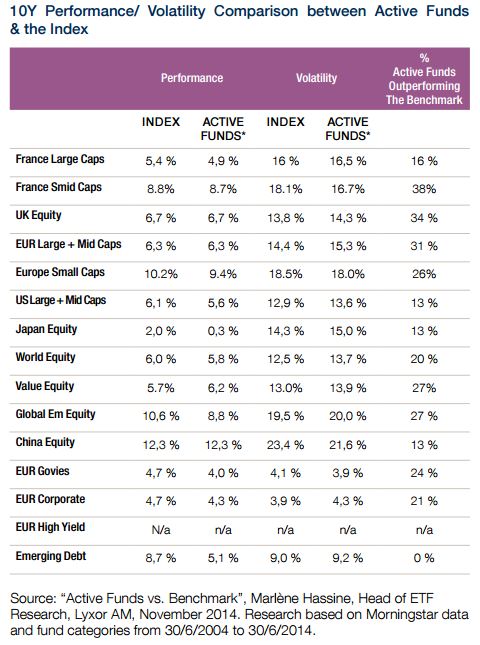
First, active managers continue to underperform their
benchmarks in aggregate. According to a recently published
study by my colleague Marlène Hassine, Lyxor’s Head
of ETF Research, only 21% of active funds on average
outperformed their benchmark over the last 10 years. And
the evidence also shows that there is little persistency in
performance over time. Managers that beat the benchmark
in one year have thus a poor chance of doing the same the
next year.

Second, passive funds, including ETFs, have a clear cost
advantage against active funds, leading many investors to
decide that they would prefer to track an index rather than
to try and beat it. Of course, it’s fair to point out that passive
funds don’t replicate their indices exactly. Other things being
equal, they will trail it by their annual costs of management.
However, passive funds’ costs are relatively low and have
been steadily decreasing.
Third, passive funds now offer access to a broad range of
asset classes and with a great degree of granularity, offering
investors significant choice. Passive funds are typically highly
diversified, giving wide access to individual market segments.
Fourth, smart beta—investment strategies, codified as
indices, with an ease of replication in a systematic, transparent
method—is an increasingly important phenomenon.
SMART BETA EXPANDS THE DEFINITION OF PASSIVE
[A.L.] Smart beta is expanding the traditional definition of passive
investing, and in a way that offers investors a valuable new tool.
Various types of portfolio strategy traditionally undertaken
by active investment managers can now be replicated
efficiently and at low cost via smart beta indices. In other
words, passive funds are increasingly being used to give
exposure to strategies that were historically offered only in
an active format. To some extent, smart beta is also likely to
replace some of investors’ traditional allocation to passive
funds, tracking indices weighted by market capitalisation.
In a recent Expert Opinion from Lyxor[[http://www.lyxor.com/fileadmin/PDF/20141106-EXPERT_OPINION_RISK_
FACTOR_RONCALLI_GB.pdf]], my colleague
Thierry Roncalli, Lyxor’s Director of Research provided an
overview of the concept of risk factors. Risk factors help
us understand the performance of equities and other asset
classes, and an increasing number of smart beta indices
offer exposure to individual risk factors.
There are other popular types of smart beta index, including
those focusing on the reweighting of index constituents, on
particular investment styles or on specific risk outcomes,
such as minimising volatility.
In the future, we think that many portfolios will include an
important allocation to smart beta, as well as to traditional
beta and to active management alpha.

ALTERNATIVES OFFER UNCORRELATED RISK
PREMIA
[N.G.] It may seem paradoxical that the demand for
alternative asset management structures, such as hedge
funds, has been increasing in the midst of this boom for
indexing and passive solutions.
But investor inflows into alternatives have been very
strong. BCG estimated in 2014 that alternative assets
more than trebled between 2003 and 2013. Another study,
conducted by Cliffwater and Lyxor, found that the weighting
of alternatives in US state pension funds has recently more
than doubled, rising from 10% in 2006 to 24% in 2013[[According to a study by Cliffwater and Lyxor AM.]].
During a period of great volatility in asset markets and
despite the negative headlines associated with some hedge
funds, investors continue to be attracted by alternatives’
ability to generate attractive risk-adjusted returns.
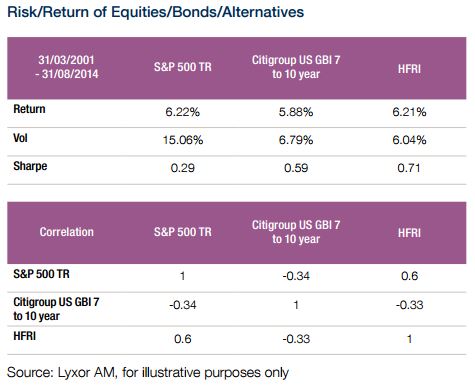
Over the period between 2001 and 2014 US equities (the
S&P 500 index) and US government bonds (the Citigroup
US GB 7-10 year index) and hedge funds (in the form of
the HFRI index) all gave total returns of around 6% a year.
But while US equities had annual volatility of around 15%
over the period, hedge funds had bond-like volatility of
around 6%. Hedge fund returns were also negatively
correlated to bond returns, and only weakly correlated to
those of equities.
These statistics reinforce the central attraction of
alternatives: they can act as an effective portfolio diversifier,
offering uncorrelated risk premia. And this results from
hedge funds’ exposure to non-traditional asset classes.

ALTERNATIVES AS TRUE ACTIVE MANAGEMENT
[N.G.] Increasingly, alternatives are being seen as the true
home of active asset management. Hedge funds are often
relatively unconstrained in the investment positions they
are allowed to take. By contrast, in many traditional core
active management mandates performance is measured
relative to an index benchmark, and managers may be
reluctant to depart too far from index weightings. The
difference between traditional active mandates and hedge
funds is also supported by a lot of academic research.
For example, in 2009 Professors Ang, Goetzmann
and Schaefer reviewed the performance of the active
management of the Norwegian Government Pension
Fund, which was largely based on traditional mandates[[https://www.regjeringen.no/globalassets/upload/fin/statens-pensjonsfond/
eksterne-rapporter-og-brev/ags-report.pdf]].
The researchers concluded that a significant proportion
of the fund’s historical returns could be explained by
exposure to systematic risk factors, rather than occurring
as a result of active manager skill. This takes me back to
Arnaud’s point about smart beta: it’s increasingly possible
to access these risk factors via transparent and low-cost
index solutions, rather than paying extra to access them
via active mandates.
In another study, published in 2012 and focusing on the
period from 1990-2008[[http://papers.ssrn.com/sol3/papers.cfm?abstract_id=1948726]], academics Aglietta, Brière,
Rigot and Signori showed that active management had
contributed nothing to US pension funds’ returns within
the equity asset class and very little to the funds’ returns
in fixed income.
In fact, most of the equity and fixed income returns
earned by US pension funds came from broad market
exposure, something the funds could have achieved by
indexing. However, the researchers found that active
management played a much more significant role than
market movements in explaining pension funds’ returns in
hedge funds and other alternative asset classes.
DEFINITIONS OF ALPHA AND BETA ARE CHANGING
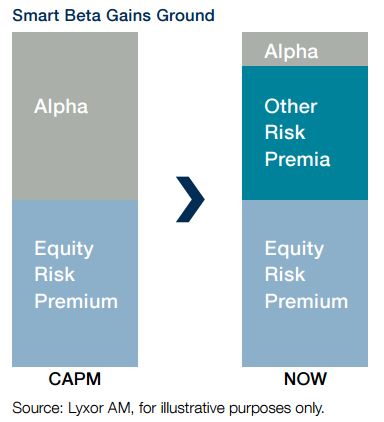
[A.L.] I’d like to expand on what Nicolas has just said.
As “beta” expands to encompass not just traditional,
capitalisation-weighted market indices but also smart beta
indices, which embed different investment strategies and risk
factor exposures, “alpha” may also change its definition.
There is likely to be much greater scrutiny of the extent
to which active managers truly add value, for example by
studies focusing on managers’ “active share” against their
performance benchmarks. And those benchmarks may be
more tailored to managers’ individual styles. For example, if
an active manager specialises in small-cap US value stocks,
why not measure his performance against the relevant smart
beta index, rather than against the broad market?
PASSIVES AND ALTERNATIVES ARE COMPLEMENTARY
[N.G] We often see passive and active management
described as being in a fight for investors’ assets. I don’t
think this is the right way of viewing things.
Instead, index-based portfolio solutions (such as passive
funds and ETFs) and truly active funds (in the form
of alternatives) should be seen as complementary. In
fact, in Lyxor’s view these portfolio approaches can by
themselves provide a full solution for the average investor.
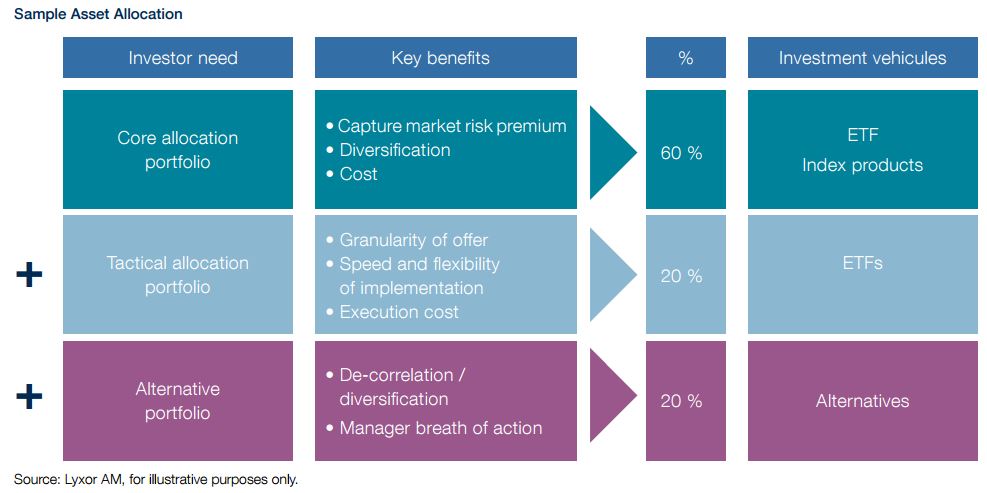
Broad-based ETFs and other index products, typically
tracking capitalisation-weighted indices, are well-suited
to the portfolio core. They capture market risk premia and
offer effective diversification at low cost.
ETFs are ideal for tactical asset allocation, since they offer
high granularity of exposures, ease of implementation and
low execution costs. Such tactical positions could include
ETFs based on strategy and factor indices.
Alternative assets can then form the active part of the
portfolio, based on the principle of uncorrelated exposures
and unconstrained investment mandates.
A typical portfolio could be split 60/20/20 between core
ETFs and index products, tactical exposures using ETFs
and the active component, represented by alternatives.
COMBINING ACTIVE AND PASSIVE
[N.G] Asset allocation approaches are evolving to take into
account the broadening range of low-cost, index-based
solutions and the growing evidence that alternatives are
the true form of active management. We believe that
combining traditional beta, smart beta and alternatives in
a portfolio provides a very effective and powerful solution
for the average investor.


Add Comment