


This post is also available in:  Français
Since the 2008 crisis, central banks have had a major influence on financial market
trends. The Bank of Japan (BoJ) in particular has orchestrated a historic rally among
Japanese equity markets since announcing its quantitative and qualitative easing
strategy (QQE) at the end of 2012. The implementation of an asset repurchase program
reflected the willingness of the government led by Shinzo Abe to defeat deflation, which had
prevailed since 1998. After its initial rapid success, this policy reached its limits however, as
inflation forecasts stagnated below the 2% target set by the central bank. The BoJ nevertheless
kept its monetary policy unchanged at the meeting held on October 30th, which surprised
investors. The BoJ’s audacious strategy is now at a technical and political crossroads. The
various constraints facing the BoJ provide a clear lesson for the future of unconventional
monetary policies in Europe (eurozone, UK, Denmark, Sweden) and the US.
At its monetary policy meeting at the end of October, the Bank of Japan surprised the markets
by opting to maintain the status quo. The Japanese economic climate is highly uncertain,
although there are clear signs of a slowdown. Household consumer spending is still struggling to
overcome the hike in TVA implemented during the spring of 2014, while exports have been hit
by the crash in Chinese industrial investment. Corporate confidence has also been undermined
by the absence of a snapback in consumer demand. Meanwhile, the leading export market,
China, is undergoing an adjustment. Capex is predicted to remain flat this year according to the
closely-watched Tankan survey. So how can the Bank of Japan’s cautious stance be justified?
The proximity of other dynamic Asian economies tends to eclipse the fact that an ageing Japan
harbors potential annual growth of only 0.3%. The economy does not require spectacular
growth in order to approach full capacity utilization, which has been triggered by a series of
budgetary stimulus packages initiated by Shinzo Abe since returning to power in 2012. The
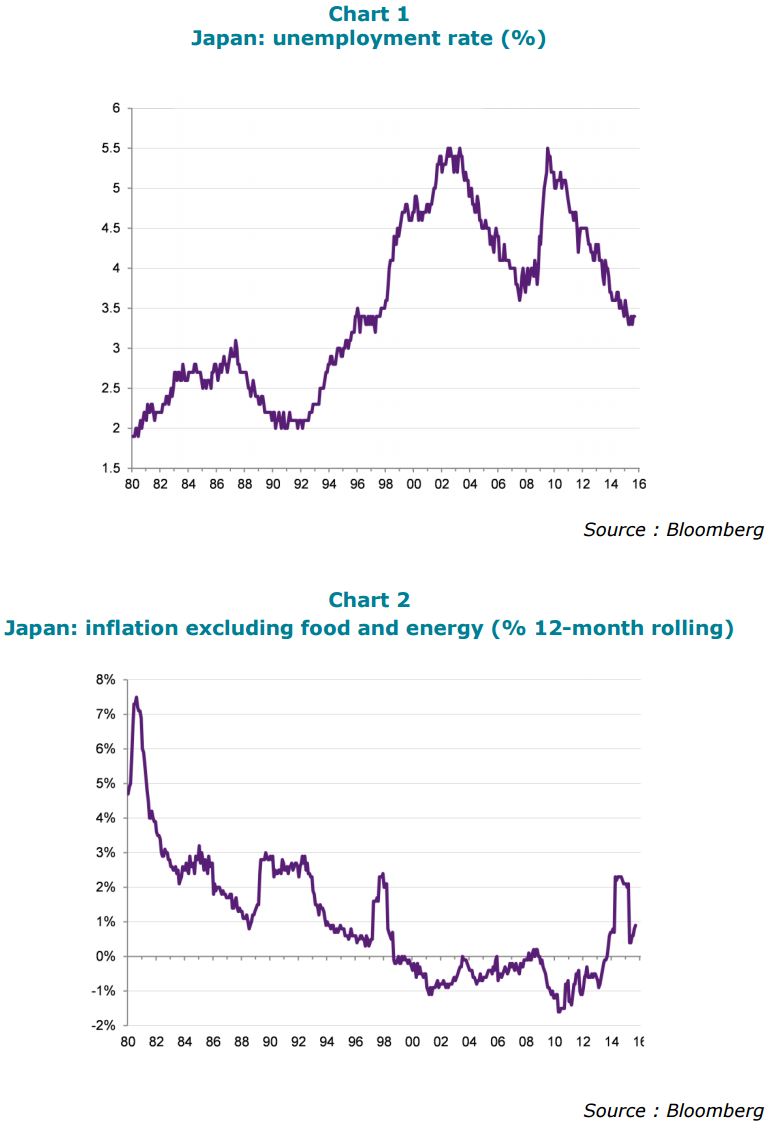
unemployment rate is at an 18-year low of only 3.4% (chart 1). Core inflation, excluding energy
and food, rallied from -1% at the end of 2012 to 0.9% in September, on a rolling 12-month
basis (chart 2). In this context, it is understandable that the BoJ considers that the risks
incurred by extending its QQE program outweigh the benefits.

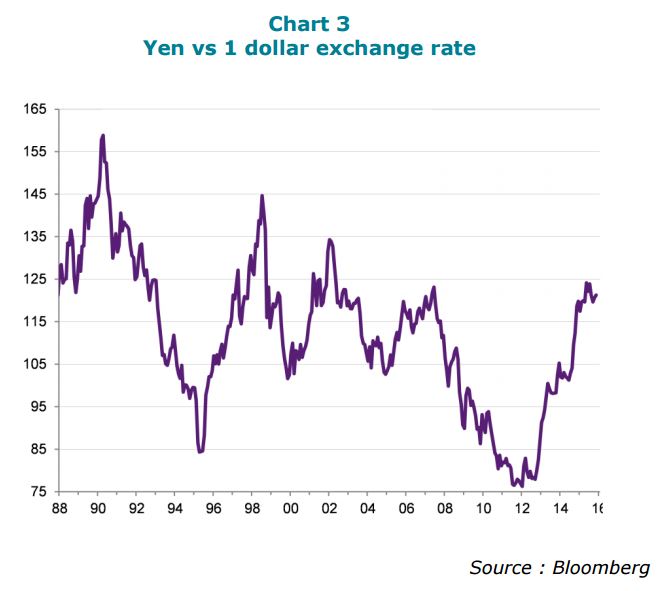
Firstly, QQE feeds through to inflation forecasts primarily thanks to weakness in the yen (chart
3). However, the government has faced the bitter experience of collateral damage inflicted by a
weak yen. Weakening the currency exchange rate, in an economy which is a heavy importer of
commodities (food, energy and industrial input), is equivalent to a hike in consumer VAT and
levying an import duty on SMEs. Furthermore, the depreciation of the yen enrichens households
which own large equity portfolios, by boosting revenues among major listed exporting
companies. The devaluation amplifies wealth inequalities, acting like a negative capital tax. In
order to preserve his political capital ahead of the forthcoming senatorial elections (summer
2016), the Prime Minister probably encouraged the BoJ to hold fire this time. Furthermore, with
the signature of the TPP currently pending approval by the US Congress, it would be
inappropriate for Japan to appear to be involved in a currency war.

Secondly, the BoJ is already buying-up considerable quantities of Japanese government bond
securities (JGB) and absorbing 10% of public debt per year. At this rate, the IMF estimates that
within one or two years, under certain hypotheses of domestic institutional investors holding
JGBs as collateral, or as liquidity or to satisfy regulatory requirements, the BoJ will run out of
government bonds to buy. Thus any acceleration in government bond repurchases will
exacerbate fears of the program being suddenly halted, once the central bank runs out of
purchasable securities. Anticipated fears of this type of withdrawal syndrome could weigh on the
economy.
Furthermore, stepping-up the QQE program incurs the risk of overheating the Japanese
economy, which is almost at full-employment, if global trade also accelerates. Japan may be at
the inflexion point of the Phillips curve, which gauges unemployment vs wage inflation. At the
inflexion point, any further fall in unemployment incurs the risk of triggering a steep rise in
wages. Higher short-term inflation forecasts would lead to capital outflow among domestic
investors seeking shelter against further cuts in real interest rates. This factor would then cause
a further depreciation of the yen, which would vindicate the higher inflation forecasts and
steepen long-term rates, which could jeopardize the government’s solvency. The BoJ would
certainly attempt to calm any tensions in the bond market by stepping in as buyer of last resort,
armed with unlimited liquidity. However, in the event of a massive bond market sell-off by
domestic institutional investors (banks, pension funds and life-insurers looking to benefit from
higher yields in foreign bond markets, while hedging against future yen weakness), the BoJ
would be forced to buy enormous quantities of JGBs in the market in order to cap rising interest
rates, given that public debt exceeds 200% of GDP. This would imply the creation of colossal
liquidity by the central bank. The injection of fresh money into the system, which is already
awash with monetary liquidity, would cause a surge in inflation expectations and therefore
trigger further capital outflow, which would weigh even more heavily on the yen. The national
currency would be caught up in a vicious negative spiral.
It is apparent that when devaluation is the only option remaining open to the central bank to
stimulate inflation forecasts, target inflation policy becomes highly risky if public debt represents
a significant multiple of the total monetary mass. This risk is even greater once the economy is
approaching full employment, which represents a turning point at which wages can become a
powerful driver behind an inflationary shock, triggered by lower exchange rates.
The BoJ is therefore at a crossroads. Its program implemented to combat deflation was
successful, as illustrated by the increase in core inflation towards 1%, but at the cost of
currency depreciation, which weighed chiefly on consumers. The 2% target is still a long way
off, whereas pursuing the program incurs increasing risks.
The government has now also refrained from putting pressure on the central bank to reach
target inflation as quickly as possible. Shinzo Abe is aware of the political cost of the increase in
inflation from -1 to +1% via the depreciation of the yen. With public debt yielding largely
negative real interest rates and a rapid monetization of the BoJ’s debt reserves, pursuing the
2% inflation target may seem highly theoretical and would have no real political upside.
Essentially, the Japanese government’s willingness to overcome modest domestic deflation,
which in many ways constitutes a stable economic equilibrium, could be motivated primarily by
the public debt situation, i.e. reversing the surge in public finances through monetary
intervention, without engaging a long-winded parliamentary debate on budgetary policy. In this
sense, it appears vital for the government to maintain the current pace of its QQE program,
which ensures rapid monetization of the debt reserves and limited interest payments for the
state, without the risk of a bond market crash, or undermining domestic political capital
(Japanese electors) or exterior political capital (the US Congress approval of the TPP) through a
hazardous depreciation of the yen.
We therefore believe, excluding a sudden downturn in the economic climate, that the BoJ is
likely to maintain its current cautious monetary policy, reflecting the high risks incurred by any
attempt to overstimulate an economy which is over-indebted, over-monetized and approaching
full unemployment. The issues facing the BoJ could soon be shared by the Fed, the Bank of
England and the Royal Bank of Sweden, as Japan in many ways represents a test-case for our
unconventional monetary policies.

Add Comment