


This post is also available in:  Français
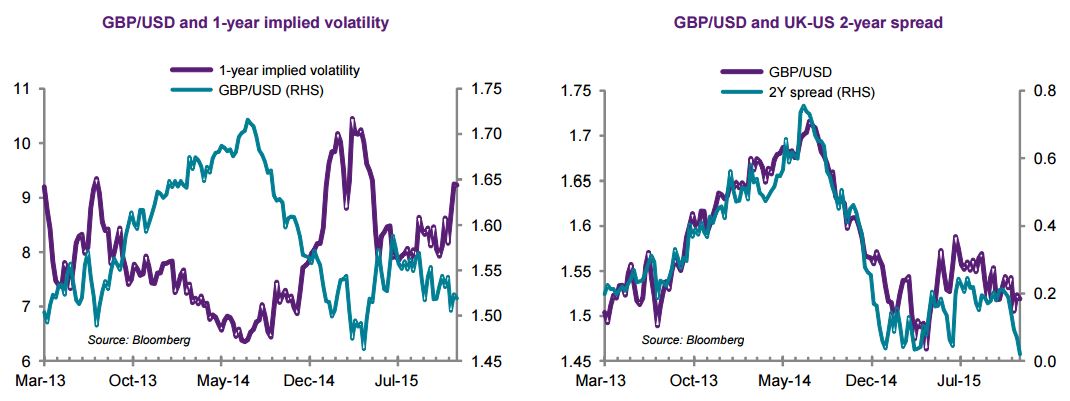
As yet, sterling appears not to have reacted to the looming referendum on the UK’s continued membership of the
European Union. Over the short to medium term, however, the currency should end up reacting negatively, so great
is the fallout for the British economy. In particular, one would expect the volatility displayed by sterling to pick up at
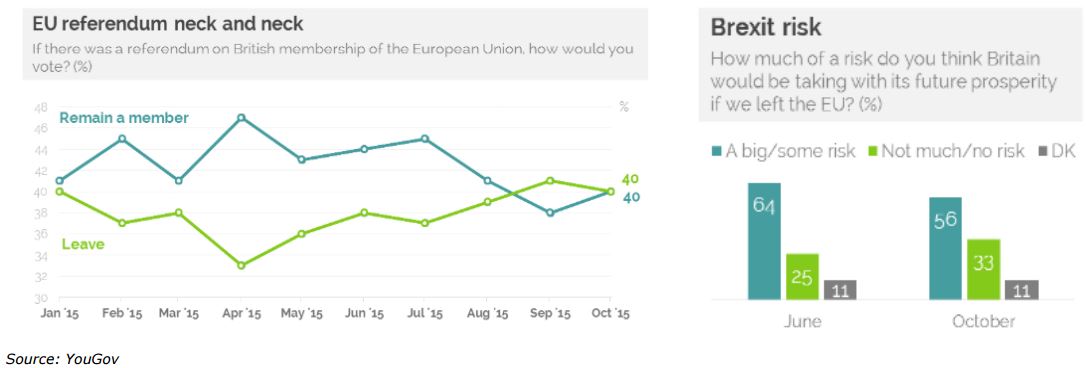
the start of 2016, bearing in mind that opinion polls are very tight. Before considering the effects of the referendum
on the British currency, we set out the context, the reforms proposed by the British government, key dates, and,
especially, the possible impact on the British economy.
In reaction to the emergence of the UK Independence Party (UKIP), David Cameron decided in January 2013 to hold
an In/Out Referendum to preserve the unity of the Conservative Party. Since the creation of the European Union,
the UK has been a rather reluctant partner, opting out of the single currency and the Schengen agreement. The
sovereign debt crisis and the influx of migrants have revived the debate over the UK’s continued EU membership. A
referendum should be held before the end of 2017. It is very likely that it will be held in Q3 2016, not in 2017 as
there are general elections in France and Germany.
So far, David Cameron has written a letter to the European Council President setting out proposed reforms requiring
the EU to change its founding treaties. If there is agreement over the proposed reforms, the British Prime Minister
indicated in the letter that he was ready to campaign for continued EU membership.
There are four main areas where the UK is seeking reform:
1. Economic governance: David Cameron wants recognition that the EU has more than one currency. He also wants
Euro-outs to have a say in developments within the Eurozone that affect all Member States, so as to preserve
the positions of Euro-outs within the EU.
2. Competitiveness: the British Prime Minister is seeking a scaling back of unnecessary legislation to improve the
competitiveness of EU Member States. He also proposes adopting a new trade strategy, including unfettered
trade deals with the US, China, Japan and ASEAN.
3. Sovereignty: David Cameron wants to end the UK’s obligation to work towards an “ever closer union” as set out
in the Rome Treaty. He wants to enhance the role of national parliaments, notably with a new arrangement
whereby groups of national parliaments, acting together, can stop unwanted legislative proposals at EU level.
4. Immigration: the Prime Minister’s priority is to introduce a 4-year restriction on access to in-work benefits in the
case of people coming to the UK from the EU.
Following the announcement of these proposals, a number of members of the European Commission have already
said that certain reforms were “highly problematic”, which suggests that negotiations will be tough at the December
meeting of the European Council.
Key dates and timetable:

The cost of a British exit on the British economy is still uncertain. The risk is that foreign investors and British
enterprises would face a prolonged period of uncertainty, which could be very costly. An erosion in investor and
business confidence would lead to a significant fall in investment. The impact on trade exchanges would be
considerable. The European Union is the UK’s biggest trade partner, accounting for 45% of exports and 53% of
imports. If the Out campaign prevails, the country would be excluded from the trade agreement with the EU. The
WTO could impose customs duties on British goods and services, significantly increasing cost of trade. At
employment level, a British exit would make the UK less attractive for migrants. The UK labour market would
therefore be deprived of a significant source of labour supply. The existence of an abundant workforce because of
the migrants has contributed to holding back wage growth and inflation. This situation has checked the rise in
salaries in recent years, hence in inflation.
Since September, the probability of a UK exit from the European Union has increased according to
opinion polls, but without this having a significant impact on sterling.

Whatever the outcome of the referendum, it will affect sterling. If there is a British exit, there will follow a period of
uncertainty for investors (impact on 1-year volatility). Although not entirely similar, the referendum on Scottish
independence saw sterling slump by 4%, but not before the fortnight preceding the vote. This time, however, the
effects will be felt far earlier when it comes to the British economy and currency as fallouts would be greater, possibly
leading to a breakup of the UK, if Scotland opts to stay in the European Union.
Our view is that the UK will vote to remain in the European Union. However, sterling will be under pressure throughout
H1 2016, particularly if the polls remain tight, as this would stoke uncertainties, hence capital outflows. The GBP/USD
could correct to 1.46 in H1 2016, which suggests that 1-year RR 25D also have downside potential in the short term.
They currently stand at -1.69 compared with -2.89 in March 2015.
Sterling will not recover until the end of 2016, heading towards 1.52 post-referendum, with the help of the Bank of
England, which can be expected to kick start its monetary tightening in reaction to the expected rebound in inflation
(disappearance of base effects). In coming months, we expect 1- and 2-year implied volatility to pick up because of
the uncertainties over the outcome of the In/Out referendum that could be held end-2016, or possibly in 2017.

If voters reject a British exit by a large majority, the GBP/USD’s rebound will be more substantial, the pair heading
towards 1.55, inasmuch as this would strengthen the UK’s position in the European Union and amongst investors. If
the vote is for a British exit, the GBP/USD will correct further given uncertainties over trade relations as well as at
economic and political levels. If this scenario unfolds, the GBP/USD could pull back post-referendum towards 1.40 at
the end of 2016.


Add Comment