


This post is also available in:  Français
Yet, in front of that, strong inflows into alternative UCITS in Europe have gone somewhat
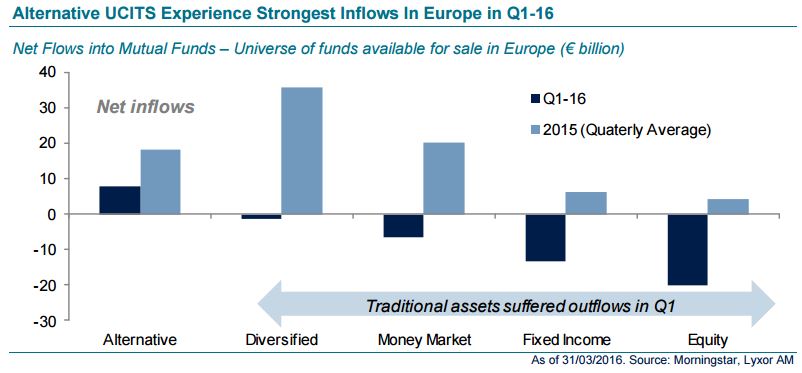
unnoticed. According to Morningstar, alternative UCITS experienced net inflows of EUR 3.6
billion in March, bringing the cumulated figure to EUR 7.7 billion in Q1-16 (based on the
universe of funds available for sale in Europe).
The strong appetite for alternative UCITS is also in stark contrast with the outflows
experienced by traditional asset classes: in Q1-16, equity mutual funds experienced
outflows of EUR 20bn and fixed income & credit funds saw outflows near EUR 13bn.
Meanwhile, money market and diversified funds also suffered outflows. Conversely,
alternative UCITS is the only asset class experiencing inflows in Europe during the first
quarter.
The reasons for such appetite are multiple. On the one hand, the market environment has
deteriorated over the last twelve months. European equities suffered a double digit
drawdown with annualized volatility in excess of 20%, while Euro area sovereign bonds
also experienced higher volatility than usual. On the other hand, the outlook for traditional
assets is clouded by many uncertainties: valuations across asset classes are rich,
economic and earnings growth face dim prospects and a huge share of risk-free assets in
the eurozone are yielding less than 0%… In this context, investors have piled into
alternative strategies that offer higher risk adjusted returns in relative terms.
With regards to recent performance, the Lyxor hedge fund index is down 0.4% during the
last week of April, and down 0.9% in April. Fixed income and credit arbitrage outperformed
while CTAs underperformed as a result of the rise in bond yields.


Add Comment