


This post is also available in:  Français
Is it now time to take partial profits? Although the
year is clearly far from over, the three factors likely to kick-start the markets, that we have been
monitoring for several months, appear to be losing momentum and, at the least, other themes are
required to extend the rally.
We were counting on an oil price rally to alleviate several of the fear factors present at the
beginning of the year. The US energy industry was caught in a downward spiral. Deflationary
pressure from falling energy prices maintained the impression that monetary policies were
ineffective. Since then however, as we foresaw, the price of crude recovered. Global trade remains
sluggish however and supply still outweighs demand. It would therefore appear that the latest rally
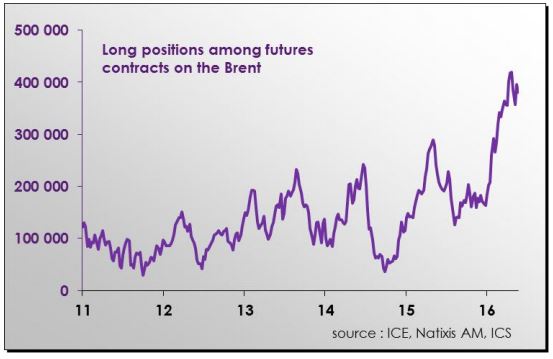
has been driven by speculative buying, as illustrated by the build-up in long positions among
futures contracts.
Long positions among futures contracts on the Brent

If, as we are expecting, oil prices
remain flat, the positive impact that
the rally has had on several other
asset classes may be undermined.
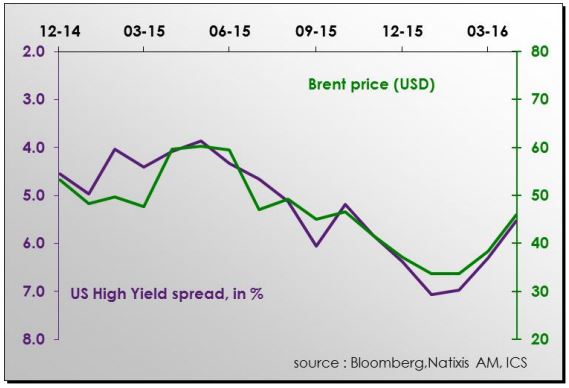
For example, the US high yield
market was driven by fresh
optimism regarding the oil-price
trend, with spreads narrowing in
the wake of the US crude price
rally.
Oil price and US high yield

This situation may also be
complicated by the Fed
adopting a more hawkish
tone. The US central bank
had deferred taking action
following market weakness
and amid fears in the
international setting. This was
the second catalyst for a
potential market rally in our
opinion. However, Janet
Yellen has now had to satisfy
the Fed hawks and has once
again stressed the
improvement in the US
economy in order to justify
possibly resuming monetary
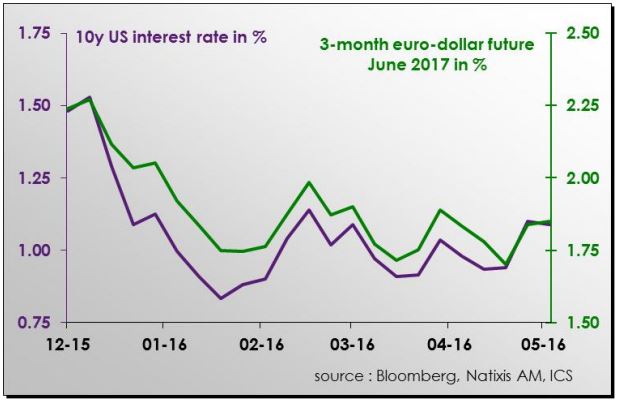
tightening. The difficulty is
that US long-term rates,
which had tracked short-term rate expectations (in this case the 3-month euro-dollar future), will
certainly steepen again. US companies, which are still weathering a slowdown in several economic
indicators, will have to face less advantageous financial conditions, just as margins are contracting
due to stagnating sales combined with slight wage pressure. As a result, the short term outlook for
Wall Street now seems more uncertain.
US: 10y interest rate and short-term rate expectations

Chinese stimulus measures were the third factor supporting our interest for risky assets. From this
point of view, investors seem to have ruled out the risk of a hard landing in the Chinese economy
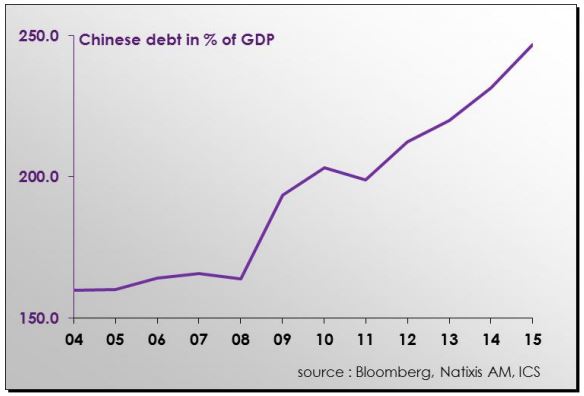
in 2016. However, China’s financial situation is becoming increasingly worrying, with debt levels
surging since 2008. Over the past 15 years, Chinese debt has grown three times more rapidly than
the economy. Corporate and household debt together equal 207% of GDP. Government debt is estimated at 40 – 55% of GDP. It is problematic for an emerging economy to have an equivalent
debt level to industrialised countries (250% global debt/GDP ratio). There is therefore a risk that
markets will penalise this type of credit-driven growth, which is unsustainable over the medium
term, once investors are reassured that 2016 has been preserved.
Evolution of Chinese debt

Several factors are therefore clouding the horizon for the markets and the best policy is
undoubtedly to remain patient, while setting up hedges or taking partial profits. Given the
forthcoming electoral incertitude in Europe and in the US, market volatility should provide some
better investment opportunities. Although the weather and the climate are, of course, two different
things and the horizon may clear progressively, it would be wise to acknowledge that a number of
threats are currently looming over the markets, which could cause a sharp drop in returns in
Europe, just like the current temperatures!

Add Comment