


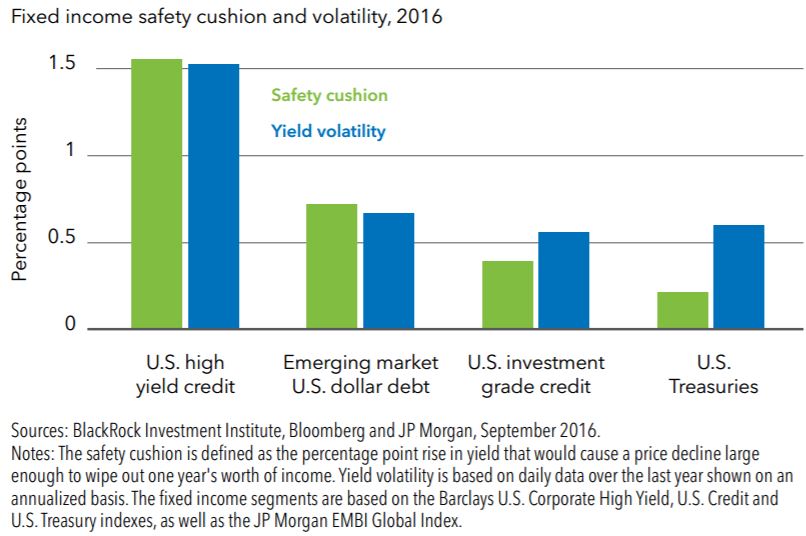
Depressed yields mean there is currently little safety cushion for holders of
U.S. government bonds. Just a 0.2 percentage point increase in Treasury
yields could wipe out a whole year’s worth of yield income.

Other fixed income sectors such as U.S. investment grade corporate bonds and emerging market dollar debt offer thicker safety cushions – with similar yield volatility in the past year. See the green and blue bars in the chart above.
A higher price for long-term insurance
The collapsing cushion comes as long-term yields are starting to rise. We see a steeper yield curve ahead amid a gradual pivot
toward fiscal expansion globally, although central banks still have the ability to limit any unwanted yield rises. Major central banks
are displaying a tolerance for letting inflation run hotter, and the Fed has adopted a go-slow approach to raising rates. Central banks
appear to be approaching limits in the effectiveness of extraordinary monetary easing, as was evident in the BoJ’s shift last week to
policy tools that steepen the local yield curve.
U.S. Treasuries are becoming less attractive to non-U.S. investors, as the increased cost of currency hedging is wiping out the extra
yield Treasuries offer. Finally, bonds tend to have higher correlations to stocks during periods when markets are concerned about Fed
tightening, damaging their traditional role as portfolio diversifiers. This is a risk as the central bank’s December meeting approaches.
Longer-maturity U.S. government bonds still have a role to play — and should buffer portfolios in any flights to safety. But investors
today are paying a lot for this diversification benefit. We prefer shorter-term corporate and municipal bonds, whose yields have
temporarily spiked ahead of U.S. money market reforms in October. Overall, we favor credit markets and see a role for other
portfolio diversifiers such as gold.

Add Comment