


Introduction
Listed solution for implied equity repo trading via EURO STOXX 50®
Index Total Return Futures complement the Eurex suite of equity index
derivatives and support the market in complying with new financial
market legislation. Eurex Total Return Futures are designed to offer listed
solutions for trading the implied equity repo rate. Index TRFs aim to
replicate the payoff on an index total return swaps (TRS) in a cost efficient
way. This research paper focuses on the inseparable relationship between
implied repo rates and equity index total return swaps. Written by Stuart
Heath, Director Equity & Index R&D at Eurex, it covers the various aspects
and calculations of both repo rates and the TRS.
1. Equity index total return swap pricing
and repo rate
Equity index total return swap (TRS) are “priced” by reference
to the spread in relation to the benchmark funding rate,
which is fixed at the inception of each TRS. One of the key
determinants used to fix the spread is the repo rate.
The determination of that repo rate is based on a number
of market factors such as:
Short term repos – one of the main drivers of the costs of
short-term repos is the inventory of stocks available to
be lent. When borrowing demand is high and inventory
(available for borrowing) is low, repo fees will tend to rise.
High borrowing demand can be due to a number of reasons,
such as:
Strong negative outlook on equities means that speculators
want to sell the stocks to benefit from the stock going
down – but of course they need to borrow it to ensure they
can deliver it.
Corporate actions – can lead in some cases to a possible
arbitrage and arbitrageurs would want to benefit from it
without taking exposure on the stock, hence they would
buy the stock and sell a forward, again putting pressure
on the repo rate.
However, there are other costs that can be incorporated
into the traded spread such as:
Withholding tax – as seen a key element to forward
pricing is distributions applied during the reference period.
In the case of dividends however these are generally
subject to a domestic withholding tax and hence allowances
may be made for this.
Balance sheet costs – for a seller of an equity index TRS
the immediate hedge could be to buy the cash basket
in order to replicate the returns – which may have balance
sheet costs that would be passed on through inclusion
in the spread.
Frictional costs – a catch all for items such as brokerage
commissions which impact cash basket replication etc.
a. Relation between equity index TRS spread
and repo rate
In determination of the forward price the repo rate
is subtracted from the interest rate to determine the total
financing cost i.e. this amount is the assumed income
a holder of the cash index will earn in the repo market.
In respect of the equity index TRS the spread is the rate over
the reference interest rate that a buyer (receiver) of total
returns must pay to the seller (payer) and of which repo rate
is the key driver. If the holder of a cash basket can receive
income from repo of the underlying stocks then equally
the buyer (receiver) of an equity index TRS would expect
the spread to be subtracted from the financing cost.
Hence TRS spread is (to a greater part) the inverse of
the repo rate.
b. Negative repo rates
In theory, with all things being equal, negative repo rates
should be arbitraged away by a simple trade of selling the
forwards/futures and buying the cash basket at the current
funding rate. The trader can then make risk free profit
between the actual repo amount earned and the negative
repo rate implied from the forward price (assuming
the minimum earnable is zero – but that still implies a profit).
A sustained negative repo rate implies that, instead of
earning repo from the cash securities held, the dealer is
in fact “paying” an amount to remove the securities
from their balance sheet.
This has in fact been the case since 2013. The key driver
is the balance sheet constraints currently applicable to banks
under the Basel III reforms introduced by the Bank of International
Settlements (BIS) and its implementation in Europe
under the Capital Requirements Directive IV (CRD IV).
The key impact of this directive is to restrict the traditional
financing activities of banks Delta 1 desks as the cost
of capital applied to balance sheet use (such as holding cash
equities) has made these trades unprofitable. Thus since
2013 negative repo rates have been sustained and equally
equity index TRS spreads have stayed positive.
2. Implied repo
In terms of EURO STOXX 50® (SX5E) forward pricing
the majority of inputs are directly observable. In particular
index spot rate and interest rates are directly observable
and distributions such as gross dividends are either directly
observable, or if projected, can be hedged with for example
the EURO STOXX 50® Index Dividend Futures.
The “other” factors in the determinant of forward prices
(predominately the repo rate) are usually implied for market
prices and are aggregated under the term of “implied repo”.
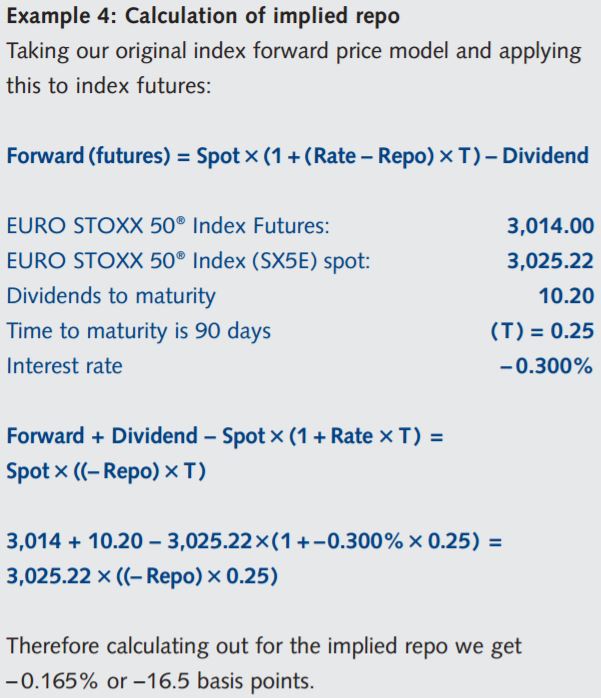
a. Calculation of implied repo
The shorter end of the implied repo curve is determined
using liquid index futures such as the Futures on the EURO
STOXX 50® Index.

We can therefore determine that of the 11.22 index points
of basis (cash index – futures price) of the Dec 16 contract,
1.25 index points is due to the implied repo – the rest being
a function of dividends and the interest rate funding.
b. Impact of implied repo
The impact of negative implied repo rates has a knock on
effect to structured trading and exotic desks – particularly
in Europe. These desks in effect sell quantities structured
retail products such as autocallables[[Autocallable is a feature of an exotic option that is often found in structured products with longer maturities.
A product with an autocallable feature would be called prior to maturity if the reference index is a predetermined
index level on specified observation dates. The investor would receive the principal amount of their investment
plus a pre-determined premium (or a coupon) and the product terminates.]] through which they are
selling downside risk. These desks are therefore typically
short forward exposure.
Short forward exposure brings two additional risk elements.
The dealer will be long dividend exposure (a fall in dividends
= a rise in forward prices) and long repo exposure (a fall
in repo = a rise in the overall financing costs = a rise in
forward prices). Whilst dividend risk can be hedged effectively
on the SX5E using EURO STOXX 50® Index Dividend Futures,
the negative implied repo represents a cost to trading.
Typically the forward exposure is hedged using a combination
of standard index futures and synthetics (call minus put at
same strikes in longer dated options), or by using total return
swaps (TRS).
3. Index total return futures – Implied repo
Index total return futures represent the final piece in terms
of hedging forward exposure by allowing trades to be based
on implied repo rates.
A buyer of an index total return future, as with a TRS,
receives the total returns of the reference index, the equity
amount i.e. both capital and distributions. Against this
the buyer pays the financing costs in the form of a funding
rate plus or minus a spread. The TRF futures unlike
conventional futures are priced in terms of the spread
in basis points.
a. Payout profile of an index total return futures
(TRFs)
Index TRFs are structured to replicate the net payout profile
of the index total returns. In terms of equity amounts
the buyer would receive the gross total returns relating to
the reference index.
For the EURO STOXX 50® Index (SX5E – a price return
index) for example, a buyer would receive the total returns
from the SX5E plus any distributions attributable. In the case
of the EURO STOXX 50® an additional EURO STOXX 50®
Distributions Point Index (SX5EDD) is calculated and
the equity amount of the total returns is the sum of these
two indexes.
In respect of the financing costs this will be made up of
the funding cost attributable to the benchmark funding rate –
which for the EUR-denominated SX5E will be EONIA –
and the additional spread agreed at the inception of the trade.
For the TRFs the benchmark rate will be used to calculate
the funding charge for the index and will be netted with
the equity amount (i.e. for the buyer will be subtracted from
the equity amounts – representing an underperformance
due to these costs[[The term “costs” in this instance is based on a premise of positive interest rates –
in a negative interest rate environment this will be inverted and will be positive
in terms of performance.]]).
The remaining spread amount will be determined or
traded by agreement between the two parties. This will be
priced in basis points on an annualized basis and represents
the additional cost (if spread is positive) to be paid by
the buyer to the seller of equity index returns until maturity.

b. Pricing a total return future (TRF)
Theoretically in order to pay the total returns to the buyer,
the seller would purchase the cash basket and would have
to pay the financing costs to maturity – these charges they
would naturally pass on to the buyer.
The financing costs consists of the benchmark interest rate
funding charge (i.e. the borrowing cost for the cash used
to purchase the cash basket) less any (positive) implied repo
that can be achieved (all other costs are disregarded).
In respect of an index total return future the cost related
to the benchmark funding rate (EONIA® in the case of
SX5E) is incorporated into the daily returns calculation as
an underperformance of the equity amount based on
the funding amount due.

Therefore the outstanding element to be priced is
the (implied) repo amount for that index until expiry.
A negative repo rate means that financing costs will
be greater than the benchmark funding rate as it represents
an additional cost and hence the seller would expect the buyer to compensate them for this additional amount.
Therefore negative implied repo (which represents
an additional cost to the holder of long equity) = positive
TRF spread.
Therefore a seller would charge an additional spread to
the buyer and this is reflected in index total return futures
on the EURO STOXX 50® at Eurex which, in common
with market convention, is priced in basis points (one basis
point = 0.0001 or 0.01%).

Hence the key driver in pricing the TRF spread required for
any maturity is the implied repo associated with carrying the
index to that term of expiry.
4. Trading implied repo and forward repo
with total return futures
Eurex Index Total Return Futures (TRF) allow traders for
the first time to hedge longer term implied repo. The EURO
STOXX 50® Index Total Return Futures will offer at least
5 years of quarterly expiring contracts. For an exotic or
structured product desk with a short forward exposure,
buying the TRF will hedge both the forward exposure and
implied repo.
The TRF contracts can additionally be used to hedge or
trade forward implied repo associated with longer dated
structured products. For example selling a five year TRF
and simultaneously buying the one-year TRF expiry in the
same amount – will result in a net position of selling
implied repo for four years – one year forward. In this case
all of the other returns of these legs (equity index,
distributions, and EONIA funding) will cancel out of
the first year.


Add Comment