


This post is also available in:  Français
For the first time since October 2016, the monthly performance of Event-Driven funds was in negative
territory. The strategy remains nonetheless the stellar performer in 2017, up 5.7% year to date according to
the Lyxor Event Driven Broad index. The summer air pocket was mainly due to the negative returns
delivered by special situations funds (-1.8% in August) which suffered losses on consumer holdings. Health
care stocks such as NuVasive and Zimmer Biomet detracted from performance earlier in the month; while
more recently Sotheby’s and Nestle dragged down the returns of special situations funds. Meanwhile,
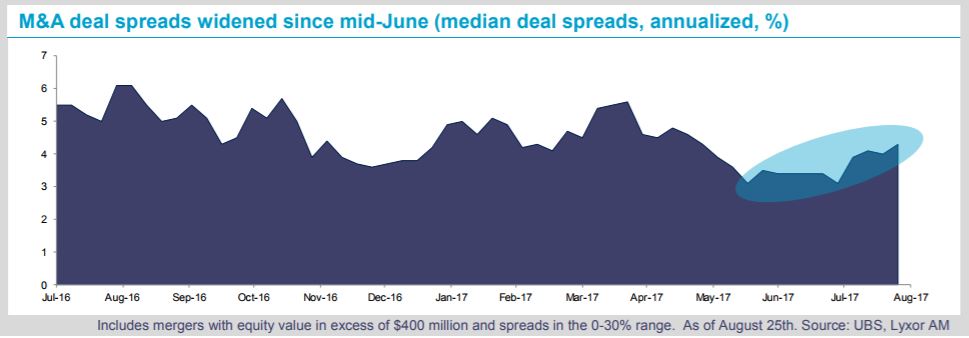
merger arbitrage funds stayed afloat (+0.1% in August) despite the widening of deal spreads over the
course of August. The NXP Semiconductors vs. Qualcomm planned merger continued to be an important
driver of performance of merger funds last month, while Time Warner vs. AT&T was a detractor.
On a positive note, CTAs continued to edge higher last week, and as signaled in the previous edition of this
report, it is noteworthy that CTAs are presently less reliant on equity trends to generate returns than they
were a few months ago. The Lyxor CTA Broad Index was up 1% last week and 2.1% in August while the
MSCI World was flat in August. FX and fixed income trends were the main drivers of recent CTA
performance. The continued fall in bond yields despite tight labour market conditions in the U.S. and price
acceleration in the euro area in August failed to dent the downward trend in bond yields. In parallel, the
Euro continued to appreciate versus the USD and that was also rewarding.
Going forward, we maintain an overweight stance on Event-Driven strategies.
We believe the summer
break is likely to be short lived. On the one hand, we still expect that the U.S. administration will be able to
move forward with fiscal reform in the coming months. If confirmed, this is likely to foster corporate activity
and provide opportunities for special situations funds. Meanwhile, with deal spreads at a wider level, we
find merger arbitrage more attractive now than it was a few months ago. On top of that it is important to
note that a few core holdings in merger portfolios are likely to experience a rerating in the deal price, which
would fuel returns.


Add Comment