


This post is also available in:  Français
As the tenth anniversary of the Global Financial Crisis passed this
month, our thoughts turned to the ongoing muted volatility in
financial markets. The ‘Goldilocks’ conditions of improving growth
without price pressures are something of a surprise, yet appear to
be increasingly discounted in analysts’ and investors’ expectations.
This situation may appear to be benign, but with valuations across
many asset classes appearing full (not to mention negative term
premia in bonds) potential risks are mounting.
Among the risks we see on the horizon are geo-politics, changes
in central bank leadership, taper tantrums, and the dollar and
emerging markets.
Political risk remains elevated in the United States, but had also
been rising in Japan with polls indicating Prime Minister Shinz?
Abe was falling out of favour with the Japanese electorate. Japan
is a favoured equity allocation across our managed funds, so the
possibility of Abe losing his position was of some concern to us.
However, the panic appears to be over, at least for now. Improved
economic growth data and a less hostile attitude from the public
following recent scandals looks to have headed off any political
crisis for Abe. Moreover, two recent cabinet appointments have
been particularly encouraging, with two potential opponents of
Abe given prominent positions within his Liberal Democratic Party,
meaning neither are likely to pose a challenge to the Prime
Minister. Our base case is that Abe survives this scare and
political stability remains until at least 2021.
A change in central bank leadership could challenge the easy
monetary policy conditions that have underpinned risk assets in
recent years, threatening the ‘lower for longer’ rate environment.
In Europe, Mario Draghi’s term ends in October 2019, but he
could bid for the Italian leadership next year; while in the US Janet
Yellen’s tenure ends in January 2018 – although her position is, to
a degree, dependent on President Trump. In Japan, Bank of
Japan governor Haruhiko Kuroda’s term ends in April and he
could be replaced by a Bank of Japan traditionalist who may be
swift to normalise monetary policy. We are mindful that
accelerated central bank normalisation could have serious
repercussions for global risk assets.
Taper tantrums are possible in Europe as the European Central Bank turns less
accommodative, especially as the ECB is the marginal buyer of bunds: Mario Draghi has talked
of a strengthening and broadening recovery in the euro area and has signalled further tapering
of his QE programme as we go into 2018. Ditto with the Fed, where term premia in US rates
has turned negative once again. With share buybacks having slowed dramatically, equities may
be vulnerable – although we do note that they price in greater risk premia than the likes of
corporate bonds. The dollar has been weak of late, which has helped emerging market rates in
particular and risk assets more broadly. But if the dollar reverses course, there could be
meaningful impacts on other asset markets.
We have also been looking at the health of emerging markets excluding Asia, where we have a
neutral allocation, noting that countries that were hit hard by the taper tantrum of 2013 – such
as Brazil, Mexico, Russia and South Africa – have undertaken meaningful reforms, with higher
quality growth as a result. Russia remains intimately linked to the price of oil, but oil at $50 a
barrel is seen as manageable for both Russia’s economy and oil companies. South Africa is
probably the weakest spot in EM ex-Asia, with soggy growth, growing political risk and low real
interest rates limiting the scope for policy stimulus. While in Mexico, weakness around the US
elections provided an opportunity to build into well-supported companies, against a backdrop of
strong consumption prospects that may be helped by policy easing as inflation comes off the
boil. Corporate sentiment in Mexico is positive, not withstanding the evolution of US trade policy
and timing of further rises in US interest rates.
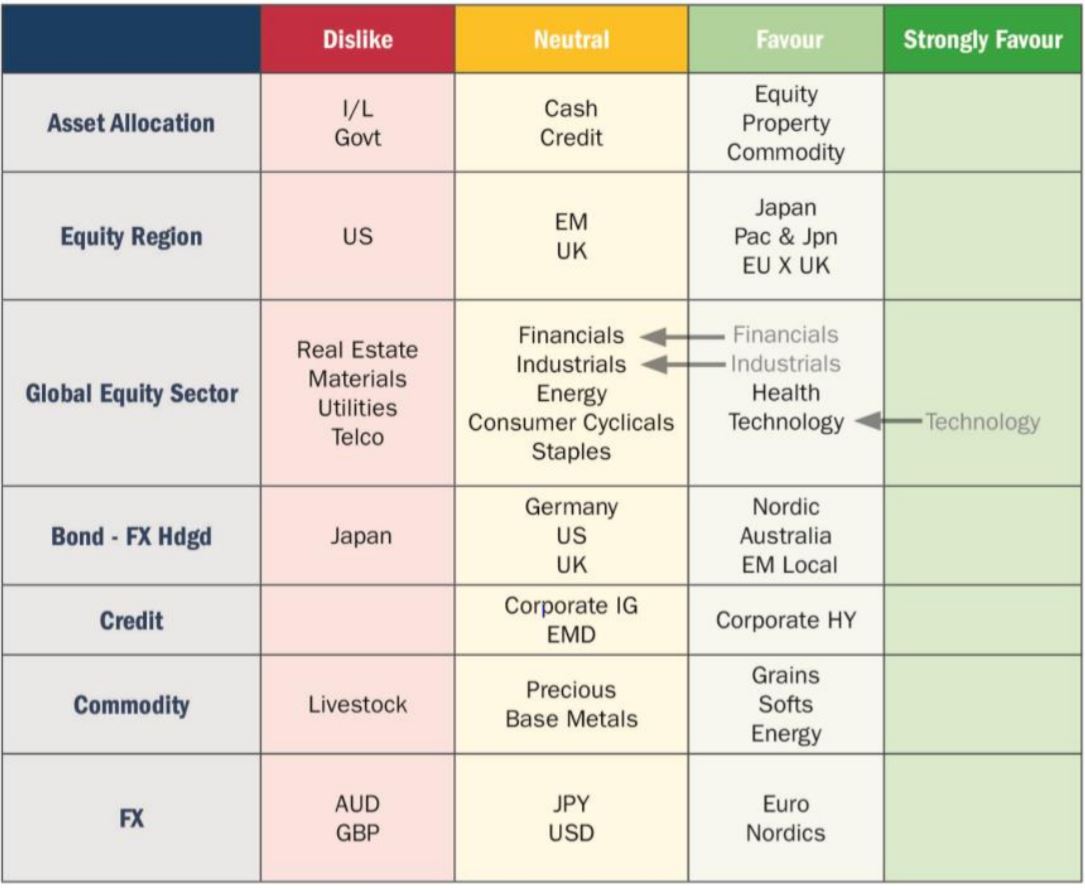
Taking all of the above into consideration, we have made no changes to our broad asset
allocation this month. However, our global equities team has downgraded three sectors:
industrials and financials have moved to neutral from favour, while technology has moved from
strongly favour to favour.
We remain positive on technology, but the valuations were such that
we felt it was prudent to clip back our exposure to the sector.
Asset allocation snapshot


Add Comment