


This post is also available in:  Français
Tax cuts implemented on top of full employment may cause a wage-inflation spiral, or an
increased current account deficit, while plans for import tariffs can hardly be seen as helpful,
says Daalder, Chief Investment Officer of Robeco Investment Solutions.
He says the old phrase that “the time to repair your roof is when the sun is shining” – using
times of positive growth momentum to strengthen your financial position – does not seem
to apply to President Trump. When the business cycle is booming, governments usually try
to lower their deficits; all Eurozone members have cut them on the back of an improving
economic outlook.
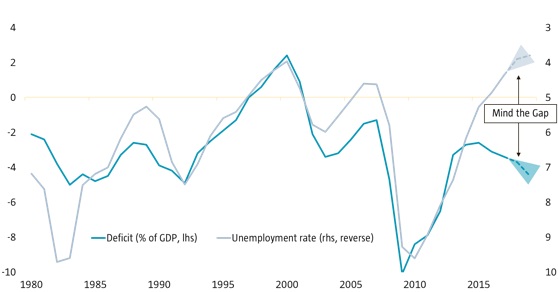
Instead, the US deficit has been rising, from 2.6% of GDP in 2015 at its lowest point during
the current expansion phase, to 3.1% in 2016 and 3.4% in 2017. The effect of the tax cuts is
now seen raising the deficit further to 4.5% in 2019, while some financial institutions are
forecasting 5% or more.

The difference is unemployment
Such a 5%+ level has been seen before: in 1983 under President Reagan; in 1992 under
Clinton; and in 2009 during the Great Recession, when it reached double figures. “The
striking difference, however, with the previous episodes of big deficits is the development of
the unemployment rate,” says Daalder.
“In all previous periods, unemployment was high and rising at 9.6% in 1983, 7.5% in 1992,
and 9.6% in 2009, while the unemployment rate is currently on the cusp of dropping below
4%. Those comparing the fiscal stimulus of Reagan to what Trump is currently doing clearly
miss this point. Whereas Reagan conducted a classic Keynesian expansionary policy in a
weak economic environment, Trump is doing the same thing in an upcycle.”
“Economists will tell you that stimulating an economy that is already running at a high speed
is not a very sensible thing to do. The aim of the tax cuts is that it leads to increased demand
for goods and services, and these need to be produced somewhere. If your economy is
already near the max, it is clear that this can pose a serious challenge.”
Capacity utilization
Daalder says the current US industrial capacity utilization rate of 76% suggests that there is
still enough spare capacity to be put to work, though this metric can be unreliable, given
that the service sector has become much more dominant.
“The ability to ramp up services domestically depends much more crucially on the availability
of skilled labor,” he says. “The unemployment rate is already pretty low, which raises the
question whether there is enough flexibility to match the increased demand for these
services. Put simply: stimulating an economy that is already running at a high speed
introduces the risk of a wage-inflation spiral.”
“There is a less painful option as well. Goods and services can be produced outside the US
and imported, thus lowering the risk of an overheating domestic economy. In fact, this is the
situation that is often referred to as the ‘Twin Deficit’ by economists: high (and rising)
government deficits tend to go hand in hand with high (and rising) trade deficits.”
“Put another way: if you stimulate the economy, part of it may indeed lead to higher
domestic production, but part of it may ‘leak away’ to your trade partners.
This amount of
leakage will of course be higher if the domestic economy is already running at its max.
Almost all experts agree that in the current situation, it is very likely that the higher
government deficit will lead to a boost in the current account deficit, the only question being
by how much. It makes you wonder whether this was what Trump had in mind when he was
talking about ‘Making America Great Again’.”
Tariffs may be toxic
Daalder says Trump’s latest plans for tariffs on imported aluminum and steel add further fuel
to the fire. “Economists will tell you that starting a trade war is a bad decision under all
circumstances, but doing so while you are stimulating an economy that is already near full
capacity is a macroeconomic poison cocktail,” he says.
“By cutting off the external sector as a potential ventilation point that can alleviate some of
the pressures that are being build up in the domestic economy, you only increase the chances
of an overheating system. Higher wages, which are already on the rise, and higher inflation,
due in part to the tariff increase, will certainly cause the Fed to raise rates more aggressively,
thereby countering the effect of the tax cuts. Additionally, higher interest rates and bond
yields could in theory trigger a strong rise of the dollar, which would only hurt the US in
international trade.”
It remains just theory
So, is the US heading for economic disaster? Not necessarily, says Daalder: “One potential
positive is that no tariffs have been levied yet, and economic theory is by definition just that:
theory. For example, one of the bigger puzzles that we currently see in financial markets is
the continued weakening of the dollar, defying the ongoing rise of the interest rate
differential in favor of the US. It indicates that higher rates do not automatically lead to a
higher dollar.”
“Probably the most important uncertainty is the one that is linked to the US economy
running at or near full capacity. If it is, then there is no doubt that the current policy mix is a
mistake of historical proportions. In that case, roof fixing would have been the better
option.”

Add Comment