


This post is also available in:  Français
Risk aversion continues to prevail so far in Q4, despite lower equity valuations and wider credit spreads.
Expectations of a year-end rally in risk assets have faded, as concerns over Brexit remain acute and the
probability of a recession in the U.S. keeps rising, albeit at a low level. The growth divergence between the U.S.
and Europe has further widened in Q4, pushing the U.S. Dollar index to record highs this year in a context of
multiple headwinds, according to the ECB at its latest monetary policy meeting.
These market conditions continue to favor low beta hedge fund strategies. Since early December, Merger
Arbitrage and L/S Equity Market Neutral has outperformed, while L/S Equity remains under pressure. Relative
Value Arbitrage was resilient. Based on a peer group of 28 onshore L/S Credit strategies, the median
performance was -0.3% month-to-date (up until December 12th) and -1.3% quarter-to-date. Yet, liquidity
concerns have investors in L/S Credit strategies in defensive mode.
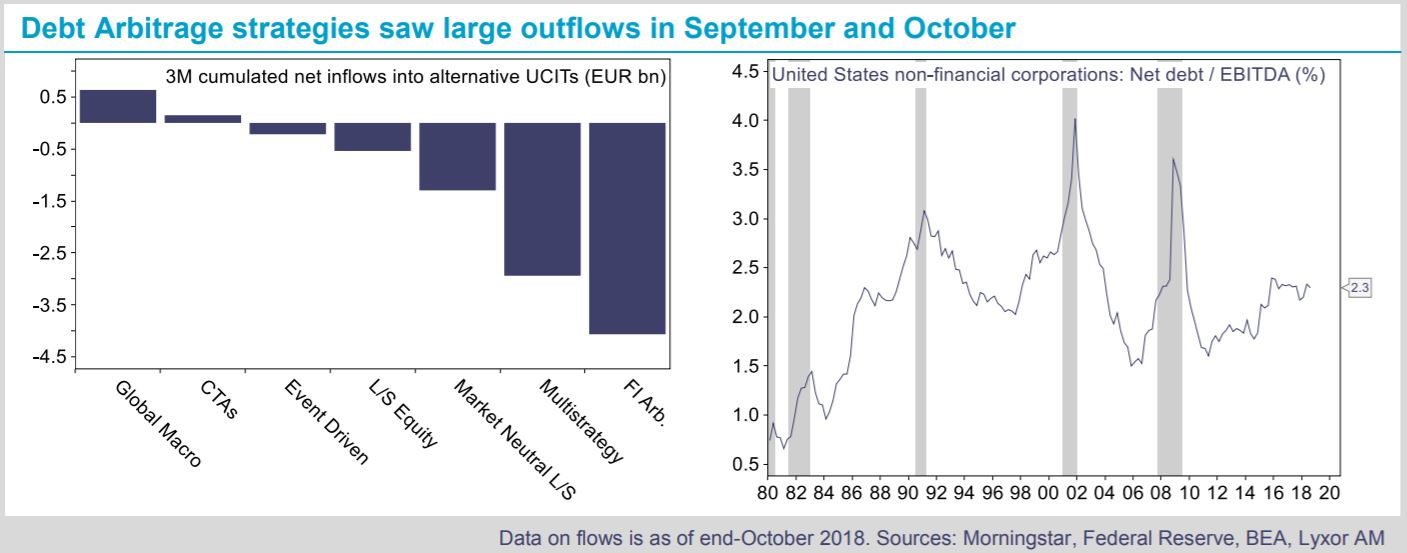
According to Morningstar data, onshore
Fixed Income strategies experienced large outflows in September and October.
Going forward, we note that U.S. corporate leverage has stabilized since 2015 at levels that prevailed in the
run-up to the Global Financial Crisis. High-yield default rates forecasted by rating agencies in twelve months
remain nonetheless benign for Europe and the U.S. These are expected to remain below 2.5% against an
average of 2.7% and 3.4%, respectively, over the past five years. Yet, liquidity tensions could flare up rapidly in
current market conditions and cause wide fluctuations in asset prices. We ourselves are bearish on credit. We
expect wider spreads across regions due to softer macro data, the end of Quantitative Easing in the euro area
and asset reallocation out of credit in favor of Treasuries. Investors are thus probably right to be concerned. Yet,
L/S Credit managers are defensive in their positioning as illustrated by resilience in Q4.
In our view, the above
supports a Neutral stance on L/S Credit strategies and a preference for strategies with lower market
directionality. Such strategies could take advantage of higher dispersion in credit markets and generate
performance from their short books.


Add Comment