


This post is also available in:  Français
Throughout 2018, our investment views on alternative strategies shifted in favor of low beta strategies as risks were
tilted to the upside. However, in early 2019 the Federal Reserve reversed the policy normalization course, and
economic growth may have stabilized. The balance of risks is thus less adverse despite the political uncertainty. The
likelihood of an escalating U.S./China trade war and a no-deal Brexit has probably decreased but has not vanished.
In a context where monetary conditions are more accommodative and sovereign bond yields are back to low levels,
it seems appropriate to re-weight carry strategies such as EM-focused Global Macro and L/S Credit. The views on
these alternative strategies are aligned with our recommendations on traditional asset classes. We suggest an
overweight stance on High Yield (in USD and in Euro) and EM sovereign credit. Specialized alternative managers in
those asset classes tend to have a long bias which implies that spread tightening, as we expect, would be as a tailwind.
Overall, we maintain a preference for Event-Driven vs. L/S Equity; and a preference for Fixed Income Arbitrage
(including L/S Credit) vs. Global Macro and CTA, with some readjustments at the level of sub-strategies. We keep an
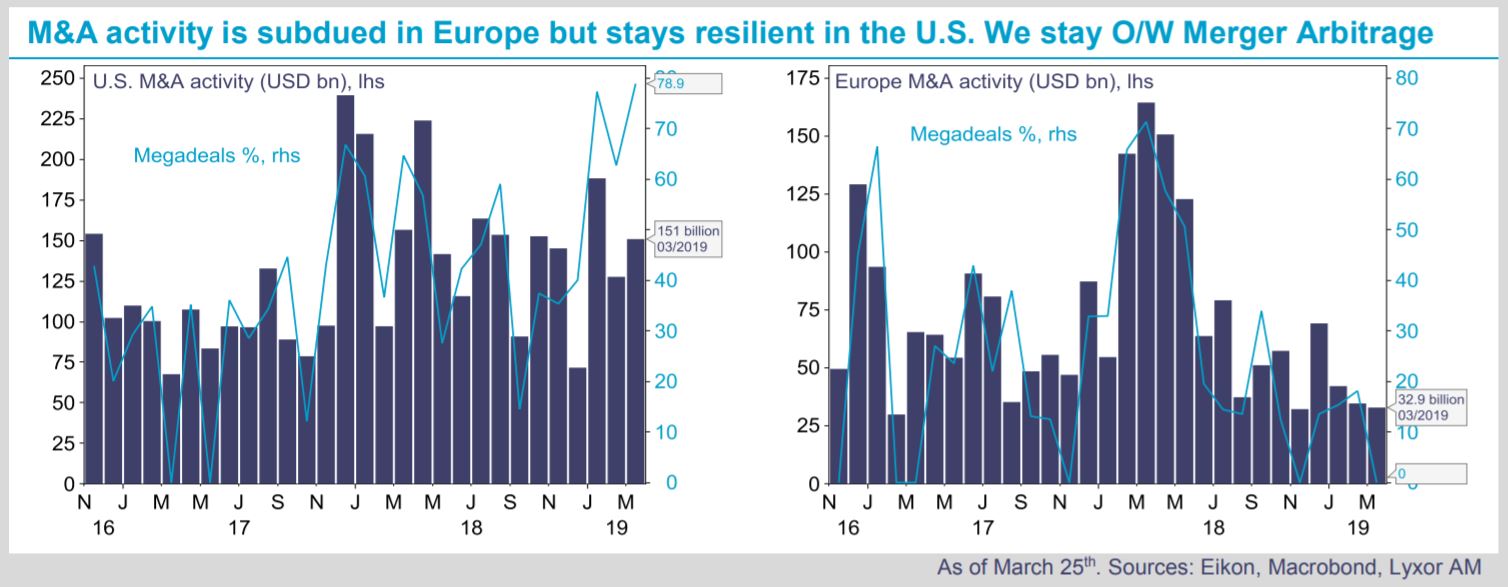
OW stance on Merger Arbitrage, which offers a low correlation to equities and a low volatility in returns. Global M&A
volumes are down (-30% YTD – as of March 25th – vs. Q1-18) but remain stable in the U.S. where the share of megadeals is significant. Deal spreads have decreased in Q1 but they tend to be volatile and are of little help to formulate
midterm views. The strategy is also an attractive hedge if things go wrong (Brexit, global growth slowdown).
We also
remain OW on Fixed Income Arbitrage. However, within the strategy we downgrade sovereign Fixed Income, that is
less attractive as implied volatility is likely to be tamed by the Fed’s bond purchases, in favour of L/S Credit strategies.
Finally, we re-weight L/S Equity long bias to capture the market beta in an environment which is likely to be more
supportive of risk assets. Historically, alpha generation by hedge funds has proved difficult when QE programmes
compressed risk premia across asset classes and dispersion within asset classes. However, in 2019 the Fed will not
expand its balance sheet, it will just stabilize it. The implications for hedge fund performance should be less significant.
In terms of recent performance, our UCITS peer groups point to an outperformance of CTAs and Special Situation
strategies month-to-date (+1.7% and +1.3%, respectively) and an underperformance of L/S Equity Market Neutral (-0.1%).
On a year-to-date basis, Directional L/S Equity, Special Situation, and EM-focused Global Macro strategies
are up close to, or above, +4%.


Add Comment