


This post is also available in:  Français
Uber’s quest to raise $10 billion is making big headlines. It’s one of a group of privately held firms
worth at least $1 billion, known as the unicorns, including AirBnB and WeWork. Globally, there are
more than 300 unicorns worth about $1.1 trillion, according to CB Insights. These companies have
garnered millions of users and customers around the world and many have generated strong sales.
But collectively, they’ve racked up billions of dollars in losses, and few have posted any profits at all.
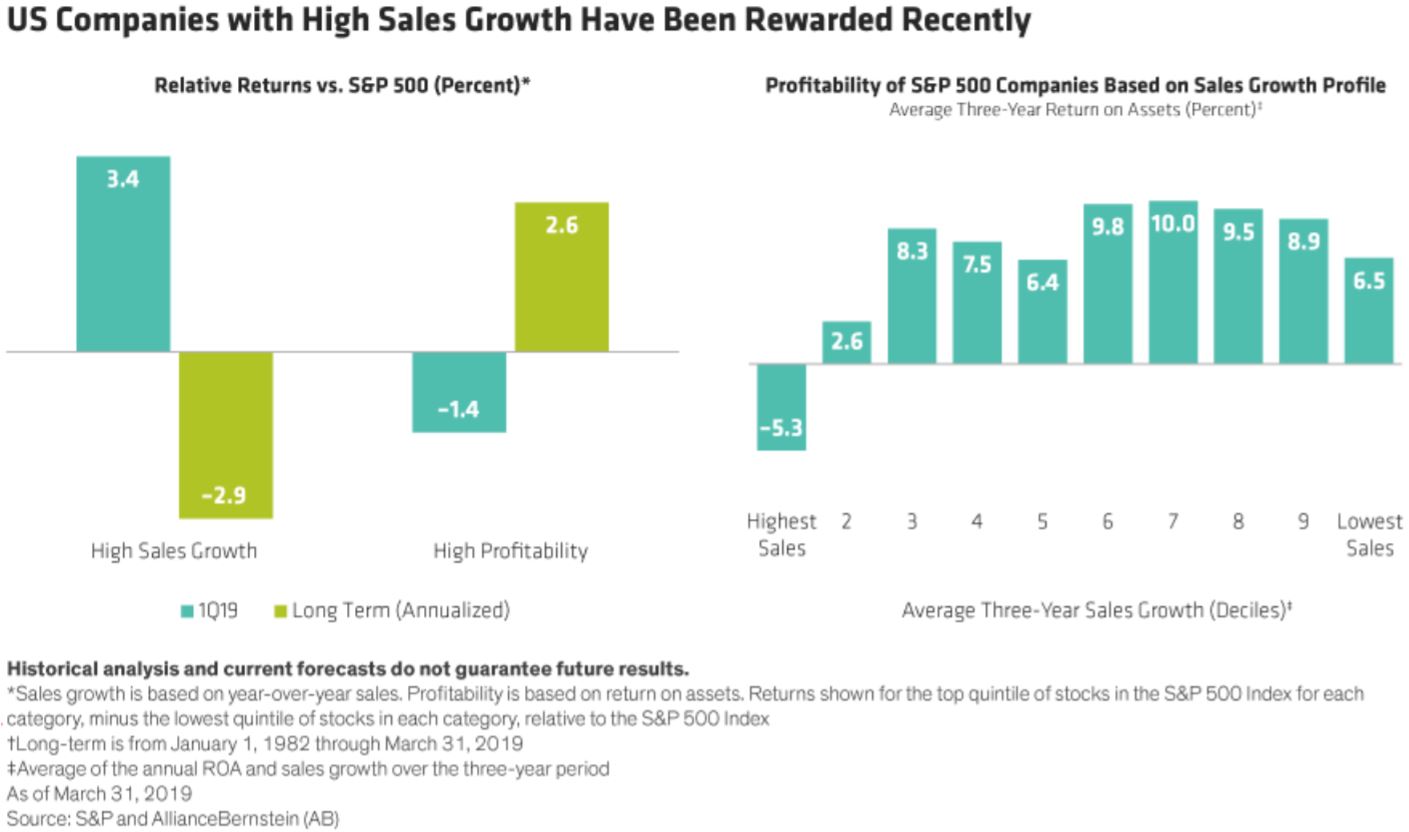
Perhaps coincidentally, investors in US stocks have been enamored by sales growth recently. In the
first quarter of 2019, shares of US companies with high sales growth delivered relative returns of
3.4% versus the S&P 500, while those with high profitability fell by 2.9% (Display, left). This contrasts
with the long-term tendency of high-sales-growth companies to underperform those with high
profitability, as measured by returns on assets. What’s more, our research shows that companies
with the strongest sales growth are also the least profitable (Display, right).

Risk Appetite Reduces Sensitivity to Profitability
So what’s been going on? In some ways, these performance patterns aren’t unusual. During the first
quarter, markets shifted back to risk-on mode after the late-2018 downturn. When risk appetite
improves, investors feel more comfortable buying stocks with little or no profitability. Like the
unicorns, strong sales growth in a publicly traded company looks like an appealing attribute that may
signal future profitability potential, especially in a world of slowing macroeconomic growth.
But for that potential to be real, you need to ask how the company is generating sales. The tech
unicorns are very young companies operating in “land-grab markets”; in other words, they’re
throwing massive resources at gaining market share in newly created markets for things like ride
shares or desks for rent. The result is high sales growth and no profits.
In their defense, some unprofitable companies have high free cash flows. However, we believe that
these cash flows may be fueled by deferred revenue and distorted by the use of stock-based
compensation on the expenses side.
Late-Cycle Concerns
These trends raise some red flags for investors, in our view. In a strong economy and market, the use
of stock compensation is less worrying. That’s because when the stock vests, the employee benefits
from the higher strike price and the company enjoys a tax benefit that flatters its cashflows.
But what happens in a weakening economy and softer market? Then, it becomes more difficult to
retain employees with stock-based compensation. This, in turn, makes it harder to maintain sales
growth and ultimately leaves shareholders out in the cold.
We don’t think we’re facing a tech bubble, like the one 20 years ago, which featured a concentration
of extremely expensive stocks and very inexpensive “old economy” stocks. That said, there are some
similarities. The price/sales ratio of the S&P 500 has reached 2.1x, similar to the levels seen in the
dot-com bubble, while young, unprofitable tech companies are quite expensive, in our view. At the
same time, we’re witnessing a deluge of IPOs as private companies seek to cash in on a buoyant
market before it’s too late.
Recent trends serve as a reminder for investors. Whether investing in a unicorn IPO or a publicly
traded company, always look beyond the headline sales figures, as seductive as they may seem. And
be wary of companies that don’t have real cash flows to support the top line. In our view, high and
rising profitability, backed by solid business models, is the best formula for identifying investments
with solid growth and return potential that can stand the test of time.

Add Comment