


This post is also available in:  Français
Systematic Macro and CTAs
are also appreciated for their diversification ability and have a good track record throughout bad times, when risk
assets experienced sharp and protracted drawdowns. Yet, we argue that both strategies are quite different.
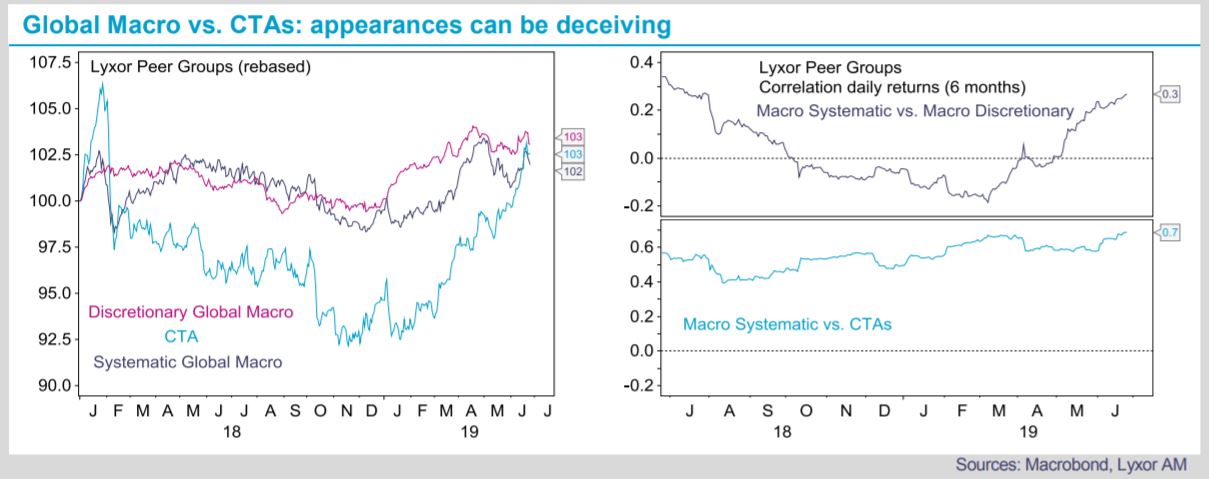
Performance between Systematic Macro and CTA strategies was comparable over the past 18 months (+2-3%)
according to Lyxor UCITS Peer Groups. Concurrently, the 6-month correlation of daily returns between CTA and
Systematic Macro strategies is as high at 0.7 at present (0.3 between CTAs and Discretionary Global Macro). From
this perspective, they have common factors. Yet, their volatility is nonetheless contrasted. We estimate that CTAs’
return volatility was 6% (annualized) over the past twelve months, while Systematic Macro’s volatility was much
lower, at 3.6%.
In terms of positioning, there are also substantial differences between them. The strong trend in bond prices since
September 2018 has led CTAs to accumulate elevated net long positions on fixed income, especially in Europe. In
turn, driven by fundamental inputs, Systematic Macro strategies expect a rise in bond yields and have accumulated
net short positions on bonds. If monetary policy accommodation boosts growth and inflation expectations, this
would steepen yield curves and push bond yields higher. Global Macro strategies are positioned to benefit from
this outcome, while CTAs would suffer from such development.
Our preference for CTAs vs. Systematic Global Macro was rewarding in Q2. Going forward, we maintain this
preference, but we are concerned about potential trend reversals in fixed income. Bond yields have reached very
low levels, particularly in Europe. The bleak macro picture does not suggest they should rise materially and
sustainably in the short to medium term. But even a modest repricing in bond yields would hurt CTAs, which hold
sizeable long exposures. As such, we maintain the preference for CTAs but argue that recent performance could
be seen as a reason to take some profits and rebalance towards Systematic Macro strategies to protect portfolios
against a potential rise in bond yields.


Add Comment