


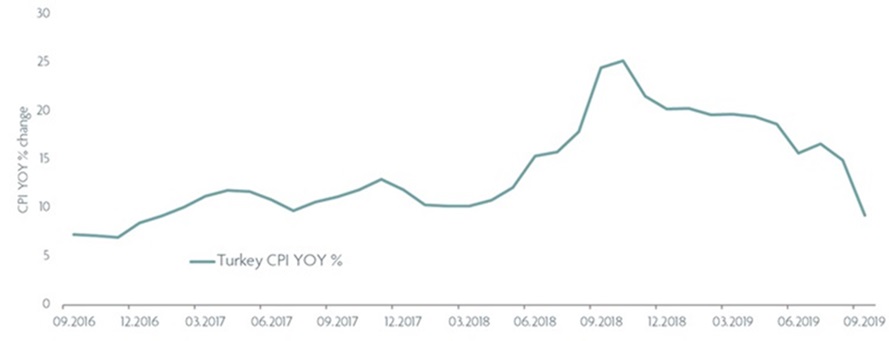
Until just a week ago, Turkey (against all the odds) seemed to be doing well again, said Reza Karim, assistant fund manager, Fixed Income. Inflation had come down from 25% last year to 9%. The central bank had managed to cut rates by 750bps, which restarted the debt-fuelled growth engine, while the government had taken steps to improve the health of the banking system. As a result, investment started to flow back and Turkish corporate debt has returned about 13% YTD.
Turkey’s inflation rate has now fallen back to its level before the crisis last year

Then the situation turned once again. There is a complicated relationship between
Turkey, the US and the Kurds. The US is allied with Turkey and used the Kurds to fight
Islamic State (IS). Turkey considers both the Kurds and IS as enemies, however, and
now that the IS threat is mostly gone, Turkey has entered Syria to fight the Kurds.
This leaves the US in an awkward position. It has been trying to pull out of Syria given it
is a hugely unpopular policy to keep troops on the ground there, which has opened up
the space for Turkey to enter Syria. The difficulty is that the US is placed in a position
where it must take the side of one important strategic ally in a conflict with another. There
is no easy option for the US, and the US government itself seems conflicted about what
to do, threatening big sanctions that actually turned out to be quite small.
Turkey’s currency has been fairly stable, given the muddiness of US policy. Reza said
that in the nine years he’s been covering Turkish debt there has been a significant fear
that the country could roll over. Those fears are underpinned by Turkey’s external debt
of $450bn, short-term debt of $126bn and net external liability of $340bn. These are very
large figures for a country which mostly runs a current account deficit. Turkey needs a
constant inflow of US dollars to keep refinancing its debt. So naturally both the currency
and the wider economy are vulnerable.
The problem is that, despite those figures, Turkey occupies a very important strategic
location. It really is the gateway to Europe, so lines to European banks are strong. And
despite US rhetoric often rising against it, this is usually scaled down because the US
does not want Turkey pairing off with Russia instead. Lots of big powers have a stake in
Turkey and therefore need the country to remain viable.

Add Comment