


The coronavirus is a clear shock to the world economy. In its nature the disease is very
different from the likes of SARS and swine flu in that the transmission rate is far higher and
mercifully the death rate is much lower. The other clear difference is that the infection has now
clearly left Asia. Up until the weekend Europeans and people in the US could be comfortable
that this was a China issue with selective outbreaks in the rest of Asia. Now, with the
developments in Korea and most critically in Italy over the weekend, this comfortable view of
markets has been shattered with the S&P close to 7% off its highs of only five sessions ago[[Bloomberg, 27 February 2020]].
Where do we think the coronavirus will develop? Being a non-medical and non-public health
person it is very difficult to forecast. I find it hard to believe we will not have a more significant
number of cases. The fact there have been school holidays throughout Europe, with many
families vacationing across the continent, just exacerbates this. So, the question is how
successful the authorities will be at containing any outbreak.
I am encouraged at the success of Singapore in limiting cases and experiencing no deaths. Of
course, as we look ahead, we think the coronavirus outbreak will die away – the heat of
summer should bring a relief in transmission rates, but even before then successful
containment should see the disease incidence taper. Looking at Chinese statistics (assuming
their accuracy) we can already see the aggressive containment strategy producing results.
There will be a time when this crisis is over, and it should be in the coming months.
So, what will the economic impact be? So far we see two clear impacts: lost consumption and
lost supply. Looking at the evidence from China, as the disease becomes the dominant factor
in people’s thinking consumption falls. An Adidas market update last week stated that its
Chinese business had fallen by 85%[[Adidas says business activity in China has tanked roughly 85% due to coronavirus, CNBC, 19 February 2020]] – at that level there is little mileage in analysts trying to
second guess the numbers. It is a clear disaster, but it is temporary. In a few months, and
certainly before the end of this year, we will likely be back on trend. However, I suspect that a
significant portion of the drop in consumption will be lost forever. While we might still ultimately
replace a smartphone, we are unlikely to buy that new spring season outfit.
The second element is supply disruption, where we are seeing clear evidence of critical
component shortages leading to underproduction. Apple already confessed to this last week[[Apple warns of coronavirus causing iPhone shortages, The Guardian, 17 February 2020]],
and we will hear much more. Again, if inventory is unavailable it will miss consumer demand
and a portion will ultimately be lost. In some industries where inventory cycles are the norm,
we will enter a period of inventory adjustment. The depth of the down cycle and how global this
event becomes will determine the required period of adjustment. It looks likely that we could
have another “industrial recession” driven by the coronavirus, similar to the 2012 euro crisis,
the 2014-15 oil price collapse, and the 2018-19 trade dispute-driven slowdown. None of these
events triggered an overall recession and given the temporary nature of the coronavirus event
we would not anticipate one this time – though in the case of Japan and perhaps Germany we
might see one, albeit mild.
Companies will experience a period of negative earnings revisions which will continue to
negatively impact the market even if its capacity to shock becomes limited. While we have not
made a formal estimate, it is possible we will see earnings downgrades of double figures. This
was the impact of the aforementioned viral slowdowns and would be enough to remove the
earnings growth that was forecast this year.
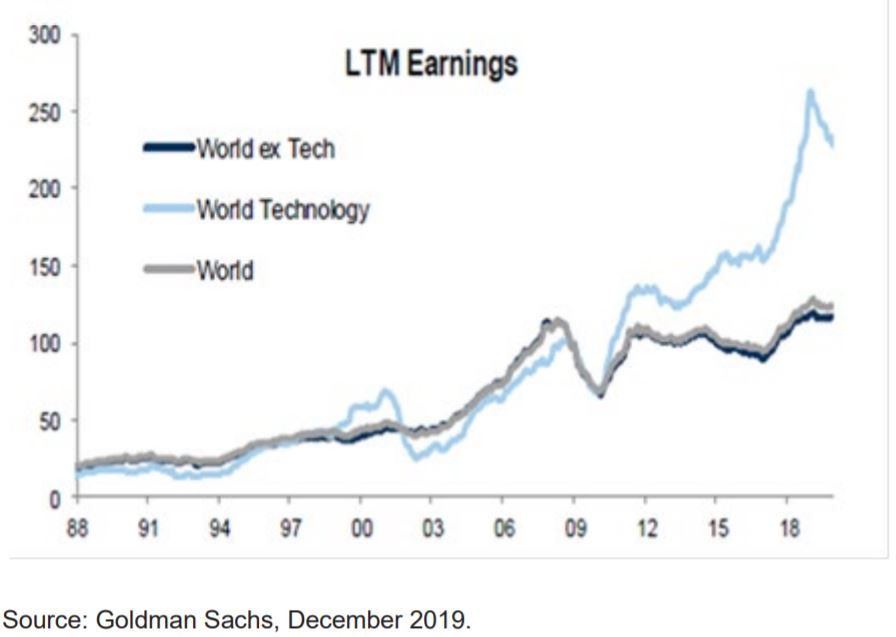
Another way of thinking about this is that the slow growth environment the world economy has
experienced since the global financial crisis (GFC) will continue. During that period the
average company has struggled to grow earnings. Figure 1, for example, shows the
development of global earnings relative to the tech sector over that period.
Figure 1: Companies last 12 months earning (1988-2019)

Coronavirus as an event means this trend will continue in 2020. Of course, it is not just
technology businesses that fit this category, but also medical tech and quality growth
businesses that can deliver in all economic environments. Earlier this week Mastercard issued a profit warning[[Mastercard cuts revenue outlook on coronavirus impact, FT.com, 25 February 2020]], reducing its revenue growth forecast by two to three percentage points.
Checking the company’s performance during the GFC, even with the headwind of a strong
dollar it sustained revenue growth of 3%[[Visa, MasterCard cut costs as revenue growth slows, Budapest Business Journal, 16 February 2009]]. Good businesses outperform and consolidate their
competitive position during tougher times.
In the medium term one of the clear implications that coronavirus brings is further pressure to
diversify or even shorten supply chains. For the past 30 years the successful model for a
western business has been to lengthen supply chains to access cheaper inputs in low wage
economies, of which China has been the poster child. President Trump has provided political
resistance to this; coronavirus adds a focus on security of supply.
Over the next decade as the use of artificial intelligence increases, the frequency with which
companies make, for example, demand forecasts will rise, and the way businesses will take
advantage of these insights is with a shorter, more agile supply chain with automation helping
to offset the resultant cost pressures.
Finally, while the above discussion provides a framework for thinking about the impact of
coronavirus, it is a fast-changing situation. I hope you all stay safe.

Add Comment