


This post is also available in:  Français
How would you describe 2014?
2014 turned out to be a high-quality vintage for most risky assets.
The MSCI World gained more than 19% on the year, and fixed-income
assets on the whole achieved strong performances, particularly on
maturities greater than 10 years. To cite one example, an investment
in the EuroMTS 15+ years (i.e., the euro zone yield on maturities
greater than 15 years) in 2014 would have achieved a return of more
than 33%, or six times the performance of the MSCI EMU equity
index. 2014 was an unusual year, dominated by the quest for returns
with heightened risk-taking. However, it was no walk in the park. The
markets performed well early in the year, despite concerns over the
solidity of growth in the US (hit by poor weather) as well as the impact
of the Japanese VAT rate hike, which once again drove the country
into recession despite the implementation of the famous three
arrows.
Risk aversion returned in the second half with severe corrections
(-10%) on the equity markets three times in six months amidst doubts
on economic recovery in the euro zone and exacerbated geopolitical
tensions in Ukraine, the Middle East and the China Sea. All these
factors ended up undermining global economic growth, forecasts of
which were steadily revised downward.
All these factors ended up undermining global economic growth,
forecasts of which were steadily revised downward. Emerging
markets, meanwhile, suffered in a context of dropping commodity
prices and geopolitical uncertainty. A distinction should be made here
between the different regions. While the Brazilian market ended in
negative territory, China and India achieved a remarkable year. Even
so, the acceleration in US growth late in the year, with the job market
strong once again, reassured investors on the robustness of the
economic recovery, at least in the US. Without a doubt, central bank
communication and actions remained the most decisive factors in the
ongoing market rally.
Alongside the spectacular pullback in sovereign yields, 2014 was also
a year of monetary innovation by the ECB, which used almost all its
tools to support the recovery of a euro zone bogged down in the risk
of deflation. These included a low refi rate, a negative deposit rate,
targeted long-term refinancing operations (TLTRO), and purchases of
covered bonds and ABS).
Even so, investors are still eagerly waiting a true quantitative easing
programme via sovereign bond purchases. And don’t forget that the
BoJ expanded its quantitative easing program to more than 80.000
billion yen, leading to a further marked decline in the yen, which hit
120 to the USD at yearend, a level it had not seen since 2007.
What were the most noteworthty bets in cpr invest reactive?
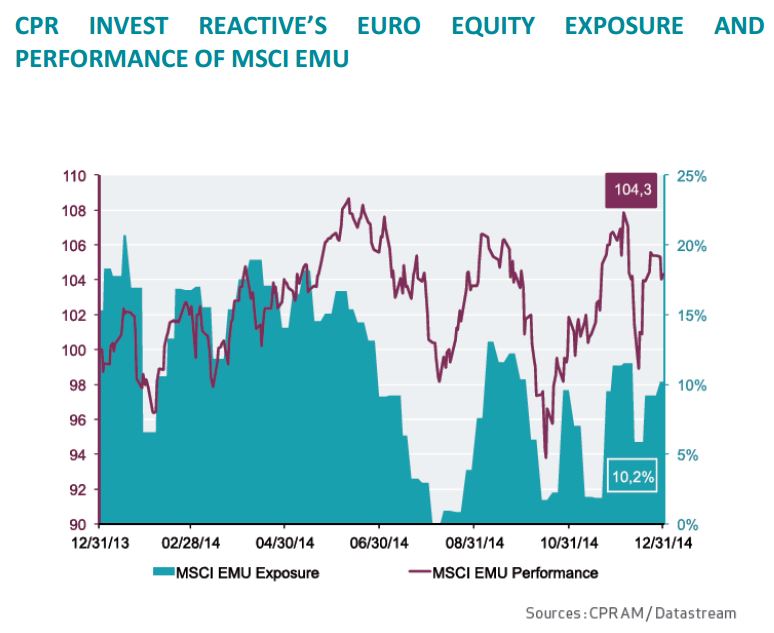
Management of CPR Invest Reactive was once again highlighted by
quick responsiveness throughout the year. To cite one example, the
equity exposure of CPR Invest Reactive ranged from 37% to 80%,
while the portfolio’s sensibility ranged from 0.6 to 4 during the
period under review. Our big achievement this year was to have
very skillfully weathered a tumultuous summer period during which
our funds as a whole achieved gains despite a significant market
correction.

We then diversified the portfolios, for example by taking aggressive
positions on the Chinese A equity market (local shares). After being
completely neglected by investors since the 2007-2008 crisis, this
market had been steeply undervalued compared to developed and
emerging markets on the whole, despite several support factors
such as ongoing structural reforms or the opening of the local
equity market to investors through the implementation of
shareholding quotas. Meanwhile, we raised our portfolios’
sensitivity considerably,
lengthening our positions to overweight 15 year + positions.
This strategy was implemented in both US and European sovereign
bonds in a global economic environment that is still marked by
weakness, sluggish wage growth, and the growing risk of deflation.
In October, we shared with our strategists the strong conviction
that the BoJ would announce a second wave of quantitative easing,
thus pursuing the dual objective of raising inflation expectations
and supporting economic growth undermined by the April VAT rate
hike. Remember that the rate hike had precipitated the Japanese
economy back into recession.
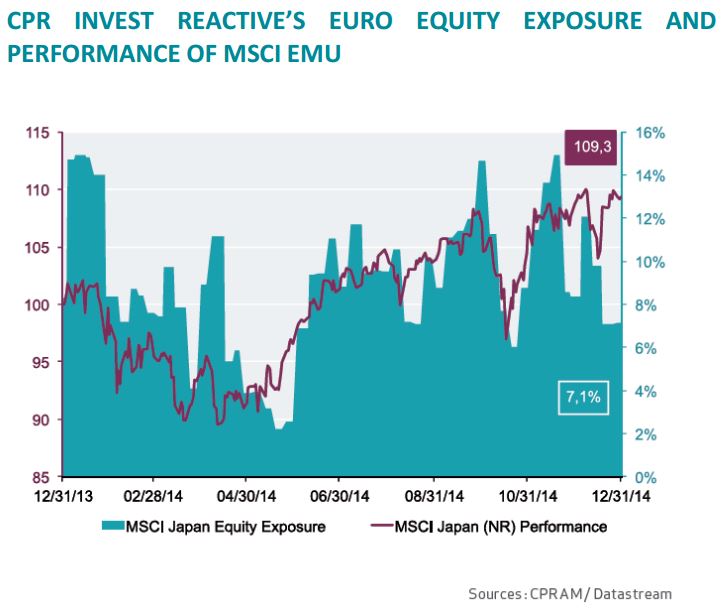
We then raised our Japanese equity exposure aggressively (while
hedging it for currency risk) two days before the BoJ’s
announcement, a strategy that paid off for the fund.

Another major investment theme came in June, when we began
to set
up dollar positions, to get the jump on the announcement of the
end of quantitative easing and the return to near-potential
growth in the US.
We also steadily increased our exposure in light of insistent
rumors that the ECB would set up a quantitative program in the
euro zone.
What’s in store for 2015?
In 2015 we should see a slight acceleration in global economic
growth, driven mainly by falling oil prices, which should boost
domestic consumption more or less everywhere. Even so, the
pace of growth will remain below its mediumand long-term
average worldwide, due to the trend decline in growth prospects
in the major emerging markets (BRIC) and the weak outlook in the
euro zone. We expect 2015 to be far more volatile than 2014, as
there will be more challenges to meet.
Without going through the entire list, we can cite the hoped-for
return in euro zone confidence with, as a corollary, further structural
reforms aiming to enhance the competitiveness of the region’s
economies, the smooth normalization of the Fed’s monetary policy,
the success of new stimulus plans in Japan, and the stabilization of
Chinese growth, which is essential for avoiding social tensions. In the
shorter term, concerns early this year
are focusing on weak inflation and wages, despite the expansionist
monetary policies conducted since 2008. Without going through the
entire list, we can cite the hoped-for return in euro zone confidence
with, as a corollary, further structural reforms aiming to enhance the
competitiveness of the region’s economies, the smooth
normalization of the Fed’s monetary policy, the success of new
stimulus plans in Japan, and the stabilization of Chinese growth,
which is essential for avoiding social tensions. In the shorter term,
concerns early this year
are focusing on weak inflation and wages, despite the expansionist
monetary policies conducted since 2008.
Against this backdrop, what allocation strategy is best for 2015?
Investors must be able to negotiate key turning points from the very
start of the year, whereas there are high hopes that a European
quantitative easing program will soon be announced.
After several warning shots in European equities since last summer,
there could be a notable spurt in volatility if the ECB were to
disappoint investors just as the Greek political situation is stirring up
old fears.
The year’s other big turning point will be the Fed’s rate hike in
response to the strength of the US economy and, above all, to what
degree this will be priced in by the markets. The cyclical lag between
the euro zone and the US should, in fact, prolong the USD’s
appreciation vs. the euro. While monetary authorities will continue
to watch their words carefully to prevent a spike in yields, a spring
2013-like shock cannot be ruled out. Such a scenario would have a
serious impact on emerging markets, which are already being hit by
the collapse in commodity prices and weak European growth. All
eyes will also be on Japan. As the government’s highly aggressive
policy will probably be more pro-earnings than pro-GDP, it is likely to
continue driving equity performance. However, as in Europe, the
shock will be commensurate with hopes if earnings let down
investors. And, lastly, liquidity on fixed-income markets will
obviously remain a key factor in the US as in Europe, where yields
are very low. Against this backdrop we are now overweighting
equities vs. bonds, in light of current valuations and the
trend towards higher interest rates likely to begin in the US.
We are retaining a large portion of our equity exposure in the US,
which is more robust and now riding the stronger dollar, and Japan,
which, in our view, is the best investment opportunity. Policies in
the euro zone are nonetheless likely to bear fruit and would
encourage us to reallocate to the euro zone – gradually, in order to
avoid “false rallies”.
In fixed income we are focusing in the short term on exposure to
long maturities (> 10 years), which are likely to get a boost from
quantitative easing and weak inflation. During the year corrections
will be more drawn out, with an ultimate gain of about 5% to 8%.
Once again, the allocation’s responsiveness will be decisive in
weathering bouts of market volatility, such as occurred in late 2014.

Add Comment