


This post is also available in:  Français
After two years of disappointing returns in 2011 and 2012,
trend-following strategies – usually called trend followers
or more generically managed futures – which offer highly
diversified exposure to the global financial markets,
experienced mixed fortunes in 2013.
The relatively poor 2013 performance of the Newedge Trend
Index (2.67%), an index representing trend followers, could
reinforce the negative view that some investors have of these
strategies: models unsuited to the market paradigm that
surfaced with the crisis, broken performance drivers and
outdated strategies. There is quite a lot of criticism that trend
followers have had their hour of glory and now no longer
belong in portfolio allocations.
Yet, as is often the case, the reality is not so black and white.
Although the indices tracking trend followers struggled to
generate positive returns in 2013, the funds tracked by these
indices also posted more varied returns than usual. Some
even posted unprecedented gains, like the performance
of over 16% achieved by the Epsilon strategy managed by
the Lyxor Asset Management teams. Therefore, in many
respects, 2013 cannot be summed up as another year
marking the decline of trend followers. On the contrary,
it heralds more of a revival for these strategies, which are
among the oldest in the hedge fund universe.
A SYSTEMATIC INVESTMENT APPROACH
FOR UNRIVALLED DIVERSIFICATION
To better understand the cause of the difficulties encountered
by trend followers in recent years, a brief reminder of the
founding principles of these strategies is required. Whereas
traditional management relies on qualitative or quantitative
analysis of asset prices, trend followers take positions in
markets solely based on the price trend, regardless of the
intrinsic value of assets.
An age-old phenomenon in the markets, trends are the
product of inefficiencies originating in factors such as the
difficulty some investors have in rebalancing their portfolios
or the herd instinct of the markets. They also lend themselves
well to a systematic investment approach that allows them to
be identified for the purpose of taking financial positions.
By determining the statistical features of the behaviour
of each market (e.g. volatility, correlation, average return,
probability of a jump in the price level, etc.) that are likely
to indicate a trend, the managers of trend followers can
disregard the fundamental approach. Such a systematic
approach, which does not require an in-depth knowledge
of each market, enables them to expose the portfolio to
a large number of markets at the same time. This results
in an investment strategy with an unparalleled degree of
diversification capable of generating returns in both bearish
and bullish market conditions if trends are present.
UNCORRELATED YET DISAPPOINTING PERFORMANCE IN 2011 AND 2012
What went wrong in 2011 and 2012, resulting in poor returns
for investors? Before answering this question, it is important
to remember that trend followers experienced difficult years
in the past. In 2003 and 2004, at the end of a downward rate
cycle that had put pressure on the fixed income markets, an
environment characterised by weak trends and a sharp rise
in correlations among markets penalised model efficiency.
The impact on performance was less severely felt, owing to
the fact that money market rates – at which assets in a trend
follower are remunerated[[It is worth bearing in mind that most of the assets in a trend follower are composed of cash, only a fraction of which – generally 10-15% of the total – is used to manage margins required by counterparties.]] – were significantly higher than
they are today.
1-PERFORMANCE OF TREND FOLLOWERS,
INTERNATIONAL EQUITIES AND BONDS
(JANUARY 2000 – JANUARY 2014)
A higher return than equities for a much lower drawdown

In 2011 and 2012, the market trend was basically a series
of risk-on/risk-off movements that were very much dictated
by the string of plans aimed at stabilising the international
financial system. By causing periods of flight to quality
(sovereign debt, gold, silver) followed by periods of
repositioning on risky assets (equities, emerging markets,
commodities, currencies), political interventions invalidated
a number of trends identified by the statistical models used
by trend followers. They also aligned all the markets which
found themselves at the mercy of a single factor: political
intervention.
At the same time, this simultaneous trend across all markets
considerably reduced the effectiveness of a traditional risk
allocation strategy. One of the basic principles of trend-following funds consists in taking positions in a large
number of markets by spreading the risk evenly across all
markets without appropriate consideration of the correlation.
However, this simplified approach towards diversification
seems to have reached its limits in 2011 and 2012.
2-TREND AND CORRELATION INDICES
A normalisation of the markets reflected in the return of trends
and less correlation

Although the criticism against trend followers is based on
the reality of a non-trending market environment marked by
major interventionism on the part of monetary authorities, the
asset class has probably also suffered from the comparison
with other strategies with lower volatility, including those
exploiting the bond recovery. However, trend followers
retain all of their appeal, the main one being their strong
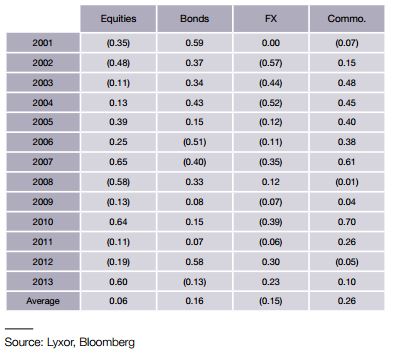
decorrelating virtue, which has been constant since 2001.
3-ANNUAL CORRELATION OF TREND FOLLOWERS
WITH THE MAIN ASSET CLASSES, 2000-2013
On average, trend followers are characterised by a low level
of correlation with the main asset classes

MARKET NORMALISATION IN 2013
As illustrated in graph 2 on trend and correlation indices,
the banking union agreement signed in the autumn of 2012
sparked a drop in correlation and breathed life into trend
followers. They performed well until 22 May 2013 when the
Federal Reserve announced the imminent tapering of the
bond buying programme. The direction taken by the debate
on the US federal budget then plunged the markets back
into a period of uncertainty, which immediately resulted
in another risk-on/risk-off environment until a last-minute
agreement was signed in Congress in the autumn. This
extension of the transition to a new monetary policy regime
explains the mixed returns of CTA funds in 2013, owing to the
difficulty in capturing trends in an environment that remained
hazy.
Initiated at the end of December, the reduced monetary
support to the US economy currently gives weight to the
assumption that the systemic crisis has been defused and
that risk-on/risk-off movements – detrimental to managed
futures strategies – have been diluted.
RISK ALLOCATION’S TRUMP CARD
A closer look at the behaviour of trend-following strategies
in a context of exceptional levels of correlation between
the markets where only a single factor comes into play, as
was the case between 2008 and 2012, reveals areas for
improvement. Unlike in 2008, when persistent upward gold
and commodity trends enabled models to shine, the lack
of trends brought this to an end in 2011-2012. This episode
calls for a reflection on the identification of market regimes.
The quality of the statistical models used to identify a market
trend is the starting point for a trend follower. The high level of
correlation seen in 2011 and 2012 highlighted the importance
of the allocation model, whose ability to sufficiently diversify
a portfolio is a prerequisite for the long-term success of a
trend follower covering different market regimes.
A standard managed-risk allocation based solely on the
know-how and experience of investment teams is not
enough. Formalising the problems associated with risk
allocation provides a more documented view of a position’s
impact on the portfolio’s overall risk.
This is what has driven Lyxor’s research teams since 2011.
Having proved conclusive over the nine months during which
it was tested on a simulated basis, an alternative allocation
model was rolled out in September 2012. For Lyxor, which
is determined to stick to a trend-following strategy over the
medium to long term where other trend-following funds allow
themselves to vary their approach every so often, this new
allocation model strengthens the management process.
A WELL-DESERVED PLACE IN ASSET ALLOCATION
A number of players in the collective, traditional and
alternative investment business already realised the
challenges facing risk allocation a few years ago.
For managers of trend-following funds, integrating these
issues is strategically important. The challenge consists in
building the competitive advantages that this strategy has
over other asset classes in the long term.
In fact, in the long term, managed futures already display
a better risk/return ratio than most of the other risky asset
classes. They also stand out for their lack of correlation to
the major market indices, which currently makes them one
of the most effective alternative investment instruments.
For example, unlike long/short funds, whose performance
includes, depending on the strategy, an equity, credit or
bond component, trend followers do not have any structural
relationship with a specific market. This decorrelation may
be detrimental, particularly during market rallies when trend
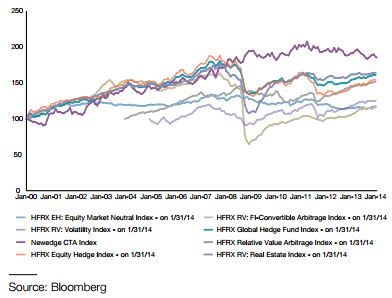
followers will underperform. Yet it has its advantages. When
sharp downturns occur, as was the case in 2008, trend
followers fare well, unlike other alternative strategies.
4-PERFORMANCE OF ALTERNATIVE STRATEGY
INDICES SINCE 2000
Relatively stable performance over the long term

The performance distribution of hedge funds is radically
different from that of trend-following strategies which have
a positive skew. When they fall, losses are much less severe
than what the strategy’s volatility would lead us to assume.
And although they often shed little, they post a sharp rise
when they make gains.
The introduction of trend-following strategies in a traditional
portfolio reveals all the benefits of diversification. Thus, as
might be expected from adding a decorrelated asset class
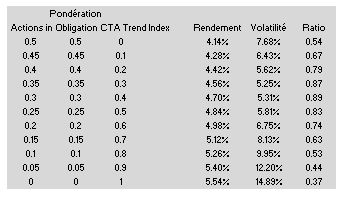
to a portfolio, the mean-variance analysis of the returns of a
portfolio composed of international equities and bonds, to
which an allocation to a trend-following strategy is added,
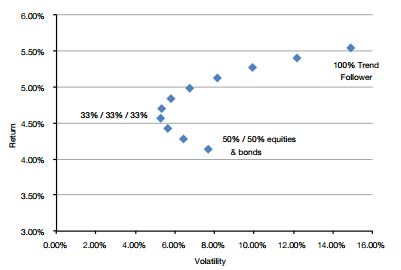
generates a more effective portfolio as it is more diversified.
This positive observation justifies an unbiased examination
of what trend-following strategies have to offer when defining
the investment strategy.
5-EFFICIENT FRONTIER OF A PORTFOLIO
WITH THREE ASSETS
Trend-following funds improve the efficient frontier



Add Comment