


This post is also available in:  Français
According to Société Générale’s cross asset
research team, there are two types of value
investor: patient value investors, who seek to
benefit from compounding above-average
dividend yields offered by quality companies;
and brave value investors, who seek to gain from
a share price recovery in companies currently
discounted by the market. In this expert opinion,
andrew lapthorne, head of quantitative
equity research at Société Générale, and
François millet, lyxor’s product line
manager for etFs and Indexing, explain the
index concept.
Building a portfolio
mixing such types of
risk factor strategies is
becoming increasingly
popular as an alternative
to diversifying in
the traditional way,
by asset class.
Why should an investor consider using a value strategy?
Andrew Lapthorne: As a strategy, value investing has
been around for decades. It was first popularised by Ben
Graham and David Dodd in the 1930s and has since been
adopted by many successful money managers, most
notably Warren Buffett.
Many studies have shown that a strategy of buying and
holding undervalued stocks has generated superior longterm
returns to other strategies, for example buying growth
stocks or owning the market as a whole.
There are different approaches to identifying value—for
example, selecting the stocks with the lowest ratio of
market price to book value, or stocks with high dividends
or low price/earnings ratios. But the central theme of these
strategies is the same: an investor buys shares that are
relatively out of favour but which end up outperforming more
glamorous stocks over time.
What are the sources of return of value strategies?
A. L: There’s a lively debate about why value stocks pay a
return premium over time. One explanation is that investors
are receiving an extra return for owning companies with
lower valuations (and therefore a higher risk of financial
distress or default).
Another is that the value premium is caused by the
irrationality of investors seeking to match or outperform
capitalisation-weighted market benchmarks. By chasing
higher-momentum growth stocks, these investors leave
other stocks undervalued, offering a return premium.
In our view both explanations have some merit. Both are
consistent with the idea that investors are rewarded for
acquiring and owning unpopular stocks.
How do value strategies compare with other “smart beta” or “factor” approaches?
A. L: Value is one of a number of “smart beta” or “factor”
strategies. Factor strategies in the equity markets include
value, momentum, small-cap and low-volatility. In the fixed
income, foreign exchange and commodities markets, factor
strategies include momentum and carry.
Building a portfolio using factors is becoming increasingly popular as an alternative to diversifying in the traditional way, by asset class.
SG’s research team has identified that the historical correlations across factor risk premia are lower than correlations across asset classes, and that cross-factor correlations are also more consistent and more robust to
shifts in market “regime”.
So buying and holding exposures to factors may be a more dependable way of earning risk premia than, for example, trying to overweight equities versus bonds.
What is the SG Value Beta index? How does
it differ from the SG Quality Income index?
Are they bo th value indices?
A. L: We think that there are essentially two different types
of equity value strategy.
The first offers a return premium from investing in higherquality,
less cyclical, lower-leverage companies with above
average yields. Such stocks are likely to underperform in a
rising market but offer better protection in a downturn.
This type of strategy—which we call “patient value”—
is represented by the SG Quality Income index and the
associated range of Lyxor ETFs. It aims to deliver long-term
returns from the compounding of an above-average yield,
together with a reduced capital drawdown risk.
the second type of value strategy—which we call “brave
value”—focuses on buying under valued stocks during a
period of relatively higher risk. An example would be buying
BP after the 2010 Deepwater horizon oil spill, before
knowing when the oil spill would be capped. the risk of an
initial capital loss is higher, but the attraction is that you are
buying the stock at a heavy discount to fair value.
This “brave value” approach is represented by our new SG
Value Beta index.
What have been the long – term returns
of the two strategies and how much
of the returns have come from capital
appreciation and income?
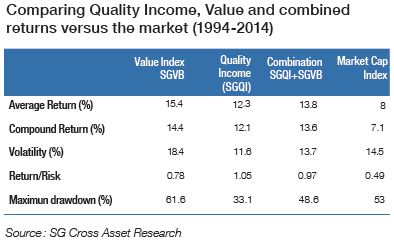
François Millet: Based upon a back-test, both the SG Quality Income and the SG value Beta indices have provided positive long-term returns relative to a Market Cap Index.

over a twenty-year period from 1994, the sg Quality Income
index and the sg value Beta index gave average
annual returns of 12.3% and 15.4%, respectively,
compared to an average return of 8% from the Market Cap
Index.
There was a difference in the composition of returns,
though. More than half of the average annual return
from the SG Quality Income index came from the
compounding of dividends. But over 70% of the average
annual return of the SG Value Beta index resulted from
capital appreciation.

Patient value investing is mainly about yield, whereas
brave value investing is mainly about potential share price
increases.
What volatility and drawdow n risks are associated with the value beta approach?
F.M: As you might expect from its focus on under valued
stocks, the sg value Beta index has had higher volatility
historically than the market, with a larger maximum
drawdown.
However, the return-to-risk ratio of the sg value Beta
index was higher than that of the market index. We
characterise the value Beta approach as offering potentially
outsized returns with volatility.
What is the methodology of the SG Value Beta index?
A. L: We rank stocks according to their relative valuations
within global industry sectors, using the equal-weighted
scores of five traditional value factors, all of which have been associated with positive long-term excess returns in academic literature: book value to price, earnings to price, forward earnings to price, EBITDA to enterprise value and
free cash flow to price.
We select the cheapest 200 companies worldwide,
based upon this value scoring system, and we equalweight
them in the index. Only companies with a freefloat
market capitalisation exceeding US$1 billion and
six-monthly average daily trading volume of US$3 million
or more qualify for the starting universe. The index is
rebalanced quarterly.
How does the SG Value Beta index compare with value indices from other
index providers?
A. L: Over the years, value indices have become relatively
more sophisticated in their methodology. For example,
until 2003 MSCI sorted stocks into “value” and “growth”
categories solely on the basis of companies’ price-to-book
ratios. This approach was questioned when in 2002 the
MSCI Value index suddenly became more expensive in P/E
terms than the MSCI Growth index.
MSCI modified this first-generation value index in 2003,
adding earnings and dividend yield to their value scoring
system. We would regard Russell’s value index methodology,
which focuses on book value-to-price and sales-to-price, as
another example of a second-generation value index.
SG’s Quality Income and Value Beta indices are thirdgeneration
value indices, using a variety of share pricedependent
and fundamental value metrics to determine
company rankings.
Our objective in designing the indices was to have a
consistent and simple methodology in a realistic and
implementable form.
In what market regimes have the SG
Value Beta and SG Quality Income indices
performed relatively better/worse?
F. M: In the chart below we show the relative performance
of the SG Value Beta index and the SG Quality Income index
during different market conditions: under strongly rising
markets, range-bound markets and strongly falling markets,
as well as overall during up months and down months, over
a twenty-year period.
The SG Value Beta index has tended to outperform during
periods of rising markets, especially strongly rising markets.
It tends to underperform the market index slightly during
downturns.
The SG Quality Income index tends to lag the overall market
index in bull markets but to outperform strongly in bear
markets.

How should investors combine the SG Value Beta and SG Quality Income indices in a portfolio?
F. M: The fact that the two indices perform so differently
during different market regimes suggests that an investor
can obtain significant diversification benefits by combining
them in an equity portfolio.
One way of doing this might be a simple 50:50 allocation
between the two index strategies.
Alternatively, an investor
could seek to invest in either of the two indices using a
regime-switching model, for example using statistical
forecasting to determine whether to allocate to the more
bullish SGVB index or the more defensive SGQI index.
We have shown the relative performance of the SG Value
Beta and SG Quality Income indices, together with an equalweighted
portfolio investing in the two indices and a regimeswitching
model in the chart below. We think the two index
strategies are highly complementary.

What country and sector exposures are prominent in the SG Value Beta index?
F. M: Currently, the SG Value Beta index has a substantial
overweight position in Japanese stocks and a relative
underweight position in the US equity market by comparison
with the MSCI World Value index.
From a sector perspective, the SG Value index currently
overweights financials and underweights defensive sectors
such as healthcare and consumer staples, again by
comparison with the MSCI World Value index.
What other value strategies does Lyxor offer in ETF format?
F.M: Lyxor offers ETFs on traditional value indices, such
as the Lyxor ETF MSCI Value and the Lyxor ETF Russell
1000 Value, as well as ETFs on third-generation value
indices, the Lyxor ETF SG Quality Income and the Lyxor
ETF SG Value Beta. The SG value Beta ETF must be
considered as an ETF with a high value factor and provides
ideal tool in a factor allocation strategy.
How much do these ETFS cost?
F.M: The Lyxor ETF MSCI Value, Lyxor ETF Russell 1000
Value and the Lyxor ETF SG Value Beta have an annual total
expense ratio of 0.4%. The Lyxor ETF SG Quality Income
has an annual total expense ratio of 0.45%.
These annual fund charges are highly competitive with actively
managed value funds. And our analysis shows that very few
active value managers have managed to beat the new SG
Value Beta index: only 6% of active funds within Morningstar’s
Global Large-Cap Value Equity category have done better
than the index over the last five years, for example.
How wo uld you summarise the key features of the SG Value Beta index?
A. L: By acting as a complementary strategy to the SG
Quality Income index, which was launched in 2012, the SG
Value Beta index enables investors to capture the positive
risk premium offered by distressed or problem stocks in a
systematic, easy-to-understand and transparent way.


Add Comment