


This post is also available in:  Français
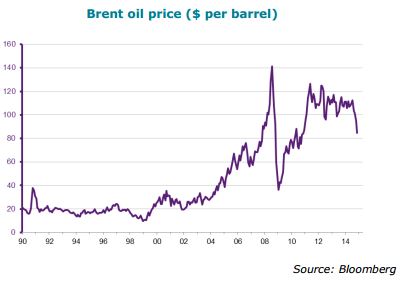
Despite rising geopolitical tensions (Iraq, Libya, Russia), oil prices have
shed more than one third of their value since peaking at $115 at the end
of June (see chart 1). Although the fall in the oil price is good news for
western consumers, this phenomenon should nonetheless be analysed in a global context in order to draw any conclusions regarding asset allocation.

It is true to say that weaker oil prices impact western households in the same way
as a cut in VAT, in that it enhances purchasing power within a segment of
domestic spending which is otherwise difficult to reduce. However, the question
arises as to whether the fall in the oil price corresponds to factors which are
endogenous or exogenous to the global economic climate.
In the case of an exogenous shock, such as the introduction of new extraction
technologies for example, a drop in the oil price is unambiguously positive for
growth and the financial markets (with the obvious exception of oil sector
equities). In this current context however, prices have been driven lower by a
downgrade in growth forecasts for global oil demand, particularly among
emerging markets. The fall in crude prices is therefore more symptomatic of the
deterioration in worldwide growth outlook than a positive shock in the global
economy. It is acting as an inherent buffer against the slowdown in demand, but
without entirely cancelling it out. In the USA in particular, real domestic income
generated by the fall in the price of oil would be entirely offset by a 2.5% decline
in US exports, which appears low in the light of downgrades in global growth.
However, the current price correction has been surprisingly sharply in comparison
with the preceding episode of doubt regarding growth in demand among emerging
markets, particularly China, during the first half of 2012. In this case, macrofinancial
factors come into play, including oil-price setting. The major difference
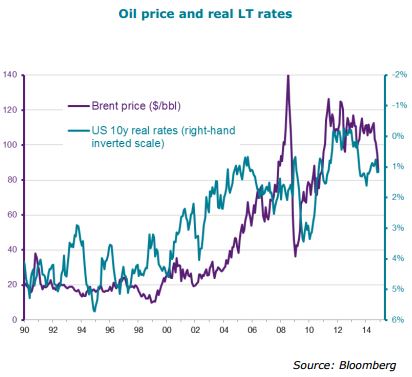
between the two bearish episodes is that in 2012, US real long-term rates were
easing (the Fed’s quantitative easing programme), whereas rates are now
steepening marginally. Hotelling’s rule intuitively explains the link between real
interest rates and the price of a non-renewable storable commodity (such as oil).
When real interest rates are low, producers maximise the value of their mining
resource stock by conserving reserves underground, thus driving prices higher
due to a lack of supply, rather than extracting their resources and selling them
cheaply on the open market and investing their revenues at low real interest
rates. Chart 2 illustrates this negative correlation between the oil price and US
real long-term rates.

Furthermore, Hotelling’s theory should also be applied to forex markets. Oil
producers effectively receive income in dollars, the denomination currency of most
commodities markets. Major producing countries (Middle East, Russia) also enjoy
high saving rates, which helps smooth out mining resource revenues over time.
They therefore have heavy revenue flows in dollars which are partially invested as
savings in the financial markets. These countries already have very large foreignexchange
reserves in dollars, and seek to marginally reduce their dependence on
the greenback. When crude prices are high, diversification of dollar-denominated
savings by oil-producing countries into other currencies therefore generates a
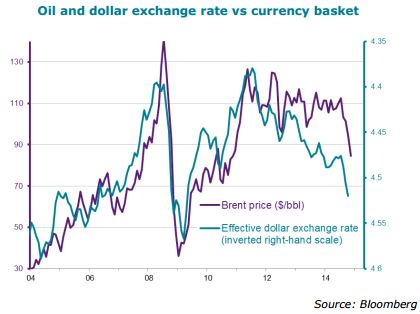
selling flow of dollars in the forex market. Thus, there is also an inverse
correlation between the price of oil and the dollar exchange rate, as illustrated in
chart 3.

The accelerating fall in the oil price can therefore be linked to the sharp increase
in the dollar since early summer. The dollar rally stems from monetary decoupling
between the USA and other developed countries. The US economy is growing at a
rate of 3% and is fast approaching full-employment, justifying a normalisation of
Fed policy, whereas the euro zone and Japan are faced with the threat of deflation
which renders their household and public debt potentially less sustainable. While
the Fed is considering the best timing to start hiking rates, the ECB and the Bank
of Japan have announced, over recent months, their intention to significantly
increase the size of their balance sheets in order to weigh on the entire yield
curve. The explicit (in the case of Japan) or implicit (in the case of the ECB) aim
of this intervention is to drive the domestic currency lower against the dollar. The
Swiss National Bank has already capped the Swiss franc against the euro.
Meanwhile, the Bank of England and the Swedish Riksbank are also considering
intervening to prevent their currencies appreciating too sharply against the
European single currency, which is being driven lower by the ultraaccommodating
stance assumed by the ECB. On the other hand, the Fed has so
far issued no significant comments regarding the strength of the dollar, meaning that the greenback remains the primary vector for the euro to express its
weakness. This accounts for the surge in the dollar, and, in correlation, the
exaggerated fall in the price of the barrel. The dollar therefore remains, for the
time being, the victim of the opening clashes of the potential ‘currency war’
between the G7 countries. Furthermore, the correlation between the dollar and
the price of oil is self-perpetuating: European and Japanese monetary easing is
driving the dollar higher and weakening the oil price, which weighs on European
and Japanese inflation and provides the central banks with the pretext to further
ease their monetary policy. This is the mirror image of the 2008 dollar-oil spiral.
The fall in the oil price is thus attributable to a real phenomenon (the downward
revision in global energy demand), but which we consider to be amplified by
macro-financial interest-rate issues (steepening US real rates) and foreign
exchange factors (dollar rally). Its significance for the current state of global
growth must therefore be viewed in perspective – the fall in the oil price greatly
exaggerates a downturn in global growth in our opinion – and it would therefore
be unwise to consequently adopt an over-pessimistic view regarding the current
valuation of risky assets. Furthermore, the oil price may rebound once the bullish
dollar trend is inversed. The Obama administration may also bring matters to a
close, judging that the dollar alone should not have to bear the burden of an
adjustment among the European and Japanese economies. The US Treasury
Secretary Jack Lew has already expressed this sentiment. The oil price is
therefore likely to remain volatile throughout 2015, as the currency war wages
on.

Add Comment