


This post is also available in:  Français
Gone is the dynamic growth that propelled Latam as one of the top performing
asset classes between 2010 and 2012. Just as western economies were
attempting to regain their footing, following the 2008 financial devastation,
South American economies were on a roll, handsomely benefitting from strong
Asian – particularly Chinese – demand for commodities and industrial raw
materials. Economic growth was further fuelled by record foreign inflows, in the
form of both direct investment and hot capital, driven particularly by carry trade
strategies amidst a ZIRP* environment.
Alas, Latam growth was excessively leveraged to the commodity “supercycle”,
neglecting diversification into productive areas and policies geared towards the
emergence of a middle class. Also, the ensuing credit expansion forced central
banks to shift into restrictive mode as consumer prices began to overshoot
inflation targets. South American economies such as Brazil, Chile and Peru,
traditionally the region’s magnets for foreign capital, thus now find themselves in
the midst of a dramatic slowdown, bordering on recession. Worst off of course, is
the white elephant: Brazil. Dilma Rousseff’s recent re-election despite her poor
economic record – the country is undergoing severe stagflation with GDP down
1% and inflation at 6.75% – makes for low expectations.

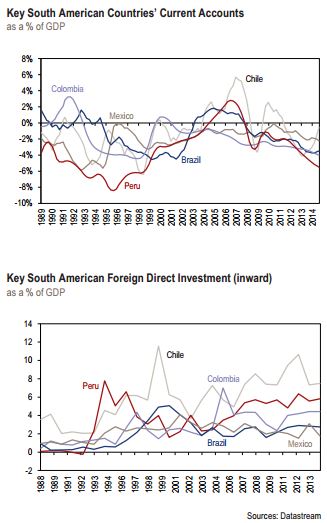
Recessions never play out well for social and political stability. South America is known for deceitful political promises of “new beginnings” and frustrated voters taking to the streets to express their deception, loud and clear. Foreign investors will be unwilling to see their capital caught in situations where, when push comes to shove, politicians would rather side with public opinion. As such, it is no surprise that capital flows to emerging markets are already shunning South America in favour of Asia – exacerbating current account deterioration, currency depreciation and sovereign spread expansion across the Latam region.
Remain underweight Latam vs. Asia… but not all is bad
While it is premature to call for a “Sambarazo” (in reference to Mexico’s 1994
“Tequilazo” which reverberated throughout the continent), we are keeping a
careful watch on Brazil et al – as well as our overall preference for Asia within
the emerging space.
Colombia and Mexico are notable exceptions to our cautious Latam stance,
faring much better than their “camaradas”. The former is, however, starting
to show signs of a sizzling real estate market and overheating credit growth.
As has been the case in neighbouring countries, central bank obsession with
inflation targets may “unintentionally” pop a Colombian asset bubble. In Mexico, the story is one of structural reforms: to reduce dependency on oil revenues, taxes have been raised, in turn pressuring wage growth. Along with subsiding inflation, this means that the central bank can afford to remain easy. Robust US manufacturing is also helping, as a large part of Mexico’s exports go north.
Finally, as regards Brazil, much of the bad news does now look priced in.
Opportunistic investors may thus find some selective high return / high risk
investments there, particularly in the fixed income space.

Add Comment