


This post is also available in:  Français
Since the announcement of the vote for Brexit at the UK referendum, long-term interest
rates have plunged to record lows across all major currencies. The US 10-year interest rate
hit an all-time low of 1.32% on July 6, before rebounding to 1.47% on July 12. But are
these levels sustainable?
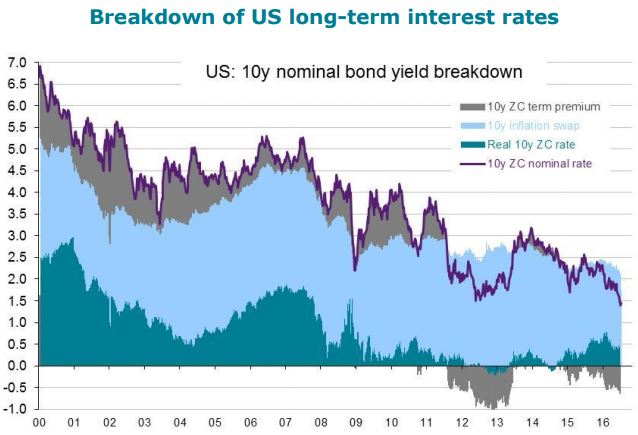
It is instructive to analyze long-term interest rates movements by breaking them down to identify
three factors: expected real short-term interest rate, inflation expectations and the term premium.
A long-term bond can be arbitraged for a short-term deposit that is rolled over for the bond’s entire
maturity, so the nominal long-term interest rate can be analyzed as the expected short-term
interest rate discounted over the long term. Accordingly, the 10-year interest rate appears as the
average value of the expected overnight interest rate over the next 10 years, plus a risk premium
that takes into account the fact that the capital invested in the case of a long-term bond can be
released onto the market before maturity only at the cost of a potential discount – the price of the
long-term bond in the secondary market is subject to interest rate risk. On the bond market, this
risk premium is known as the term premium. This average expected short-term interest rate can
itself be broken down into a real short-term interest rate and projected future inflation, according
to Fisher’s equation. These three factors, expected real short-term interest rate, inflation
expectations and the term premium, are presented in the chart below for the US 10-year interest
rate. We use the calculations of economists Kim and Wright, as published by the US
Federal Reserve, for the term premium and the expected nominal short-term interest rate. The
calculation of the term premium is derived from a modelling process that extracts the information
on expectations of future short-term interest rates across the entire yield curve.
Breakdown of US long-term interest rates
This breakdown indicates
that the fall in long-term
interest rates can
primarily be attributed to
the drop in the expected
real short-term interest
rate and in the term
premium, while 10-year
expected inflation, which
is approximated by the
10-year inflation swap in
this case, remains
virtually stable.

The market is actually
pricing in a scenario
whereby a normalization
of the Fed’s interest rates is impossible, even in the long term. The expected average real shortterm
interest rate has fallen to 0.36%. By way of comparison, the Fed’s median scenario
(“Summary of Economic projections” of June 15) expects a long-term equilibrium value of the Fed
Funds rate at 3%. If we take into account its medium-term inflation target of 2%, this is therefore
equivalent to a real short-term interest rate of 1%. Admittedly, the interest rate that the Fed
expects has fallen markedly since these projections started in 2012, but it still remains well above
the figure that the market now expects. The market is therefore showing the Fed that it is set to
fail in its efforts: investors expect that monetary policy normalization will turn out to be impossible.
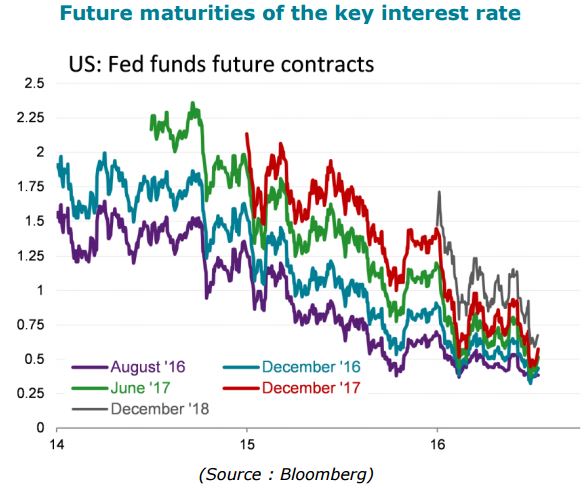
Future maturities of the key interest rate
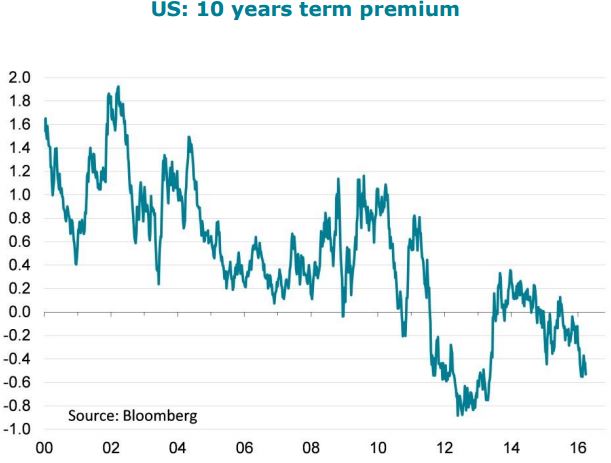
According to our estimates, the
term premium stands at -0.6%. As shown by the
chart below, this term premium is
not yet at its historical low, which
was reached during the Fed’s
quantitative easing programs in
2012. However, our term premium
modelling approach indicates that
this extremely negative figure is
justified by several factors: the
degree of political uncertainty, as
measured by the Baker, Bloom &
Davis indicator; the flight to
quality, as assessed by the
valuation of other safe havens
such as the Swiss franc and
precious metals; the level of
excess dollar supply, as reflected
by US banks’ excess reserves; and
the pressure on the market for long-term financing in dollars (EUR/USD basis swaps).

US: 10 years term premium
Beyond the increase in the
post-Brexit political uncertainty,
this shock has prompted a
slight downward revision of
expectations for global growth,
but the most salient point in
our opinion is that it has
revealed market complacency
in its assessment of political
risks. The obvious failure of
political analysts, pollsters and
online betting sites to
accurately forecast the result
of the UK referendum showed
that the markets largely
underestimated the cost of
political uncertainty. This
“repricing” should now affect
all forthcoming election results,
in Europe as well as in the
United States.

Furthermore, we would also add another factor that is set to put downward pressure on the term
premium, i.e. the increasingly negative impact of long-term interest rates in Europe (Germany,
Switzerland, etc.) and in Japan. This trend is forcing domestic institutional investors to search for
yield in markets that are still liquid and provide positive yields, such as the US Treasuries market.
In this more uncertain post-Brexit world, capital that is fleeing risk will continue to find a safe
haven in the liquidity of US bonds. We therefore continue to favor this market in our asset
allocation to hedge our positions on global equities.

Add Comment