


This post is also available in:  Français
During an unprecedented period of political
change across the globe, from the UK
referendum on EU membership to the election
of Donald Trump and the Italian Referendum,
2016 was a year where the key drivers shaping
markets irrevocably changed.
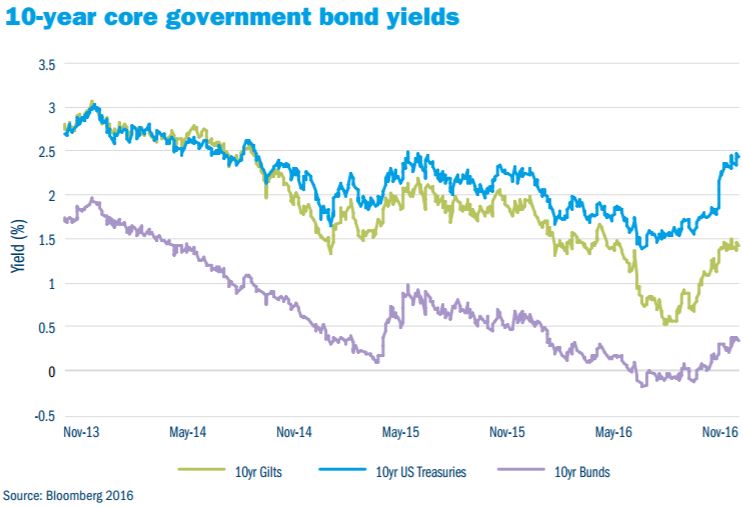
It was a year of two halves. The bond rally
in the beginning of the year was bigger than
expected, with deflationary pulses continuing
to hit the market, reminding investors that
geo-political risk was alive and well. This led
to an impressive rally where, capped off by
Brexit, ten-year gilt yields rallied from 2% at
the beginning of the year to nearly 0.5% in July,
before moving back to 1.5% at year-end.
In hindsight, the extra dose of post-Brexit
quantitative easing looks increasingly like the
last hurrah for monetary policy. The odds are
high that the sell-off in the latter half of the year
was an inflection point that marked the end of
the long-running bull market in bonds, triggered
by a combination of extreme over-valuations
colliding with the expectation that the rules
going forward will be different.

In our view, the bond-bubble was likely to burst, not because of a sudden acceleration in growth
or inflation, but because a change in policy would change the rules and shatter the complacency.
The world is slowly adjusting to the idea that monetary policy will transition to stimulative fiscal
policy. Trump’s victory appeared an unlikely place for this trend to start, but it has set down a
marker that will be difficult to contain.
The disenfranchised middle-class has voted – negative rates and quantitative easing
are inadequate ways of raising their living
standards. They want a new rule book. And if
the current political establishment is unwilling
to rewrite the rules, they will soon be voted
out of office in favour of someone who will.
For some time, markets have become
accustomed to thinking that any disappointing
data on growth and inflation would be met by
lower rates or quantitative easing.
But these tools have been increasingly used
as last-ditch efforts to spark economic growth.
As we reach the end-game for monetary policy,
there is now an acknowledgement that central
banks soaking up a dwindling supply of bonds
has a number of detrimental side effects.
More spending and tax cuts appear to be the
way forward, yet fiscal stimulus is inflationary.
This would be negative for bonds in a normal
environment. Coming from a bubble-like
starting point, it’s even more ominous.
With the collapse of long-dated interest rates
in mid-2016, bond markets had been pricing
in little inflation risk for at least the next
decade. But with the rule change we expect,
term premia is likely to normalise and the
idea that investors should price-in permanent
disinflation will fade into obscurity. In that
environment, a continued sell-off in bonds
is likely.
The bond bubble is bursting.
How spectacular will it be? That
remains to be seen, as there
are many deflationary forces
still bubbling just beneath the
surface.
If all of Trump’s agenda becomes law, the bear
market will have much further to run.
With this in mind, we believe investors should
look out for three key signals that might tell us
just how far bond yields might rise.
One: Inflation expectations
If fiscal stimulus becomes the policy lever
of choice, we would expect an inflationary
reaction. ‘Fiscal’ means more spending, which
should boost growth as well as increasing
deficits. Growth and inflation, if combined with
deregulation (which we expect with a Trump
presidency), spurs corporates to spend more and that can create a virtuous circle that’s
very bond-negative. But inflationary
expectations are also a function of wage
pressures and trade protectionism. We’re at
close to full employment in the US, and wage
gains could start to push higher given that
labour markets are tight and a high number
of people that have left the workforce are not
coming back. Wage pressures, along with fiscal
stimulus and a more protectionist agenda
(which is itself inflationary through trade tariffs
and immigration), will see inflation expectations
continue to rise from what are still
depressed levels.
Two: China
China should be watched very closely. Longdated
global rates reflect a decade-long series
of capital outflows from China. The central
bank has purchased hundreds of billions of
foreign bonds. This bond-buying programme
is a function of years of over-investment in
plants and equipment, which itself led to overproduction
and excess capacity. China’s capital
outflows put immense downward pressure on
global real rates and term premia.
China’s economy has been slowing. A savings
glut, sluggish business investment and worries
over potential devaluation in the yuan have all
provided the impetus to move money offshore.
But if the Chinese economy were to merely stabilise, it would provide yet another catalyst
for bonds to sell off. A surprise reacceleration
in China would force foreign flows to rapidly
recede, leaving global government bonds
without a key source of demand. Somewhat
worrying is that there are some signs that this
is happening, just as Donald Trump is set to
enact some of his policy proposals, though this
is something of a coincidence.
If fiscal stimulus becomes the
policy lever of choice, we would
expect an inflationary reaction.
Three: Europe and geo-politics
What happens in Europe, from a geo-political
point of view, will be critical. In 2016, we have
already seen the UK vote to leave the EU and
the electorate reject the Italian prime minister
Matteo Renzi’s referendum proposal. In 2017
we have elections in France and Germany, not
to mention Article 50 being invoked.
A continued political shift to the right would
imply that more populist policies will continue
to be enacted. There are limits in Europe as
to the scale of any tax cuts and increases
in spending that can be delivered, because
fiscal policy is limited by the Maastricht
Treaty, which caps member state
government deficits to 3% of GDP (and public debt levels to 60%). However, if populist
parties who claim they will breach these rules
are elected, this raises the risks surrounding
the eurozone project. Ironically, in Europe, this
is a recipe for higher rates overall, rather than
lower rates.
Conclusion
The bond bubble is bursting. How spectacular
will the sell-off be? That remains to be seen,
as there are many deflationary forces still
bubbling just beneath the surface, and a
plethora of policy uncertainties. Trump will
almost certainly succeed in getting tax cuts
through and a scaled down version of his
defence and infrastructure spending package
passed. China is stabilising and with it comes
less of a reliance on their easy monetary policy.
Capital outflows will likely diminish as the yuan reprices and the powerful force of central
bank buying – either through investment or
QE channels – will recede. With respect to
Europe, it is very difficult to forecast, but it
would be wrong to extrapolate what happened
in the UK with Brexit (as well as the election
of Donald Trump and the Italian referendum).
Nonetheless, the previously unthinkable is
now possible.
We believe inflation expectations will continue
to rise from what are still depressed levels.
The US economy is near-full employment.
Wage inflation coupled with even modest
protectionism and the prolonged recovery
should create elevated inflation expectations.
We envisage policy rates staying lower for
some time in Europe as there is still enough
uncertainty – not just geo-political risk, but also
concerns over the strength of some economies
in the region – for central banks to continue
with a ‘lower for longer‘ policy. Rate rises are
also unlikely in Japan, which leaves the US
as something of a focal point. On the back of
increasing wage pressures and fiscal spend,
we expect rate hikes in 2017 to follow the
December Fed hike. The tide has turned.

Add Comment