


This post is also available in:  Français
- Quantitative easing (QE) has resulted in heavily indebted developed economies and has had varying degrees of success.
- An unwinding of QE could cause increased volatility in the markets and a fight for remaining liquidity, as the supply of government bonds starts to disappear.
- QE has served its purpose of being a life raft for many of the largest economies and now central banks must start to go back towards the norm of pre-crisis levels, so that they have ammunition to tackle the inevitable next crisis.
The reasons for using QE and its effectiveness
have been argued at length and this article aims
not to discuss whether or not QE has worked, but
to look at the likely next steps of central banks
and how these could impact markets.
QE first reared its head in Japan in 2001, when
the Bank of Japan (BoJ) became the first central
bank to purchase government bonds financed
by the creation of central bank reserves. This
happened when the BoJ found itself backed into
a corner as it approached the presupposed lower
bound for nominal interest rates and needed
to stimulate the economy. Following the global financial crisis, central banks in the US, UK and
Europe were forced to follow suit, pumping large
amounts of money into the banking system to
prevent it from collapsing.
These measures have caused an array of
consequences (intended or otherwise) that will
need to be addressed sooner or later. At its core,
QE has resulted in heavily indebted developed
economies and has had varying degrees of
success, which has arguably been dependent
on the extent of distortions or frictions in the
functioning of various markets.[[http://www.bankofengland.co.uk/research/Documents/workingpapers/2016/swp624.pdf]]
FIGURE 1: CENTRAL BANK BALANCE SHEET SIZE RELATIVE TO NOMINAL GDP (LHS) AND GOVERNMENT DEBT (RHS)

Now that we are a decade on since the start of the crisis, surely it is time to think about what happens
next to QE. Despite a fairly uniform decision to undertake QE across developed markets, the methods
used have differed and so will the approaches to unwinding in the US, UK, Europe and Japan. The
general market effects of QE have been lower discount rates, a weaker currency, and a strong
environment for risk assets. Bank of England (BoE) studies have also shown there to be strong positive
international spill-over effects of QE. Therefore, it is safe to assume that any rollback of QE would also
have international impacts in such an interconnected world.
Are central banks maintaining their independence?
Before we get into the when and how, let us
first consider if QE even needs to be unwound.
Arguably, if the debts held by central banks are
continually rolled over and the coupons on the
debt are not required to be paid, then does the
debt really exist?
The idea of simply cancelling QE debt has been
bandied around and, although not economically
different from central banks holding onto the
bonds and accumulating cash flows indefinitely,
markets would react very differently to these
options. The budgetary implications of QE in
the UK already correspond to a de facto debt
cancellation, but a de jure cancellation would
impede the BoE’s ability to resterilise the
monetary base at some point in the future.
This is something the former governor of the
BoE, Sir Mervyn King, has highlighted but
the BoE in particular wanted to avoid, as by
doing this it would suggest that central bank
independence is not so independent after all.
Announcing debt cancellation would indicate that governments could indebt themselves without
real consequences and could lead to consistent
overspending. As markets lose their faith in the
reliability of a country’s intentions to fulfil debt
obligations, we could see inflation shoot up and
the value of the country’s currency plummet. As
we all know, trust is fundamental to the efficient
functioning of markets – so which (if any) central
bank is brave enough to admit to taking this step?
Consequently, could the rolling back of QE be
considered so much of an inconvenience that
central banks simply opt to keep it indefinitely on
the balance sheets? This would certainly make
those central bankers, already concerned by the
bloated balance sheets, uneasy as they face the
prospect of a new norm plagued by the threat of
inflation and a lesser set of tools at their disposal
in the event of the next crisis. Or perhaps there
will be an attempt to gradually reduce the debt
while trying to avoid another taper tantrum? Let
us consider the likely options central banks could
take around the world.
US
In the US, the Federal Reserve is arguably the
furthest along in terms of starting down the
path to the old status quo. The last of QE was
completed in 2014, leaving the Fed with a portfolio
of US$4.5 trillion on its balance sheet, which it
has since maintained at this level by rolling over
the debt and reinvesting any principal. While the
Fed considers its stance on when the balance
sheet can start to be reduced we have seen small
rate hikes. The ‘softly softly’ approach is very
much being taken with lots of hints being passed
to the markets so as not to spook them and
cause an event like the taper tantrum in 2013,
which led to a surge in US Treasury yields. That
event is precisely the reason that Federal Reserve
Chair Janet Yellen is delaying an unwind, as the
central bank wants to maintain a buffer to absorb
economic shocks while the economy remains
seemingly fragile.
As the Fed continues its gradual rate hiking we
are likely to start to see a tapering of balance
sheet reinvestment starting in 2018, with details
emerging over the forthcoming Federal Open
Market Committee (FOMC) meetings. With the
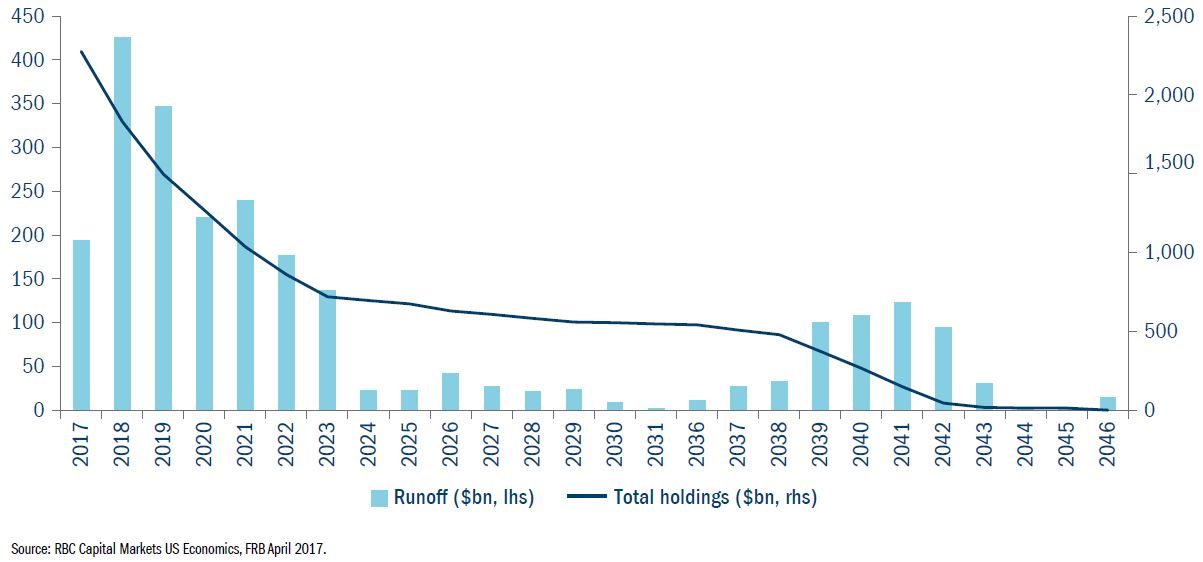
current shape of the portfolio on the Fed’s
balance sheet, if all the debt maturing is allowed
to roll off then there would be a sharp run off
in 2018, reducing until 2024 when this flattens
out. To avoid such a large shock to markets, the
path of the debt roll-off is much more likely to
be smoothed as is indicated in Figure 2. In this
scenario, we would expect to see a small amount
of upward pressure at the long end of the curve of
between 15-30bps towards the end of 2018. The
tapered approach to debt roll-off would help the
Fed maintain some flexibility to change its mind as
the markets’ reaction is observed.
FIGURE 2: FED’S TREASURY PORTFOLIO

For now we should expect further gradual rate hikes, which may pause if the FOMC starts to normalise
the balance sheet later this year on the back of more positive economic numbers (as hinted by Dudley
in a recent speech). Markets are yet to take Dudley’s suggestion or any more drastic options seriously,
though surely at some point this will have to change – if the US does not set the trend of rolling back
QE, what hope is there for the rest of the world?
UK
The next obvious place to follow suit in the
unwinding of QE would have been the UK;
however, studies have shown that any unwind is
currently near impossible. This is because of the
large amount of QE banks have used to meet their
prescribed regulatory buffers. Any removal of this
money will leave financial institutions fighting over
remaining liquidity to avoid falling foul of these
regulations. The way around this is to reduce the
amount required to be held in buffers, but it is
unlikely that central banks will want to take away
that safety net.
It is important to note that in the UK we can see
some of the unintended consequences of QE,
which highlight the need to address the situation
before more irrevocable damage ensues. Firstly
the housing market has been impacted by
artificially low rates inflating house prices as those
with the means to put down large deposits invest.
Banks insist on larger deposits as a means of
identifying individuals who will be able to continue
to service mortgages if interest rates increase,
which keeps the younger generations off the
housing ladder for longer. This is compounded
by the fact that rent is going up, hindering those
same younger generations from ever being able to
save for a deposit.
At the other end of the generational scale, there
are those whose defined pensions are at risk. The
present value of long-term future-defined benefit
pension liabilities has risen to the point that they
are mismatched with the pension assets that have
been boosted less by the lower rates and higher
asset prices. These issues are starting to wear
thin with the British public, so surely something
must be done. Perhaps though, this is not yet
the time for the BoE to make its move with the
uncertainty of Brexit on the horizon. Interest rates
will most likely stay low (though small hikes could
be possible) to attract Foreign Direct Investment,
which is so vital to the UK to finance its current
account deficit. This does leave the country at
risk of having minimal tools to use if another crisis
were to take place. Maybe helicopter money or
debt write-off are the next steps? In the UK, the
equivalent of around 30% of overall debt has, from
a budgetary perspective, already been effectively
cancelled. So could it be argued that this might
not be too much of a leap for the BoE?
Europe
2017 is all about politics in Europe with the
numerous elections taking place. Markets have
been suspicious after the shock votes in 2016,
but so far fears have been unfounded as the
populism craze seems to be going out of fashion.
Also, in spite of the election concerns, we are
seeing good economic numbers coming out of
Europe which could suggest that more QE is
less likely. Earlier this year Draghi stated that
policymakers were now confident that they had
removed the threat of a severe bout of deflation.
Couple this with a calmer political outlook and
we are likely to see the ECB move towards a less
loose monetary stance.
The first stage for Europe has been the signal
of the end of QE-infinity before an actual halt to
QE ? and then finally a roll-back much further
down the line. So far, the ECB is around 80% of
the way through the EUR2.28 trillion QE extension
which will be complete by the end of the year,
with a complete end of QE (with the potential to
start tapering) as soon as the end of 2018, as
the ECB is quickly running out of eligible bonds
to buy. The ECB is the central bank most at risk,
as it owns a large proportion of government debt
of the multiple member states. This puts the
ECB balance sheet at risk of default if there is a
fracturing of the European Union.
FIGURE 3: ECB QE PURCHASES BY TYPE AND COUNTRY

The ECB has stated that it will be tapering first and then considering rate hikes, so we are unlikely to
see any hikes until the end of 2018 at the earliest. Draghi has gone further by outlining four necessary
conditions for inflation to meet the price stability target before tapering can be considered. Inflation
must be medium-term, durable (not just driven by base effects), self-sustained (not reliant on the
extraordinary monetary conditions) and broad-based across the eurozone. It may be some time before
this comes to pass and, even if interest rates start moving at the end of next year, the balance sheet
still won’t shrink until 2020 or 2021.
What about Japan?
Japan was the first to use QE and the most likely
to keep meaningfully extending its balance sheet
beyond 2017. In fact, Japan is potentially decades
away from its desired inflation target and, even
if it is reached, it will have to be sustained for
a period of time before the idea of stopping QE
can be fathomed. Being the guinea pig for QE
has meant the BoJ has faced a great deal of
criticism, including claims that it waited too long
to implement QE and tightened monetary policy
too quickly. For the unwinding of QE, maybe the
BoJ will wait for the Fed to move so they can learn
from its mistakes.
An International Monetary Fund (IMF) paper
by Hiromi Yamaoka and Murtaza Syed called
‘Managing the Exit: Lessons from Japan’s reversal
of Unconventional Monetary Policy’ looked at what
we can learn from the BoJ’s first QE exit strategy.
This paper found that the gradual and orderly way
in which the BoJ unwound QE in 2006, with clear
indications given to the market, did not result in
any obvious disruption to financial markets.
This proved that “it is possible to exit from a period
of QE in a smooth manner, without overshooting
of inflation, derailing economic recovery, or
destabilizing financial markets.”[[https://www.imf.org/external/pubs/ft/wp/2010/wp10114.pdf]]
Nevertheless,
with the arrival of the global financial crisis the
BoJ was forced to enter another monetary easing
phase, having only raised rates back to 0.5%
leaving the exit incomplete and Japan with a
persistently weak pricing environment. It feels like
years since ‘normal’ economic conditions have
been here in Japan – maybe they will surprise us
all and move first again?



Add Comment