


This post is also available in:  Français
WHY LOOK INTO CHINESE BANKS TODAY?
Aude Lerivrain: Chinese banking issuers are increasingly present on
international bond markets. That’s why we decided to
look into the health of the Chinese banking sector, which
is at the heart of this economy in full flux.
To get a good idea of the workings of this complex system
we need to look back at the uniqueness of its
development. The banking system was a monopoly and
hardly existed at all before 1978. It was recast from the
ground up by Deng Xiaoping’s reforms and opening up of
the economy, with the establishment of four state banks,
each enjoying a monopoly in a specific area, i.e.,
infrastructure, industry, foreign trade and agriculture. The
Commercial Bank Law of 1995 eliminated this monopoly
for state banks and expanded the system with the
creation of three policy banks in charge of assisting the
development of certain sectors without a profitability
objective and the creation of public-private banks and
local banks. This raised the number of banks from five to
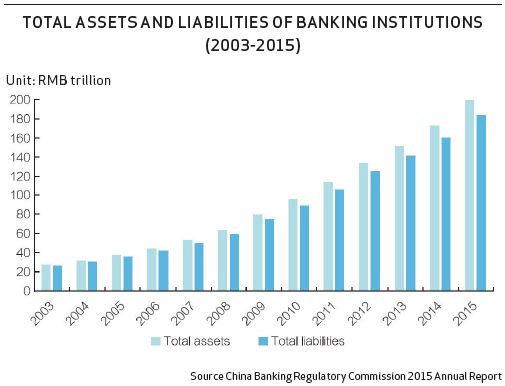
more than 30,000 in 20 years. Bank assets quintupled in
10 years to 232 trillion renminbi in 2016 (about 32 trillion
euros), and four Chinese banks are now classified as GSIBs
(Global Systemically Important Banks). This
breakneck growth was driven by the fact that the
government at first counted on the banks and not the
financial markets to finance China’s development. It is
now turning towards market financing on both its
domestic market and internationally.
ARE THE CHINESE BANKING SYSTEMS’ WELL-KNOWN
WEAKNESSS DUE TO ITS HISTORY?
Aude Lerivrain: It is quite right that Chinese banks’ structural weaknesses
are due to the structure and development of the Chinese
economy. The “all state and administered” model with its
implicit state guarantee at all levels has not urged banks
to develop a culture of risk and fair price.

WHATS THE POINT OF REVIEWING A LOAN PORTFOLIO IF
THE COMPANY IS PUBLIC AND IF THE STATE IS THE
GUARANTOR OF LAST RESORT?
Aude Lerivrain: This phenomenon has been made even worse by the
reliability of the legal framework and reporting,
corruption, and the proper economic functioning of
publicly owned companies (including “zombie
companies” and “living dead public-sector groups” the
banking regulator talks about). Coming on top of the
explosion in outstanding loans and the cyclical nature of
the Chinese economy, no wonder non-performing loans
skyrocketed. The Chinese state has taken on this problem
many times in the past with the creation of defeasance
structures, but this is still an issue, as the flow of nonperforming
loans continues, in particular in city
commercial banks and credit cooperatives!
Another risk factor to keep an eye on is shadow banking.
In recent years banks have developed off-balance-sheet
activities in order to get around regulations that hemmed
in their growth. With their frightening amount of offbalance-sheet
assets (more than 20 trillion renminbi),
wealth management products, which are bank deposit
substitutes, are the main concern, as they are still implied
liabilities for banks, given that they are targeted to retail
customers but with no offsetting capital. They are
invested in assets that traditionally are riskier than
balance sheet assets and carry short maturities and need
to be rolled over very often. So Chinese banks could begin
to face liquidity issues, whereas financing via domestic
customer deposits was one its main strengths and
seemed to rule out any liquidity risk.
In short, we are seeing in the Chinese banking system
many of the early warning signs of the major banking
crises of recent years (in the US, Ireland and Spain). Is a
soft landing of the Chinese financial system possible?
Seems unlikely without state support!
IN THAT CASE WHY TAKE THE RISK OF INVESTING?
Aude Lerivrain: The state is ubiquitous in China. Banks are state-run; they
lend to public-sector companies; and investors authorise
investments, while assuming that the state will serve as a
last resort. So confidence in the Chinese government to
control leverage in the financial system, manage
economic growth and overheating in certain sectors is
crucial. And the government’s will to do so in this area is
beyond a doubt! Especially as it can rely on the strengths
of its economy, including abundant domestic savings,
very heavy fiscal resources, and little dependence on
foreign investors. But is this argument enough for
investing in Chinese banking groups?

Add Comment