


This post is also available in:  Français
The 2008 crisis caused a major shock for all
developed and emerging economies. However,
the stock market crash of 1929 – comparable
in scope and nature – provided valuable
experience and insight: fast and massive
intervention from governments and central
banks helped to avert the worst.
After bringing key rates down in all developed
countries, central banks set exceptional
monetary policy actions into motion. Stepping
way beyond their traditional role as a lender
of last resort, they flooded capital markets
with liquidity, using increasingly daring
mechanisms, before deploying asset purchase
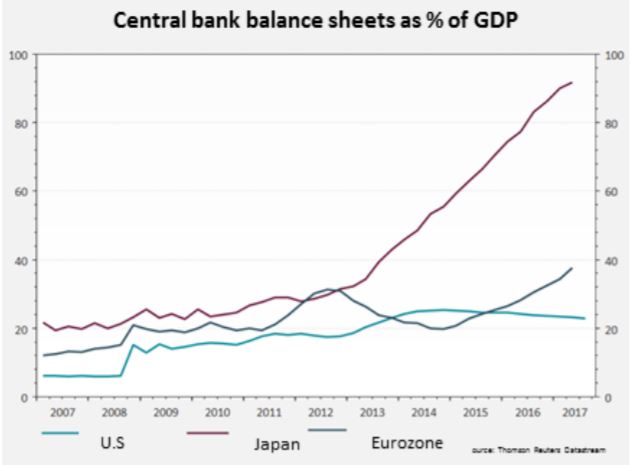
programmes in most countries. The volumes
involved were unheard of: central banks
owned over 20% of GDP in the U.S., over 30%
in the Eurozone, and over 90% in Japan (of
which a significant amount in ETFs).
Furthermore, the way central banks
communicate evolved, as they moved
towards “forward guidance”, providing
information on the upcoming policy as early as
possible, at least in broad terms even if details
cannot be disclosed.
This largely contributed to stabilising shortterm,
and therefore long-term, rate forecasts.
However the most successful form of
communication came from Mr Draghi,
Chairman of the ECB, when he publically
stated that he would do “whatever it takes” to
save the Eurozone, and probably did in the
process.
Central bank communication is now
scrutinised in its finest detail – every six weeks
when the scheduled meetings take place, but
also whenever one of the members makes a
statement.

The end of these extraordinary monetary
policy measures is now in sight, with the
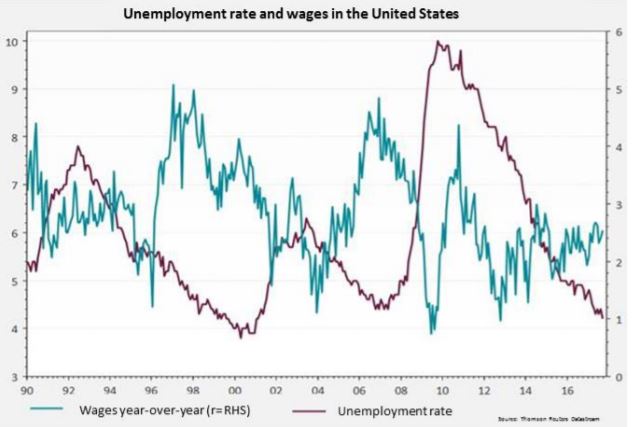
disappearance of deflationary risks. However
inflation has still not returned – “a mystery” to
quote Janet Yellen. Is the technological
disruption, which is driving long-term changes
in consumer behaviour, causing durable
disruption to inflation models? More recently,
timid wage growth has continued to raise
questions, considering the current stage of the
cycle.
To decipher this lack of inflationary pressure,
it will be important to make a clear distinction
between structural (demographic for instance)
and environment-related factors (such as the
return of long-term unemployment).
We firmly believe that the environmentrelated
factors will wane, enabling inflation to
rise beyond 2%, even if structural factors
mean that the scenario of run-away inflation
cannot materialise.
The fact remains that central banks will not
wait until their inflation targets are reached
before they start to normalise monetary policy.
In this respect, the Federal Reserve has
already, very gradually, upped its interest rate
and has started not to reinvest some of the
proceeds from maturing bonds. The ECB is
planning to make further cuts to the volume
of asset purchases in 2018.

The presence of central banks across the
entire yield curve, but also in the corporate
bond market, has disrupted the normal
running of capital markets.
Volatility collapsed in the corporate bond
market; this made sense, but also indirectly
affected the equity market. Furthermore,
these low volatility levels stem from the huge
sector dispersion observed across markets today. This is particularly true in the United
States, where technology and real estate
stocks have rallied by over 30% in 12 months
and have more than offset the losses posted
by the energy or food retail industries (-20%).
Volatility then spread to currencies, a perfect
example of which would be the exceptional
performance of the dollar in recent weeks.
Investors will also need to keep a close watch
on credit valuations as several records have
been broken: last summer, several high yield
corporate bonds in the Eurozone yielded less
than 10-year U.S. Treasury bills!
This normalisation process will take time and
in all likelihood, the target level for key rates
will be much lower than it was in the past. It
will also be very gradual: central bankers are
perfectly aware of their important role in
driving capital markets and now pay great
attention to “preparation” – as they do when
managing the probability of a Fed fund hike
ahead of each meeting. Currency market
volatility has created an additional challenge
for central bankers. Officially, they do not
have forex objectives; however markets
sometimes react violently depending on the
decisions they make. The interaction between
“driving markets”/ “market over-reactions” to
the statements made/measures taken by
central bankers is particularly challenging.
The structure of the market has also
undergone durable change, driven by the
numerous and diversified regulatory measures
impacting banks, insurance companies and asset managers. As a result, deals between
final investors have grown significantly
(intermediation). Questions remain over the
real and effective liquidity that will be
available in crises to come. Some market
observers have rightly pointed out that
liquidity is available when investors have little
need for it, and then disappears when they
require it. Measuring liquidity objectively is an
extremely difficult task in markets operated by
market makers, who have no interest at all in
being transparent over their capacity for
position-taking.
‘‘Regulation impacts liquidity
as a whole and this will be a
major challenge when
central banks leave the scene’’
Events of recent weeks have shown how
political developments can cause disruption to
financial markets. First in line is U.S. domestic
policy, with President Trump’s unpredictable
behaviour and the procrastination over the
project for fiscal reform. In Europe, the impact
of Brexit – both on the British economy and
capital markets, including international – has
not been truly factored in. Furthermore,
developments in the emerging world often
tend to be overlooked when analysing market
changes. Yet China is undergoing considerable transformation; the government is
determined to bring about change and to
create a service-driven country based on a
sustainable economic model. This
transformation implies major investment in
renewable and all-electric energy, but also
abroad, via the “One Belt, One Road”
programme designed to bring China closer to
Europe via the Middle East.

Clearly, this major crisis has caused deep
changes to the global economic environment
and to the way capital markets operate. These
upheavals that are currently at play are still
difficult to grasp; and in any event, they
cannot be measured effectively using available
statistical tools. However, in the short-term,
some areas of certainty remain, such as the
controls exerted by central banks on fixed
income markets.
As no one expects inflation to accelerate
sharply, the control from central banks does help to limit the risk of a crash on bond
markets.
Nonetheless, it is true that a badlyorchestrated
rise in interest rates can trigger a
severe correction in equity markets. We are
also convinced that the credit market will be
subject to the ECB’s tapering policy sooner or
later.
In this environment, we shall clearly favour
equities over credit investments in developed
markets, while leveraging on current
opportunities in emerging markets (both
bonds and equities). This new market
environment is not as favourable as it once
was to contrarian position-taking; markets are
momentum-driven at the moment and due to
regulatory changes, banks have invested less
of their own equity in the market.
Nevertheless, according to financial theory,
the “momentum approach” has not shown a
clear ability to outperform a “contrarian
approach” in the context of asset allocation.
It will therefore be important to use
diversification as a performance driver
(always useful as long as the “true”
correlations between assets are estimated –
hence the importance of a multi-scenario
approach); fund managers will also have to
demonstrate a high degree of flexibility in
order to adapt to the various shifts in market
regime that are bound to occur.


Add Comment