


This post is also available in:  Français
- Hedge Funds displayed remarkable resilience in January. Both
markets and analysts started the year with reasonable growth
expectations. These were aggressively revised down, triggered by
the release of the disappointing Chinese PMI and the CNY
depreciation. Strikingly, investors started to price in more serious
odds for a Chinese hard landing, the growing central banks’
impotence, the risk of a US recession, and the return of global
deflation.
In that context, CTAs thrived on their short commodities and long
bond exposures. FI Arbitrage and Global Macro funds exploited
monetary relative and tactical opportunities. To the exception of the
L/S Equity Long Bias and Special Situations funds – hit on their
beta – the other strategies managed to deliver flat to modestly
negative returns.
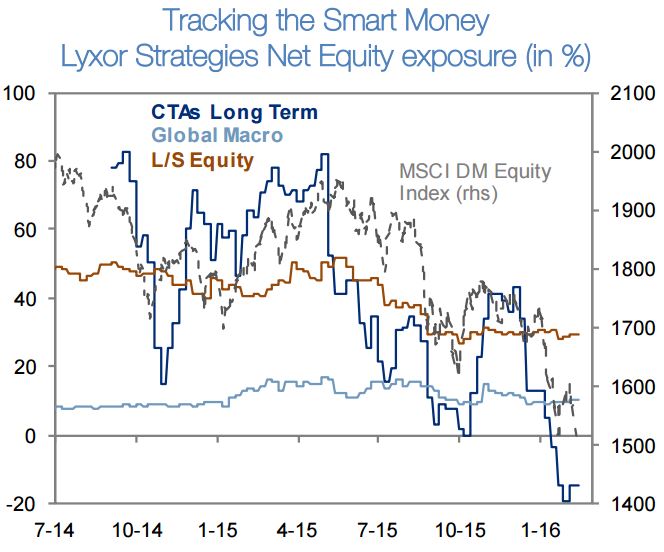
- L/S Equity funds were resilient as they remained on the
sideline. European managers kept their low market exposure. Their
beta was mainly expressed through sectors tilts, with the bulk of
their allocation on the consumer and financial sectors. Implicitly,
they played the reflation and stronger domestic demand themes,
keeping some optionality on the coming March ECB meeting.
The performance of the Long bias funds mirrored their beta
exposure. They produced limited alpha, amid elevated stock
correlation and thinner dispersion.
Japanese funds maintained their cautious positioning since August
2015. They raised their allocation to financials but maintained low
exposure to domestic demand driven sectors. Such a positioning
is consistent with greater expectations from BoJ, but persisting
skepticism as to Abenomics’ success.
- The pricing of M&A deals and the Merger Arbitrage returns
were reasonably insulated from the market turmoil. Investors’
concerns expressed in January did not put in question the existing
M&A operations. Besides, merger funds benefitted from several
deal completions. The erosion of executives’ confidence and
market volatility tamed the pipeline of M&A deals in January.
However, significant operations continued to fuel arbitragers’
opportunities, including the announced Shire vs. Baxalta, Tyco vs.
Johnson Controls, Abott vs. Alere deals.
Special Situation suffered yet again in line with their market beta.
There was a limited number of idiosyncratic events in the Special
Situations space. Their aggregate net exposure remained steady at
50% – including a 10% of short indices – the bulk of which
allocated to consumer, telecom and technology situations.
- The rebound in oil prices eased the pressure on L/S Credit
strategies. While credit markets kept on bleeding, they
outperformed equity markets. Spreads already pricing a recession
and the rebound of oil did help. With growing dispersion within credit sectors, the alpha backdrop improved. By month-end L/S
Credit funds started to chase opportunities, while adding long
government bonds.

- CTAs, best performers, thrived on their short commodities and
long bond exposures. Meanwhile they were immune from the
equity sell-off, having cut all of their remaining exposures by midDecember.
Short-term models even built up short exposures to
equities.
They gave back some of the accumulated gains by month-end.
Indeed, the sharp rebound in oil prices hit their short on energy
futures and their short FX exposures on the commodity block (CAD
especially). As of today, they are -40% short on energy positions
and 49% long on USD crosses.
CTAs once again stood as hedge in portfolios during risk aversion
episodes.
- Bond positions saved the day for Global Macro funds.
Individual positioning displayed increasing managers’ divergence.
In aggregate, most of the gains were made main through global
rate arbitrage. They were overall long US and short European
bonds, according to their relative monetary policy anticipations.
They did not profit from BoJ unexpectedly pushing rates further into
negative territories: they held a small short allocation to Japanese
bonds. A majority of the managers refrained from playing
commodities, though some of them built up short positions in the
second half.
Within their equity bucket (a small one, around 10% in net
exposure), they concentrated on reflation zones: a drag on
performance, but a modest one. Overall, global macro funds
continue to maintain relative value and balanced exposures. Their
key vulnerability lies with their long USD crosses, which would
suffer from a reversal in dollar.
“While a sub-par global growth seems well priced in, the
accumulation of downside risks lead us to stick to our preference
for relative-value, tactical and macro styles, which should
outperform the more directional strategies.” says Jean-Baptiste
Berthon, senior cross asset strategist at Lyxor AM.

Add Comment