


This post is also available in:  Français
This week, we take a deeper look at the Merger Arbitrage strategy and its environment.
While off from recent peaks, the flow of M&A stands at its 20 years average. Persisting trade wars and Brexit
uncertainty continued to take their toll on manufacturing, exports and now capex. It is weighting on executive
confidence and delaying some corporate operations. Yet, these concerns do not seem to question the relevance of
external growth, amid stalling internal growth opportunities, and declining reward from pure investors distribution
strategy. Additionally, liquidity conditions remain supportive. Companies accumulated more debt and have less cash,
but funding costs are low and acquirers continue to get banks’ support as well as credit access. Moreover, corporate
valuations (and hence M&A opportunities) remain affordable. In the U.S., the equity market value is in aggregate 14%
richer than the replacement cost (a more relevant book-value estimate), marginally higher than the long-term average.
M&A patterns are also showing healthy dynamics. A healthy number of hostile deals (usually riskier but more
profitable) tends to concentrate on smaller targets. Jumbo deals are increasingly funded by stock and cash
combinations, also favorable for arbitrageurs. At 30% in average, deal premiums are attractive, yet not so high as to
jeopardize operations. All in all, by most measures, M&A activity, which sets the menu of opportunities for arbitrageurs,
is consistent with mid-cycle patterns, neither too hot, nor too cold.
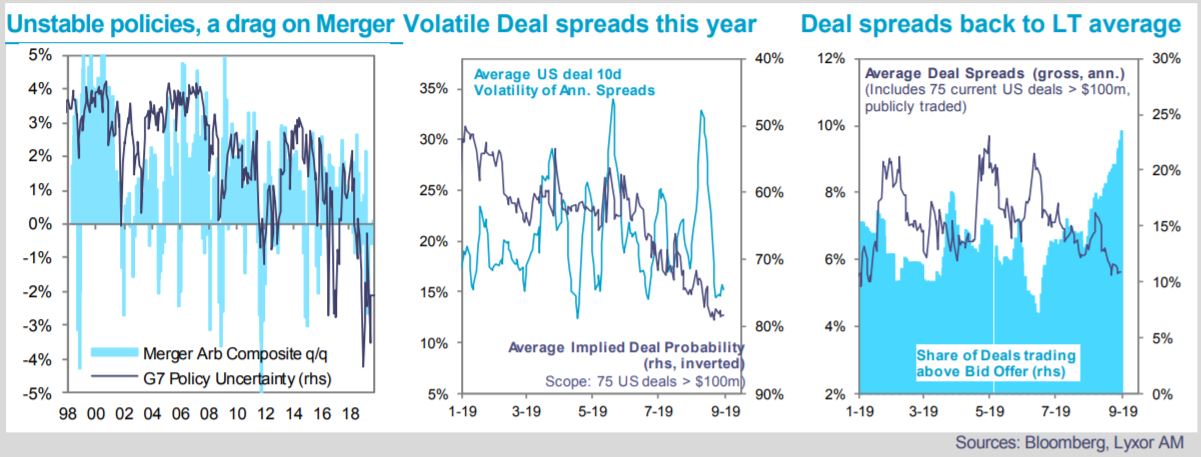
The Merger Arb. backdrop is attractive given its strong diversification patterns.Well isolated from market volatility,
swings in fiscal/regulation/trade policies are however unsettling.
It contributed to moderate YTD returns (+1.5% on
average). Volatility in deal spreads spiked, forcing managers to reduce exposures or take higher risks. Despite greater
volatility, the risk of M&A break-up remained minimal (< 2% transactions failed), translating in elevated implied deal
probability and contributing to compress merger spreads. The average gross spread of 75 live and large deals stands
at 6%, close to the long-term average. With only few compelling bidding war situations and external flows from carry
investors, the best deals were crowded, leading to several hits to merger portfolios this year. The merger environment may seem currently “average”, but its returns-to-correlation profile outrank most other market
segments. Its carry favorably compares with credit or dividend yield, the strategy also shows strong diversifying
patterns in allocations and decorrelation from risky assets, with consistent alpha generation. We are O/W. 

Add Comment