


This post is also available in:  Français
Still the ECB surprised positively
and especially the currency responded strongly to the further
increase in “easiness” of the policy stance. The details of the
rate cut and asset purchasing program have been discussed
previously in the economics part, but probably most
important for markets was that words (by Draghi) were
followed by action (of the ECB).
Key is that this reflects an ongoing “whatever it takes”-
mentality at the leadership of the ECB that keeps both the
cyclical recovery and sovereign QE hopes alive.
Moreover, it
inspires daydreaming about a European version of the
Japanese regime shift in policy setting that took place late
2012, known as Abenomics (after then elected Japanese
Prime Minister Abe), that could create an even more
significant asset price reflation in Europe than seen since the
peak of the Euro crisis.
The inspiring speech that Draghi gave in Jackson Hole did
indeed hint at a more wide-ranging shift in the European
policy agenda. He not only emphasised that eroding inflation
expectations justify further policy easing, but also pressed for
the need of a more comprehensive policy impulse and
effective reform package that balances near-term demand
support (both fiscal and monetary) and enhancement of the
economy’s long-term growth potential.
By further emphasising that the risk of doing too little
currently outweighs the risk of doing too much, both the
urgency and composition of the message from the ECB
President sounds remarkably similar to that of Japanese
Prime Minister Abe. However, whether Draghinomics will
make a similar impact on European asset prices as
Abenomics did on asset prices in Japan remains to be seen.
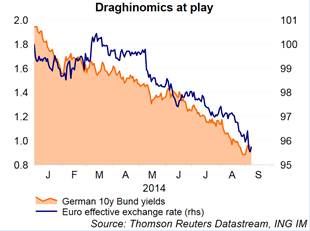
Draghi’s progressive thinking is certainly off to a reasonable
start in terms of market impact, as bond yields and the Euro
are lower and equity prices are up in recent weeks.
Still, it should not be overlooked that the size of the moves
seen so far remains far smaller than what was seen in Japan
after the start of Abenomics.
For example, the Euro is only
down 4% in trade-weighted terms from its peak for the year,
while the Japanese Yen dropped around 25% as a result of the shift in policy settings in 2013. It remains early days,
however, to judge the impact Draghinomics as it took 4-5
months in Japan to generate the full impact on bond, equity
and currency prices.
The political hurdles for some of
Draghi’s ideas remain formidable so a repeat of the Japan
experience in Europe still seems a stretch, but further steps
on a more cautious reflation path cannot be excluded.

The implications for our asset allocation stance are currently
mainly regionally of nature (closing our underweight in
European equities, staying overweight in European credits),
but if the impact of Draghinomics where to grow so will its
impact on our allocation stance. It is not yet a reason to
increase our overall risk-on stance, but has contributed to
eliminating the concerns we had on disappointing growth
numbers in Europe as a potential driver of future risk
aversion amongst investors (and yes, the better German and
French data releases also helped here). If further traction in
especially the currency market becomes visible, a renewed
increase in risky asset exposure will certainly be considered.
Fixed Income
We are neutral on fixed income spread products. Visibility on
the economic recovery has improved and emerging market
tail risks have faded (although not disappeared). Also, in an
environment of easy monetary policy stances and low return
expectations, the search for yield remains an important driver
of investor flows. However, technical factors are now less
positive and liquidity and gap risk have increased recently.
Within fixed income spread products, we closed the
underweight high yield. High Yield’s relative valuation and
momentum have improved after the sell-off while flows have
returned. Liquidity within high yield nevertheless remains a
concern. Euro Investment Grade Credits are neutral.
We are neutral EMD HC and upgraded EMD local rates to
overweight. Investor flows returned to EMD as did
momentum in local bonds. Search for yield and reform
potential (Indonesia, Brasil) may provide further support. We
keep Eurozone Peripherals at a medium overweight as
further ECB action is increasingly likely and underlying
fundamental improvement is expected.
Equities
Equities are a medium overweight. A moderate cyclical
sector allocation remains in place as we believe much of the
data disappointment is weather-related and expect a growth
re-acceleration in the second half. We prefer Financials,
Discretionary, Energy and Materials. Elsewhere, the stable
growth sectors remain underweight as they are still too
popular and expensive. Earnings are also providing welcome
support both in the US as well as in Europe.
After the ECB measures we upgraded Europe from a
medium underweight to neutral. The monetary policy cycle
and the earnings cycle may offer support for European
equities. However, we continue to prefer the non-European
markets.
Regionally we prefer Japan. The country remains attractive
due to lowered expectations, high earnings growth, attractive
valuations and investor positioning. US is a small overweight
following better than expected earnings and improving
economic surprise indicators. Finally, we upgraded emerging
markets on fading cyclical risks for the region, attractive
valuations and strong flow momentum. At the same time
lingering growth and system risks in China remain an
important risk factor.
Real Estate
Real estate was reduced from a strong to a medium
overweight. Globally, fundamentals remain firm almost
everywhere in DM space and non-residential real estate
starts to pick up in the light of a better economic outlook.
The recovery started in the US but today also the UK,
Germany, Japan and, more recently, other parts of core and
peripheral Europe are improving in terms of house prices,
home sales and unemployment dynamics. Chinese real
estate on the other hand sees his prospects deteriorating.
Commodities
Commodities are on a small overweight. Global cyclical
indicators and some improvement in selective Chinese data
provide support. Meanwhile, El Nino probability has come
down but could flare up again and some supply side
squeezes in (non-US) agri and metals components might
arise on the back of this. Also, geopolitical risks remain
omnipresent while non-commercial positioning in key segments (Energy, Agriculture) came down substantially. At
the same time, uncertainty with respect to the outlook for
both growth and stability of the financial system in China
offers a potential headwind for commodities.

Add Comment