


This post is also available in:  Français
If the market was fully rational in its current pricing, policy makers could actually see current low levels of bond yields as a vote of confidence in their long-term credibility. It would then be rational for policy makers to exploit the lowest funding costs ever
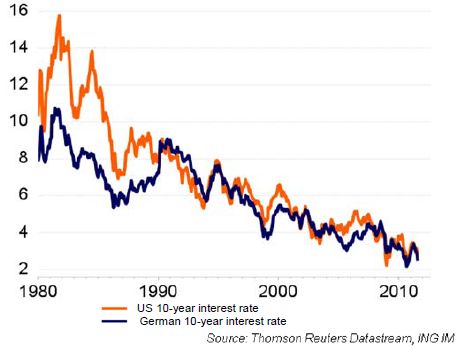
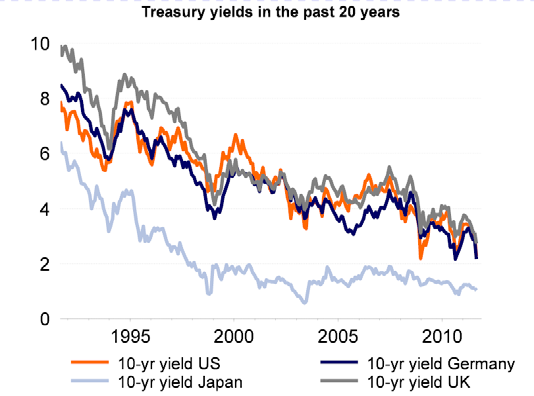
Outside of European peripheral markets, treasury yields have started to trade around all-time lows. In Germany, yields are back at last year’s Euro Crisis 1.0 level, while US treasury yields are in Great Depression territory and UK GILT yields at their lowest point for the last 200 years. Systemic scares and growth fears have conspired to reach this impressive result.
For those still convinced that unprecedented easy monetary policy will lead to large upward inflation risks (and higher treasury yields) or that stretched public finances will trigger near term solvency fears (also pushing treasury yields up), recent market behaviour should provide clear evidence that they have been wrong in anticipating market drivers. However, some will probably argue that higher yields will still arrive at some point in the future on the back of inflation and/or solvency worries and that the market is just temporarily irrational in his behaviour.
Most fiscal policy makers certainly seem to think that this is the case as Core Europe, the UK and the US are all preparing for a significant round of fiscal tightening in an effort to improve public finances before the market changes his mind and starts demanding higher risk premiums from sovereign borrowers that are currently able to borrow at record cheap rates.
At least it seems very hard to justify the current behaviour of these fiscal policy makers in any other way. If the market was fully rational in its current pricing, policy makers could actually see current low levels of bond yields as a vote of confidence in their long-term credibility. It would then be rational for policy makers to exploit the lowest funding costs ever to stimulate final demand at a time that their economies are flirting with a recession again. Partly (but certainly not only) because a new recession would only deteriorate the state of public finances; not help to strengthen them.

So the market must be irrational in the eyes of fiscal policy
makers who pursue aggressive fiscal austerity over the next two
years to prevent them from being hit by much higher funding costs once the market gets its sanity back. But wait, if the
market is irrational in its pricing today, than a unique opportunity
has to be in place to exploit this mispricing of risk. A rational
borrower would realise that the most effective way to profit from
this opportunity was to combine temporary higher borrowing at
irrationally low costs with credible measures to lower future
expected borrowings. The obvious examples of the latter for the
Euro, UK and US governments are efforts to diminish funding
gaps for liabilities related to future pension and healthcare
schemes.
By taking this approach, average borrowing costs over both the
short and long term would actually fall, which on its own would
already contribute positively to the solvency outlook for the
government involved. Moreover, short-term temporary
borrowing can be employed for fiscal stimulus of the economy
which will probably prevent a renewed recession or make it less
severe. The stronger economic backdrop and utilisation of
productive resources which will otherwise be left idle will
actually help to mitigate the negative impact of additional
borrowing on government finances. It will lead to lower
unemployment benefit outlays and higher corporate and
household income, which will at least dampen the negative
impact of stimulus borrowing for the next two years.
This underscores the puzzling response that fiscal policy
makers are currently displaying to combat deteriorating public
finances and rising recession risks. Either they believe that
markets are rational and use their vote of confidence to support
the economy or they are convinced that markets are irrational
and exploit the cheap funding opportunities this creates to
support the economy for at least as long as the market remains
irrational. Whatever the outcome of the sanity-check of the
market, it seems difficult not to conclude that another round of
temporary fiscal stimulus is the best way forward for policy.
The fact that fiscal policy makers in Europe, the UK and the US
are coming to a different conclusion is therefore a bit confusing
and contributing to the recent increase in recession probabilities
in these regions. The confusion stems from the assumption that
policy makers are expected to respond rationally to the market
environment that they are faced with. Maybe that assumption is
actually the irrationality in our own analysis.

Add Comment