


This post is also available in:  Français
The Pandemic Emergency Financing Facility
In 2017, the International Bank for International Reconstruction and Development (IBRD; part of the
WBG) established the PEF following the cross-border 2014–15 West African Ebola virus outbreak, which
caused more than 11,000 deaths. This outbreak proved the need for an established funding mechanism
to mitigate pandemics in developing countries.
The IBRD and the International Development Association (IDA; part of the WBG), in collaboration with
the World Health Organization (WHO) and other public- and private-sector partners, designed the PEF to
provide surge funding for response efforts in eligible countries to help prevent rare, high-severity disease
outbreaks from becoming pandemics. In general, countries with access to the PEF are those eligible to
receive resources from IDA.[[See http://ida.worldbank.org/about/borrowing-countries for a list of PEF-eligible countries.]]
This funding mechanism aims to provide additional financing to help the
world’s poorest countries respond to cross-border, larger-scale outbreaks by complementing, rather than
replacing, the much wider role that IDA as well as other international organizations and donors play in
supporting pandemic responses.
PEF funds can be used to finance the cost of response efforts during an outbreak. This includes, but is
not limited to, the deployment of human resources, drugs and medicines, essential and critical lifesaving
medical equipment and personal protective equipment, logistics and supply chain of critical supplies,
nonmedical equipment, minor civil works (e.g., setting up temporary attention centres), services,
transportation, hazard payments, and communication and coordination.
The Insurance Window and Pandemic Bonds
The PEF provides funding to eligible countries through (1) a cash window and (2) an insurance window.
These windows are triggered in different ways and are specifically designed to complement each other.
To date, the PEF has paid out $61.4 million from its cash windows to fight Ebola in the Democratic
Republic of Congo, including $50 million for the current 10th outbreak. The insurance window provides
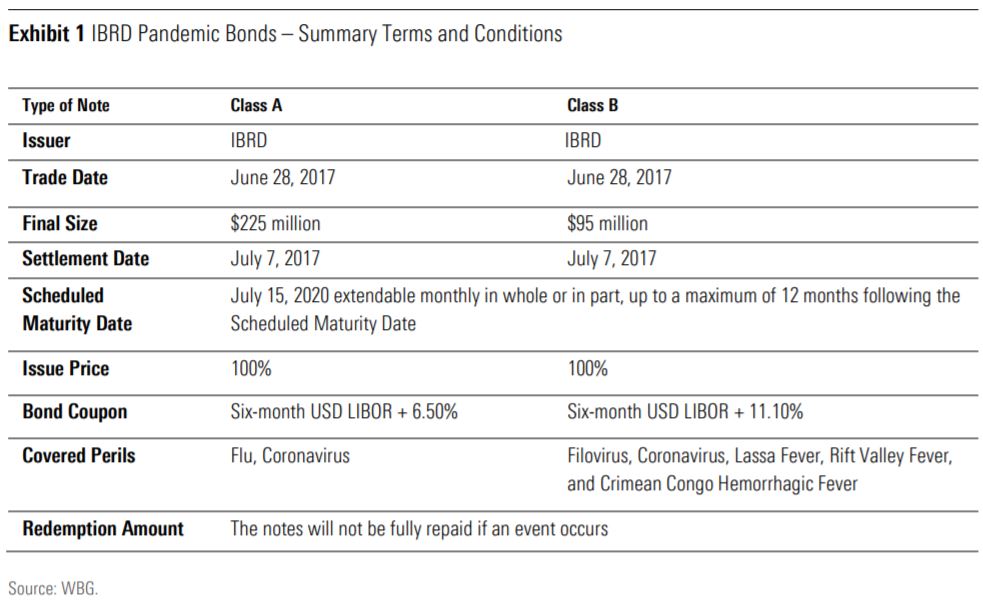
coverage of up to $425 million, composed of pandemic-risk-linked swaps[[ Since these are private transactions, no public information is available about their triggers.]] for $105 million and two classes of pandemic bonds for $320 million in floating-rate catastrophe-linked capital at-risk notes issued
in June 2017 (see Exhibit 1). Class A of these pandemic bonds totalled $225 million while Class B
totalled $95 million. Similar to other catastrophe-linked bonds in the market, investors could lose their
principal if a set of parametric triggers, such as outbreak size, growth rate, and spread across borders,
are met.

Under the current coronavirus outbreak, investors in both classes of IBRD pandemic bonds can
potentially lose all or part of their principal, given the conditions outlined in the prospectus of these
pandemic bonds and the most recent statistical information provided by the WHO. However, we
estimate that Class B investors are more likely to be affected and the proportional loss of their principal
will be higher. For an outbreak to become an eligible event under the terms of the IBRD’s pandemic
bonds, it needs to meet a certain level of severity in terms of event duration, number of confirmed
deaths, geographical spread, and growth rate.
The Class A Notes would require the current coronavirus outbreak to (1) cause more than 2,500 fatalities
in countries and territories specified in the prospectus with 250 cases confirmed on rolling basis, (2) last
at least 12 weeks, and (3) cause more than 20 fatalities in a second country. If these conditions are met,
the Class A Notes would lose 16.67% of principal or $37.5 million,[[A full payout of the Class A Notes (full loss of principal) would be triggered only by an influenza pandemic.]]
which will be available for the PEF to
distribute among governments of certain countries or specialized international agencies. Based on the
most recent data published by the WHO, COVID-19 essentially meets the conditions to trigger the Class
A Notes in terms of the number of fatalities and geographic spreads; however, the WHO dates the start
of this outbreak on December 31, 2019, which means that the bonds will pay out on March 24, 2020 (the
12-week duration period).
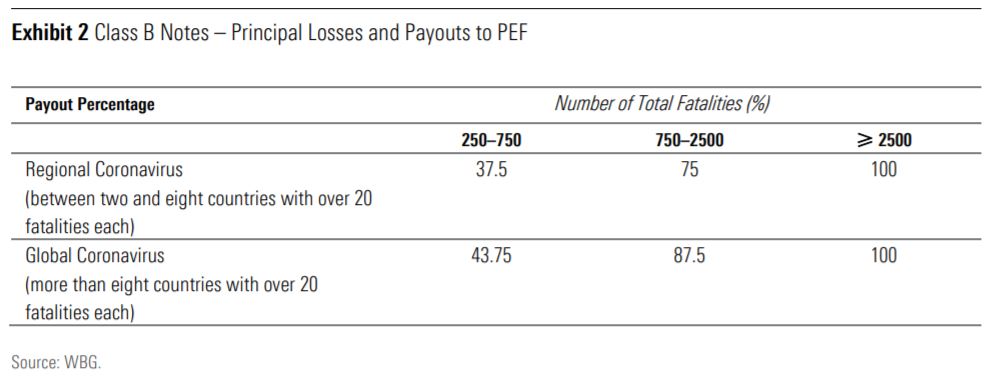
The Class B Notes require fewer fatalities to be triggered (250) while the rest of the conditions are
materially similar to those for the Class A Notes. The main difference is that, if all conditions are met,
Class B investors would lose all principal ($90 million) on March 24, 2020 (see Exhibit 2). As of the date
of this commentary, this would be the case for Class B investors, bringing the total amount available in
the PEF to $132.5 million; however, a larger coupon compensates for this higher risk associated with the
Class B Notes.

Outlook for the Pandemic Bonds Market
IBRD-issued pandemic bonds amounting to $320 million account for a small fraction of total catastrophe
bonds, which are currently sized at approximately $37 billion. Although IBRD pandemic bonds were
oversubscribed in 2017 at over 200%, there have been no other issuances of pandemic bonds since.
Similar to other catastrophe bonds, defining parametric triggers is not an easy task and IBRD pandemic
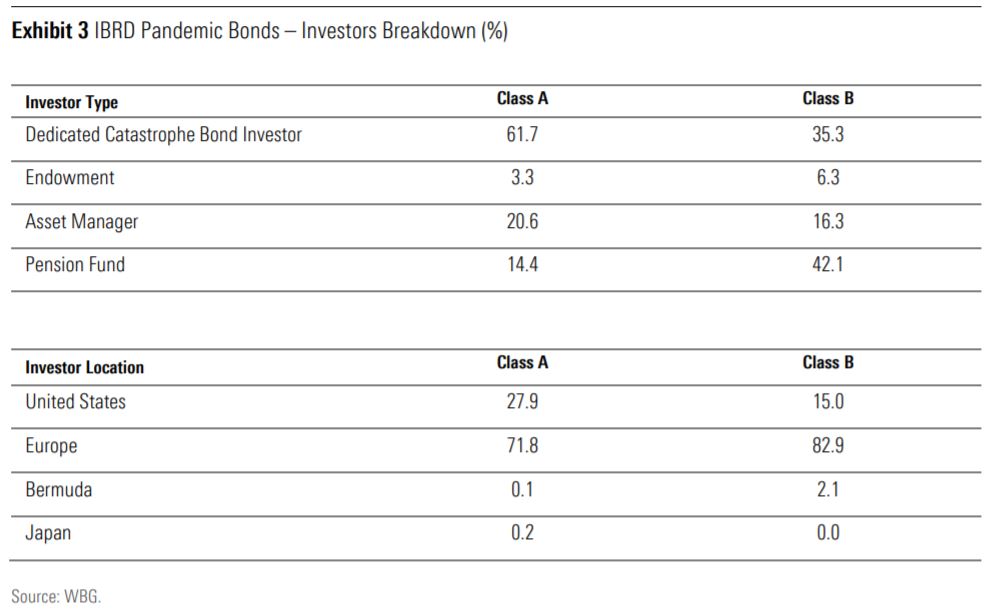
bonds are no exception with a prospectus of almost 400 pages. Although catastrophe bonds are mostly
bought by sophisticated institutional investors (see Exhibit 3), the convoluted definition of trigger events
for the different types of pandemics covered might make pandemics bond valuation extremely difficult.

The typical investor in catastrophe bonds is attracted to this asset class because it is generally
uncorrelated with the general markets; however, the current coronavirus outbreak is showing that the
valuation of pandemic bonds is highly correlated with the performance of global financial markets when
it matters most. Pandemic bonds are designed to cover events whose impact is much more global by
definition while traditional catastrophe bonds are designed to cover earthquakes or hurricanes, which
tend to have a more geographically focalized impact, making them less correlated with the overall global
market.
Another objection from public health experts is that pandemic bonds are not designed to help poor
countries prevent an outbreak as funding might be available too late. Public health experts have also
pointed out that pandemic bonds are quite expensive, given that they have high-interest coupons and
that these resources can be invested in the health sector infrastructure of developing countries;
however, pandemic bonds were never intended to replace other development aid programs, but rather
to introduce market-based funding tools to transfer some risk to the financial markets. Despite a number
of complaints in the early stages of the current coronavirus outbreak which highlighted that pandemic
bonds would not likely pay out, we believe that they will actually be triggered soon and that resources
from principal write-offs will be available to help the poorest countries in the world manage this extreme
event. It is still to be seen if investors will remain attracted to pandemic bonds after payouts are
activated, but past experience with catastrophe bonds illustrates that interest remains even after large
natural catastrophes affect this asset class. We believe that a second round of pandemic bonds can
address some existing concerns and remain a viable funding source for low-frequency but high-severity
pandemics.

Add Comment