


This post is also available in:  Français
Developments in healthcare have undeniably taken a
spectacular leap forward since the last century. This is
well demonstrated by longer life expectancies. The
average life expectancy has risen from 46.6 years
worldwide in the 1950s to 71.4 years in 2015[[NU figures.]]
and could even reach 90 years for women in some
countries by 2030[[Research by the Imperial College of London published in The Lancet medical review.]]. This longevity is partly due to the
general improvement in living conditions. However, it
is mainly the result of the progress made in medical
research in recent years.
As in other sectors, this progress is driven by the
breakthroughs made elsewhere in the high tech
industry. The interaction of these two universes has
resulted in major advances in the treatment of some
conditions.
Biotech, immunotherapy and medtech are
all new disciplines that are taking the place of
conventional medicine and research and are evidence
of the recent disruption to healthcare and the life
sciences. “This development is dictated by cost and
demand considerations”, summarises Estelle Ménard,
Assistant Head of Thematic Management at CPR AM.
“Healthcare spending is on an unsustainable path due to demographic trends and the ageing of the population”.
It accounts for 10% to 12% of the GDP of OECD
countries on average. In the US, this figure reached
17.8% in 2015, in other words $3,200 billion. The cost
of drugs alone amounts to $315 billion on this market,
representing 9.8% of total healthcare spending. “We
are gradually changing mentality, explains MarieHélène
Leopold, a healthcare and pharmaceuticals
analyst at Amundi. The idea is no longer to prescribe
more drugs; on the contrary, the focus is on avoiding
repeated treatments by improving the quality of
healthcare and the effectiveness of drugs”. The
progress made in recent years has been aimed, along
these lines, at developing a more personalised, and
therefore less expensive, healthcare system. The
current disruptive forces are also redirecting
traditionally “reparative” medicine towards a more
preventive approach.
These development focuses are attributable to several
factors. First there is the exponential increase in usable
data, also known as big data.
More information is
being gathered thanks to the emergence of large-scale
players, following the consolidation of the healthcare
sector, and the expanding of social security cover.
Incumbent laboratories have also stepped up their
collaboration with more innovative biotech companies,
whose development is focused more on the processing
of these data. The quantitative and qualitative
improvement in the information gathered has finally
resulted in more sophisticated analysis. These
significant advances in research have allowed
laboratories to concentrate on disease prevention.
Data can also be analysed more quickly. Thanks to the development of artificial intelligence and algorithms,
and to connected objects’ ever more finely tuned
sensors, diagnoses, and therefore the prescriptions
given as a result, have considerably improved. A year
ago, for instance, BioFire (Biomérieux) made a
remarkable achievement by launching a test that is
able to detect whether a case of meningitis is viral or
bacterial in less than an hour.
“Generally speaking, the digitisation of the sector now
allows the monitoring of individuals’ health in real time
and the prevention of chronic conditions such as high
blood pressure, summarises Wesley Lebeau, the
manager of the CPR Invest – Global Disruptive
Opportunities fund. The goal is to achieve better
foresight and to management treatments accordingly”.
The range of possibilities, encompassing algorithms,
connected objects and data processing, is such that IT
giants such as Google and Apple now have a large
presence in the healthcare field and have recently
signed agreements with big laboratories.
The quality of the care given is also a feature of the
current shake-up. Whereas in the past the use of a
broad-spectrum antibiotic was a prerequisite before
administering the right molecule, the process has now
been simplified. The advances made in research by
biotech companies, especially when it comes to
targeted therapies, are in this way significant. For
example, “Herceptin can now be used to treat a specific
type of breast cancer that had one of the highest
mortality rates just ten years ago”, says Marie-Hélène
Leopold. Other fields than immuno-oncology have also
been truly revolutionised in the last few years, such as
genomics and microbiota. The potential benefits are
huge and are whetting the appetites of the big
laboratories. This is the case for Roche, which
considerably expanded its portfolio of products, and
patents, by taking over the company Genentech in
2009.
As “disrupted” healthcare is simpler, faster and more
effective, it above all meets cost control needs. “The
solutions offered by biotech companies are still
expensive, acknowledges Marie-Hélène Leopold. But
new technologies, such as the 3D-printing of tissues, are being introduced to reduce their cost”. Pressure on
laboratories’ R&D budgets and the explosion of
available data are at the same time improving research
productivity. Some estimates put the savings at around
5% of expenditure on the US market, in other words
$20 billion.
More generally, digitisation could reduce
both the total cost of approved drugs, which currently
stands at $2.6 billion, and also increase the number of
these drugs.
“Whereas on average, over the last ten
years, 28 drugs were given the go ahead by the FDA
each year, this figure could rise to 33, or even higher,
thanks to digitisation”, says Marie-Hélène Leopold. The
possibilities offered by disruption are all the greater as
the healthcare sector is vast.
“Our approach is based on five sub-fields”, explains
Wesley Lebeau. “Biotech, medtech, immunotherapy, ehealthcare,
life sciences and diagnostics”. The CPR
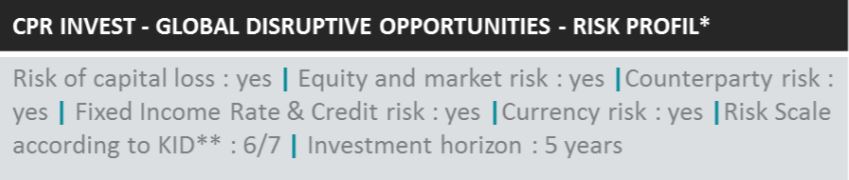
Invest – Global Disruptive Opportunities fund therefore
indiscriminately covers both pure players and
incumbent laboratories that are reinventing
themselves in order to take part in the revolution
under way.


Add Comment