


This post is also available in:  Français
The Japanese government implemented the first of the two planned consumption tax rises in April this year.
Now the second one to raise it from 8% to 10% is scheduled for October 2015. But will it happen against the
background of the recent weak economic data? Weather has also played a part in dampening consumer
sentiment as Japan has been hit by typhoons, one of which caused the devastating landslide in Hiroshima,
claiming more than 70 lives.
Domestic stocks left out
Japanese equities have rallied strongly in recent months. Exporters such as car, machinery and electronics
makers have benefited from the yen’s renewed weakness since mid-August.
On the other hand, the
performance of the companies that rely on domestic demand has been relatively subdued, as consumption
has not recovered as firmly as analysts had hoped following the April tax rise.
Japan’s job market improving
However, we maintain a focus on domestic
stocks as we believe the underlying domestic
economy is improving steadily. Many
investors seem to have overlooked the
importance of the recent tightness of Japan’s
labour market. Unemployment is now at a 25-
year low and wages have begun to rise. In
the construction sector, there are now six or
seven job offers for every person who wants
a job[[Source: Credit Suisse]], so this sector has seen particularly
sharp wage rises.
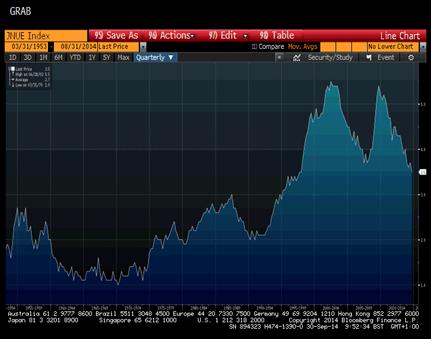
Japan historically has a low unemployment
rate among developed economies. The rate
mostly stayed below 3% until mid-’90s.
However, the economy suffered from
stagnation and chronic deflation in the late
’90s onward and as a result, the unemployment number rose steadily to more than 5% when the tech bubble
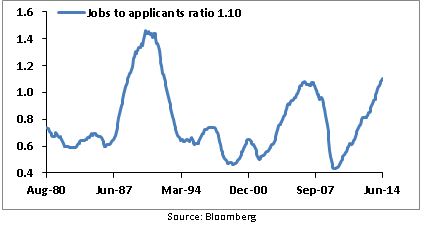
burst in 2000 and again after the global financial crisis in 2008. Recent data showed that unemployment fell
to 3.5% in August, while the jobs-to-applicants ratio, which is widely regarded as a leading indicator for the
labour market, improved to 1.10, the highest reading since 1992[[Source for data and chart: Bloomberg]].
Chart1: Japan’s unemployment rate

Chart 2: Japan’s jobs to applicants ratio

Promoting women as part of labour reform
After Prime Minister Abe concentrated on changing Japan’s pacifist constitution, his focus now appears to be returning to structural reforms. Abe reshuffled his cabinet in early September for the first time since he became prime minister. The 18 person cabinet now includes five women, the biggest number ever, which should be seen as a nudge to the rest of the economy to encourage women, Japan’s most underused human resource, into employment. Abe’s popularity, especially among female voters, has recovered sharply.
Wages have begun to rise
Wage growth is critical for the Japanese economy in the current reflationary environment. Basic wages have been at best flat in nominal terms since 1998 when Japan’s persistent deflation began to take hold. With inflation rising and consumption tax raised in April, household spending will be squeezed if wages fail to rise. The tightening labour market began to bolster wage growth and recent data showed summer bonuses rose more than 7%, supporting Japan’s nascent recovery in wages. Even regular wages, which remained stagnant, have begun to rise, albeit only by 0.3% both in June and July[[Source for data and chart: Bloomberg]].
More stimulus measures possible
At the moment, Abe says he may decide to cancel the tax rise if consumption remains weak. However, we believe that Abe, Central Bank Governor Kuroda and the Ministry of Finance are all determined to widen the tax base by increasing the consumption tax as scheduled. Therefore, if data does not improve, we expect some stimulus measures to be introduced to support consumer spending in order to pave the way for the planned tax rise. Indeed, recent government data showing inflation slowed to 3.1% in August, or 1.1% excluding the effect of the tax rise, prompted Kuroda to state that he might increase the Bank’s quantitative easing policy. These measures should support domestic stocks.
More pension buying expected
In his cabinet reshuffle, Abe also elevated LDP Deputy Policy Chief Yasuhisa Shiozaki to the role of Minister of Health, Labour and Welfare. This is widely seen as a signal that the giant government pension fund will shift its allocations more aggressively towards domestic equities. We view the cabinet reshuffle as a statement of intent from the administration and we are more hopeful that the long-awaited “third arrow” reform measures could materialise after all.
We believe domestic stocks should gain a boost if the government announces stimulus and/or reform initiatives in the coming months.

Add Comment