


This post is also available in:  Français
Fixed Income market globally has been selling off since
beginning of the year, with 10Y US Treasuries (USTs)
and 10Y Bunds yields higher by nearly 50bp and 30bp
respectively. The move has been driven by a number of
factors 1) expected shift in central bank policies
2) beginning of year portfolio flows and the return of
supply 3) better economic data.
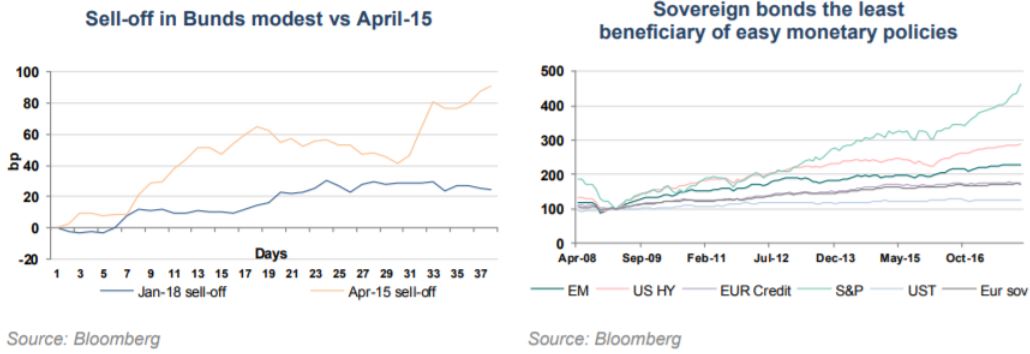
Even though the sell-off appears aggressive, it is
relatively modest versus previous episodes. 10Y USTs
moved by nearly 80bp in the month following US
presidential elections in 2016 and by nearly 135bp
around the taper tantrum. Similarly 10Y Bunds had sold
off by nearly 90bp in April-15 which was driven by
position squaring rather than macro factors. In all the
above cases, the sell-off did not last long and
eventually reversed.
Despite the recent sell-off, valuations for both the US
and the European markets are not stretched. Our risk
premium metric (which compares bond yields versus
long term expectations of growth and inflation) suggests
that the fair value range for 10Y USTs is 2.05% to
2.80% and that for 10Y Bunds is 25bp to 75bp.
Currently we have moved to the upper end of the fair
value range both in the US and in Germany. While
valuations may not be stretched, as rates move to the
upper end of the fair value range, the sensitivity of risky
assets to the level of rates should increase.

To gauge the sensitivity of risky assets to a move in rates, we can
use a risk premium framework. Conventional measures
of valuing equities would suggest that equities are
over-valued. However, when valued vs rates (equity
yield – real bond yield), equity risk premium does not
appear in a bubble territory, suggesting that risky
assets are supported only as long as rates continue to
remain low.
We would argue that risky assets are more sensitive to
a shift in central bank policies than rates. Using a
simplistic framework for central bank policy impact, we
compare the asset price evolution since the start of the
easy monetary policy.
On a comparative basis, we find that rates have
benefited the least from the easy monetary policies.
Equities, EM and HY have been the largest
beneficiaries of the support from central banks.
As the supportive policies are withdrawn, one would expect
that the asset price evolution to be in exactly the same
order i.e. Equities, EM and HY would be much more
vulnerable to a rate sell-off than the sovereign bond
market.
Thus a rate sell-off from current levels becomes
self-defeating. If rates sell-off further, it would trigger a
sell-off in risky assets which would in-turn create a bid
for fixed income.

Add Comment