


This post is also available in:  Français
In reviewing the primary options available for investment – stocks, bonds and cash –
noticing that each has its problems is unfortunately the easy part of the analysis. Stock P/E
ratios have expanded dramatically over the past six years, reaching levels unseen for quite
some time and exposing investors to any reversal in underlying confidence. Bond yields
have fallen to extraordinarily low levels in nominal terms, thus presenting investors with the
possibility of negative real returns should inflation or credit quality prove problematic down
the line. Cash returns nothing today – as discussed in a prior Outlook – and similar to
bonds, holds the prospect of lagging inflation over time. There is also real estate, which for
many investors means their house. While home prices may not be out of line with long-term
historical valuation parameters, most homeowners have learned the lesson that house
prices can in fact decline, so yes, there is risk in this asset class too. In total, it seems the
investment landscape today holds plenty of risk.

Beyond the bedrock approach of buying cheap assets, diversification can be of great
assistance in building a strong portfolio, one with ample expected return but not too much
risk. In theory, when one asset price zigs, another may zag. By combining assets with
differing return and risk profiles, the characteristics of a portfolio may be superior to its
individual components.
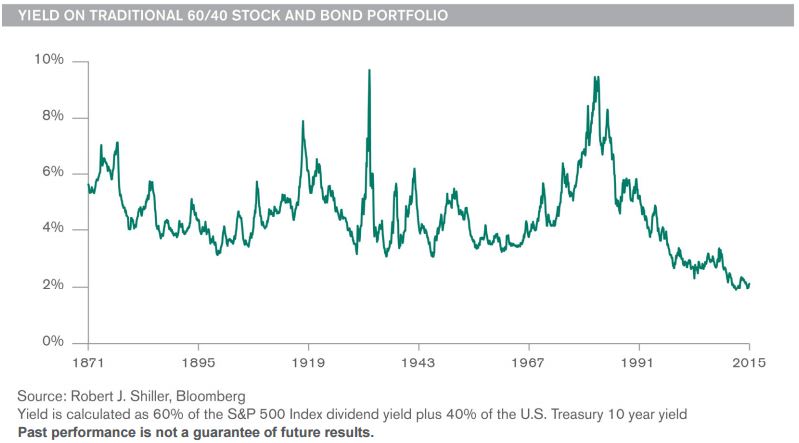
In practice today, however, the yield on a traditional 60/40 stock
and bond portfolio is at a 100+ year low. Both asset classes are expensive, leaving an investor little to work with in the way of portfolio building blocks. Worse yet is the uncomfortable possibility that the correlation between stocks and bonds may become high should the mood of the markets darken, and thus mute the potential benefits of diversification.
In the realm of equities – our focus at Perkins – risk can sneak up on you, in a way. In a
bullish environment, an investor may assess her portfolio as consisting of a
pharmaceutical company with a potential blockbuster in the pipeline, a cable television
operator which may participate in a merger boom, and a world-class industrial
manufacturer focused on efficiency gains to drive its margins higher. In a less optimistic
setting, the same investor may feel she owns a drug company facing pricing pressure, an
old media provider grappling with cord-cutting, and a cyclical industrial firm earning peak
margins with nowhere to go but lower. Further, it is when in this more pessimistic mood
that she will recognize that in addition to a number of serious company-specific or
perhaps industry-level risks embedded in the portfolio, the correlation among these risks
is frighteningly high. For example, the drug pipeline optimism seems to fade at the same
time as media M&A activity declines and industrial production rolls over.
The seemingly
natural tendency to recognize risk here, risk there, risk everywhere in a stock portfolio –
during and after a sizable drawdown in the market – is something to avoid at all costs.
One must try to recognize and avoid/manage the risks in advance.
As our benchmarks keep setting new highs, our investment team keeps an account of the
risks which are accruing. Our analysts model an explicit downside scenario for every
stock under consideration. This discipline helps us identify risks, even during a bullish
phase in the market.
We are especially leery of cyclically high sales and profit margins, as
well as valuation multiples stretched by the demand for dividend yield. Conversely, we like
companies which may benefit from “self help,” such as lowering operating expenses or
refinancing high-cost debt. We also favor earnings streams which are tied to repeat
purchases unlikely to change as a result of fluctuations in the economy, as we believe
these stocks are relatively less likely to be subject to a weakening of market confidence.
Our portfolio managers are aiming for a thoughtful degree of diversification, not just in
sector classification or geographic region but by underlying drivers of the cash flows, book
values and valuations of our holdings. We are always on the lookout for that which is out
of favor and unloved – even today there are examples of this “meat and potatoes” of
value investing – and in its absence hold quality in high regard.

Add Comment