


This post is also available in:  Français
Almost all of the performance of diversified
portfolios, across both equities and fixed
income, could be explained by factors
RISK FACTORS HELP US TO UNDERSTAND THE MARKET
Risk factors help explain systematic return patterns in the
equity market and in other asset classes.
In traditional finance theory, such as the Capital Asset Pricing
Model (CAPM) that was set out by Treynor, Sharpe and others
in the 1960s, there is a single equity market risk premium,
measured by beta. This risk premium compensates investors
for holding equities rather than less risky assets. An investor
can capture the equity market risk premium by holding the
market portfolio of stocks.
But since CAPM was introduced researchers have put
forward convincing evidence that there are other systematic
sources of return in the equity markets than simply the
market beta. These alternative return premia, or risk factors,
include those relating to stocks’ size, their valuation, their
momentum and their historical riskiness.
So now we can talk about “smart beta”: a combination of
market beta and alternative risk premia representing these
other factors.
Smart beta = market beta + alternative risk premia
Factor investing means the attempt to capture particular
factor risk premia in a systematic way, for example by
building a factor index and replicating it, or by constructing
a portfolio that gives you exposure to a range of risk factors.
The objective is to combine factors to enhance the long-term
performance of portfolios.
FACTOR INVESTING IS A SUBSET OF SMART BETA
Factor investing, including factor indices, are part of the
smart beta trend. But smart beta goes beyond factors.
Smart beta indices include all indices that depart from the
traditional method of weighting components by their market
capitalisation—companies’ individual stock market footprint.
Equally weighted, minimum variance indices, maximum
Sharpe ratio and equal risk contribution indices are all part
of smart beta. Many of these index approaches have factor
“tilts” but they are a by-product of the index design.
In contrast, factor indices are those that are designed
intentionally to capture a specific risk premium, such as
value, size, low volatility, quality or momentum.
FACTORS AND ACTIVE MANAGEMENT
Factor investing has attracted a lot of interest because the
past performance of traditional active managers seems to
be due in a large extent to exposure to particular risk premia.
There’s a lot of evidence that the average active manager
has had long-standing exposure to particular factors, such
as size and momentum.
For example, an influential study of the past performance
of the Norwegian Government Pension Fund, published
in 2009, showed that almost all of the performance of the
fund’s external managers, across both equities and fixed
income, could be explained by factor “tilts”.
This observation raises an important question. If a fund’s
performance can be attributed in large part to a combination
of return factors, why not seek to replicate the factors in a
systematic and low-cost way? We are seeing a lot of interest
in doing just this via smart beta indices and ETFs.
I don’t want to downplay the role of active investors altogether.
This type of fund management will always play an important
role. But active managers should be rewarded for taking truly
idiosyncratic risks.
DON’T GET LOST IN THE FACTOR ZOO
In their influential 1992 paper, “Common Risk Factors in the
Returns on Stocks and Bonds”, Eugene Fama and Kenneth
French showed that, in addition to the market risk premium,
two other factors relating to firms’ size and to value help to
explain stock returns.
Since then, researchers have provided evidence for the
existence of other factors, including momentum, low volatility
and quality.
Momentum is a well-documented tendency for persistence in
stocks’ price returns: stocks that have recently outperformed
tend to continue to do so for some time. The low volatility factor is a return stream associated with less risky stocks
and the quality factor represents the performance of a
subset of more defensive stocks.
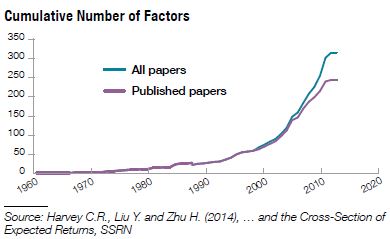
But statistical analysis can be and has been used to claim the
existence of more and more factors. In fact John Cochrane,
president of the American Finance Association, has recently
referred to a “zoo” of factors. We recently counted around
250 in published academic papers, and their number has
been increasing exponentially.

To avoid getting lost in the factor zoo—so as not to be misled
by spurious correlations—we think that there should be solid
empirical evidence for the existence of a factor and that there
should also be some theoretical justification for its existence.
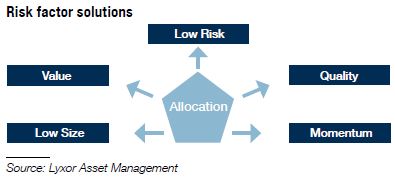
LYXOR’S FIVE-FACTOR FRAMEWORK
Lyxor’s equity market factor framework focuses on
those alternative risk premia that have solid theoretical
support and which are backed by empirical evidence. The
framework has five components: in addition to the Fama-
French factors of value and size we include momentum,
low volatility and quality.

FACTOR APPROACHES WORK BEST REGIONALLY
Our research suggests that factor investment approaches work best in a regional context.
Value Factor Returns by Region.

Size Factor Returns by Region.

Over the period between 1995 and 2013 value factor investing
produced positive relative returns in the US, Europe, Japan
and Asia-Pacific, particularly in the period between the
market peaks of 2000 and 2008. But, relative to local largecap
stocks, small caps have done better in the US than in the
other three regions. These differences in factor returns across
regions probably reflect differences in market structure.
THE EXPLANATORY POWER OF FACTORS VARIES
When compared to traditional market beta, the ability of
alternative factors like value and size to explain market returns
is not fixed. Our research suggests that the ability of individual
factors to explain stock returns probably moves in a 5-10 year
cycle and, over time, reverts to the mean.
And it’s important to point out that the collective power of
factors also varies. Since 2005, the combined impact of the
Fama-French value and size factors on the US equity market
was lower than in the 2000-2005 period, for example. Value
and size stocks moved very much in unison during the period
after the dot-com bubble burst.
These observations suggest that it makes sense to diversify
across factors in a portfolio.
It’s important to point out that there is
diversity a mongst factor a pproaches
THE VALUE FACTOR HAS TWO COMPONENTS
Within Lyxor’s factor framework, two factors are similar in that
they both focus on stocks that trade at a valuation discount to
the market portfolio: quality and value.
The quality factor highlights higher-quality, less cyclical, lowerleverage
companies with above-average yields: these are
defensive stocks that are likely to underperform in a rising
market but which offer better protection in a downturn.
Our value factor focuses on distressed stocks, which are
relatively risky but which offer the potential of large price gains
in a recovery[[See Lyxor’s Expert Opinion, “Brave Value Investing”.]]. Examples of stocks in this category are BP after
the 2010 Deepwater Horizon oil spill or Tesco after the 2014
disclosure that the company’s earnings had been overstated.
Société Générale calculates indices based on both these
factor approaches, the SG Quality Income and the SG
Value Beta indices. In our view these strategies are highly
complementary for a portfolio investor.
FACTOR STRATEGIES MUST TAKE INTO ACCOUNT
LIQUIDITY AND CAPACITY
Factor-based strategies are of interest to many types of
investor, including the very largest pension and sovereign
wealth funds.
But the potential implementation costs of a smart beta
strategy of any size are important, particularly for the largest
investors. Any investment portfolio that deviates from the
market capitalisation-weighted index will generate some
incremental costs as a result of additional turnover.
Research by Frazzini and others, published in 2012, suggests
that value is the factor with the greatest potential investment
capacity, followed by size and momentum.
It’s important to point out that there is diversity amongst factor
approaches, something that may alleviate potential capacity
constraints and concerns over crowding. For example the value factor indices published by the main index providers
have subtle differences in their methodologies, so they don’t
all hold the same stocks in the same proportions.
ALLOCATING EQUALLY ACROSS FACTORS CAN GIVE POWERFUL RESULTS
One of the principal reasons for the rising interest in factor
investing is that diversifying across factors appears to give
more powerful results than diversifying in the traditional way,
by asset class, because of the lower correlations we observe
between factors.
But how much of a portfolio should we allocate to each factor?
When asset allocators consider how much of their portfolios
to devote to equities and bonds they usually start with quite
distinct return and risk forecasts for these two asset classes,
leading to a variable equity/bond allocation for investors with
different risk appetites. This type of forecasting exercise,
which is not easy, is even more difficult for factor returns.
In the table and chart below we show the return and risk
characteristics of five world factors and we compare them to
the MSCI World Net Total Return Index. All the factor indices
produce higher Sharpe ratios than the market portfolio, but
note that the returns of the individual factor indices are within a
range of just over 3% a year.
Factors need to be used consciously and carefully, with full knowledge of their characteristics


In fact a simple approach to factor allocation—equalweighting—
has a lot of benefits. Our calculations show
that for this period equal weighting produced better returns
than other, more complex approaches to allocation, such
as equal risk contribution, volatility weighting or minimum
variance.
FACTORS SHOULD BE USED SENSIBLY
Factors can be a powerful tool to represent in a systematic
way how the equity market’s returns are produced. They are
having a major impact on how investing and asset allocation
are done. But factors need to be used consciously and
carefully, with full knowledge of their characteristics.
MOVING FROM THEORY TO PRACTICE
Investors may feel lost when confronted with 250 risk
factors. They are required not only to understand the
characteristics of each factor but also how to combine
them in a portfolio. And to move from theory to practice,
factor investing demands both technical expertise and
experience. It’s also natural to question whether factors
should be used as part of a strategic allocation or to take
more tactical investment positions.
To help answer such questions, together with my co-author
Zélia Cazalet I have recently written a paper entitled “Facts
and Fantasies About Factor Investing”. We take a holistic
view of risk factors, aiming to demonstrate certain factors’
persistence and suggesting how to allocate between them
in portfolios.


Add Comment