


This post is also available in:  Français
Many large investors already apply risk budgeting to asset
classes in their allocation (although sometimes mistakenly
referred to as ‘risk parity’, it is not always a question of
equally weighted risks). The main difficulty lies in defining
risk budgets that are appropriate for each investor. By taking
economic risk factors into account, we can accurately define
precise risk budgets to match the specific objectives of each
investor profile. This represents a step up from the traditional
risk parity approach, which focuses solely on asset classes.
The economic and financial crisis has prompted many
pension funds and institutional investors to reconsider their
long-term asset allocation strategy. They are calling into
question traditional portfolio optimisation as propounded
by Harry Markowitz and are increasingly leaning towards
the risk budgeting approach and its corollary, risk parity.
The principle underlying risk budgeting-based allocation
is simple: the asset allocation is established on the basis
of the risk contribution of each portfolio component,
rather than the expected return. In the case of a portfolio
comprising two assets managed using the equallyweighted
risks approach, each asset makes an equal
contribution to risk and therefore to performance. To
achieve this balance, exposure to the riskier assets is
reduced, and vice versa.
Traditional diversification via weightings leads to markedly
different results. For example, in a balanced portfolio
composed of 50% equities and 50% bonds, the equity
component accounts for almost 90% of the portfolio’s
volatility. By way of symmetry, the equity component will
also generate the same proportion of performance.
Risk-based diversification thus intuitively seems much
more accurate and equitable. Investors can use it to
optimise their risk profile beyond mere diversification
based on market capitalisation, and thus to obtain a better
risk-adjusted return. In addition, it allows for an ex-ante
understanding of performance attribution: due to the
mirroring effect between risk and performance, investors
can anticipate the source of their portfolio’s performance.
Risk factors
A major challenge remains to be addressed, namely
defining a risk allocation that is in line with investors’
objectives. Even if a portfolio’s allocation appears to be
optimally, or at least neutrally, diversified using the risk
parity approach, it may harbour other hidden sources
of risk, e.g. financial and economic factors affecting the
performance of the asset classes in the portfolio. Insofar
as risk factors can affect more than one asset class at a
time, ignoring them and focusing solely on asset classes
can lead to a concentration of a limited number of factors.
Long-term investors may go a step further in applying this
approach by no longer considering only asset classes
(equities, bonds, commodities, etc.) but also economic
risk factors such as economic activity (GDP, industrial
production), inflation (commodity and consumer prices),
interest rates (real interest rates, steepening and convexity
of the yield curve) and the effective exchange rate.
Using such a framework, the portfolio is constructed on
the basis of the risk budget allocated to these various
economic criteria. At first glance, this might seem easily
achieved by simply linking an asset class with a particular
type of risk – e.g. bonds with interest rate risk – and
applying the traditional risk budgeting method. However,
such an approach would not be effective as an asset
class can be exposed to several economic risk factors at a
time. While equities are affected by economic growth and
industrial production, they are also impacted by interest
rates – as shown by the Gordon-Shapiro model – and
inflation. Therefore the sensitivity of each asset class to
certain risk factors must be identified in order to establish
an asset allocation.
It is all the more appropriate to consider economic risk
factors rather than financial assets given that many pension
funds and asset managers reason in macroeconomic
terms. For example, a pension fund expecting a lasting
period of growth may try to increase the GDP sensitivity
of its allocation. By assigning a budget per risk factor, it
can do so with great accuracy by selecting a set of assets
sensitive to growth.
Such an approach standardises the concept of risk parity in that several asset allocations can then be compared on the basis of common factors, regardless of the asset classes used. It also reconciles the quantitative approach to strategic asset allocation with the fundamental approach.
Smart beta selection
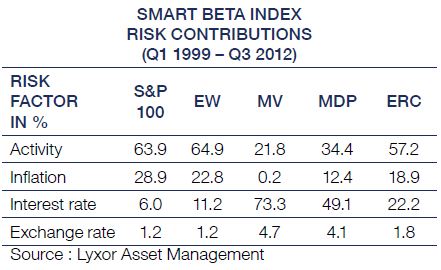
Furthermore, an increasing number of pension funds are opting to invest in ‘alternative’ or ‘smart beta’ indices to supplement their passive management activities. Several competing methods currently exist, each with their own objectives. These include approaches such as the Equally Weighted Portfolio (EW), Minimum Variance Portfolio (MV), Equal Risk Contribution Portfolio (ERC) and the Most Diversified Portfolio (MDP), among others. Analysing the risk contribution of each factor by type of approach gives investors a clearer picture of the various competing smart beta methodologies.

By way of example, the S&P 100 index is sensitive to economic activity but it is also affected by interest rates as shown in the risk contribution table. This can be explained by the fact that the slope of the yield curve is a leading economic indicator. Interest rate risk is therefore not exclusive to bonds.
Sensitivity to interest rate risk is higher in the case of minimum variance portfolios. As the equities making up an MV portfolio are generally among the least volatile in their universe, they have bond-like characteristics. Result: implementing the MV approach in the equity component introduces bond risk. From a strategic allocation viewpoint, this amounts to transferring part of the equity component allocation to the bond component.
Analysing the risk contribution of each factor thus allows us to assess a portfolio’s economic profile. It also provides a clear idea of sensitivity to economic risk factors and, above all, allows for a more accurate prediction of how “smart beta” indices will behave in different macroeconomic conditions.

Add Comment