


This post is also available in:  Français
This spread is also at its highest since July 2011. The determinants of this re-pricing of the US curve are well known:
1. The forward guidance protects the short end of the curve, especially since the Federal Reserve is apparently
discussing the opportunity of lowering its unemployment rate target below which it could envisage raising the
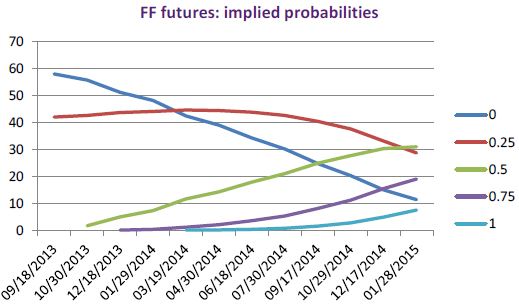
federal funds rate target. This discussion is probably tied to the behaviour of the Fed funds futures, as they
price in an interest rate hike as early as the end of next year. A few weeks ago, no increase in the Federal
funds was priced in before the start of 2015.
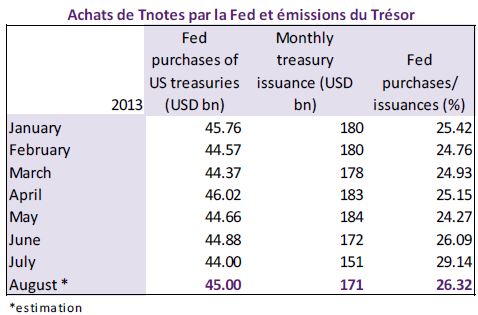
2. Prospects of a QE3 tapering is weighing on the long end of the curve (currently, purchases by the Federal
Reserve “cover” one quarter of TNote, TBond and TIPS issuance). It is not yet totally certain this tapering will
get under way in September, but for long-dated issues it matters not greatly whether this tapering begins in
September or December: the issue is not “if” but rather “when” and “how”. What matters for the market is
that the signal has been given. Currently, investors expect asset purchases by the Federal Reserve to end
mid-2014. They will react (positively or negatively) if comments by the Federal Reserve when it announces
the actual tapering do not confirm this timing.


If one considers real yields, it will be observed that much of the yield curve has clawed its way out of negative
territory: currently, TIPS maturing in more than 6 years offer positive yields. At the start of the year, only TIPS
maturing in more than 20 years offered positive yields. At the start of 2010, no TIPS maturing in more than 3 years
offered negative yields. At the start of 2008, real yields were positive right across the curve (weakest real yields
were around 1%).
The rise in TNote yields results from the following phenomena:
1. In the short term, therefore, prospects of the tapering getting under way.
2. Longer term, prospects of a rise in the Federal funds rate target (in principle once the unemployment rate
has pulled back below 6.5% or lower still if the threshold is revised downwards).
3. Anticipations of stronger growth (US economy is turning in very honourable performances, especially
considering the fiscal tightening has reduced growth by around 1pp in 2013 alone).
4. And probably, the Federal Reserve’s intention to normalise monetary policy as soon as possible, in other
words once growth is self-sustained or, as Mark Carney would say, once escape velocity has been reached.
It may be the Federal Reserve will succeed in calming the markets in September. However, many of the above
phenomena are irreversible, save if the improvement in the economy is short-lived and deflation gradually takes hold
in the US. What is still not known is their velocity (for one thing, the Federal Reserve has not made firm
commitments regarding its balance sheet policy come mid-2014). There may be some offsetting at flow levels, but it
does seem that the rise in TNote yields will be a lasting phenomenon. A 3% yield for the 10Y TNote is no longer
outlandish, but what awaits tomorrow. As regards the curve, the Federal Reserve’s rhetoric points to a further
steepening (the possibility that the 6.5% unemployment rate threshold could be lowered affords more protection to
the short end than to the long end). The Federal Reserve clearly wants to disassociate the balance sheet policy from
the interest rate policy (i.e. non conventional measures from conventional measures). Indeed this is such that the
two policies could, in appearance, go their separate ways to a large extent. It is this quasi-divergence of policies that
could lead to a further steepening of the yield curve in the near term.

Add Comment