


This post is also available in:  Français
Background of the asset class
Corporate bonds have an attractive long-term risk/return
profile. Historically the asset class generates returns
somewhere between equities and sovereigns but, in the
past five (albeit exceptional) years and in a favourable
environment of global deleveraging, it has far outperformed
equities. Corporates are a long-established asset
class in the US where they are the mainstay of many
pension funds and the asset class is expanding rapidly.
Post credit crunch, many companies have turned to the
credit markets rather than the banks for funding. Thus it
is that Emerging Markets corporates has grown into an
asset class of its own.
In the Emerging Markets, credit markets are maturing just
as rapidly as stock markets. Not only do EM corporates
offer attractive diversification away from EM sovereigns
and equities, they also currently offer very attractive
return potential, compared with their US counterparts.
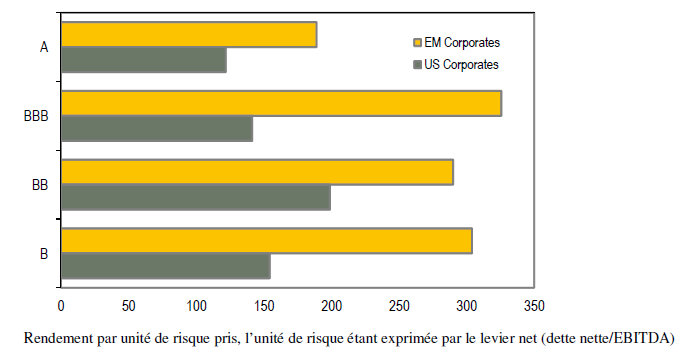
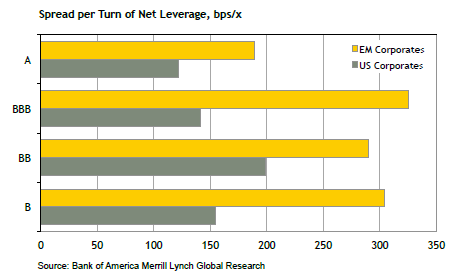
As the chart below shows, EM corporates are paying
more per unit of risk than US corporates across much
of the credit spectrum. With the High Yield credit premium
at 800 basis points and Investment Grade at 250 basis points, the willingness of investors to settle for
historically low or negative interest rates from US and
European ‘safe’ sovereign bonds is all the more surprising.

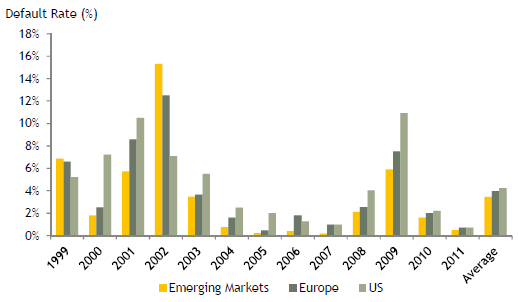
What makes these risk premia all the more attractive is
the fact that default risk is lower on average in Emerging
Market nations because of the corporate tradition of
keeping debt levels low and cash levels high. The higher
cash buffers in EM companies will also help them to
withstand recession better and invest for growth as the
recession ends.
Investment opportunities in EM bonds
As markets begin to mature and companies are able to
demonstrate a history of debt repayment and creditorfriendly
behaviour, so a value approach to corporate
bond investment becomes possible. As with value equity
investment, value bond investment means looking for
pricing inefficiencies in the markets and investing with a ‘margin of safety’ which hinges on a low net-debt-toequity
ratio. Experience has shown that value and smallcap
bonds in companies with low debts generate excess
returns and therefore represent an identifiable alpha
factor in the credit universe. This effect can be amplified
in Emerging Markets. For example, we frequently find
examples of smaller companies and value companies
that are penalised by rating agencies for reasons totally
unrelated to their ability to repay their debts. Also, the
‘sovereign ceiling’ effect has, in the past, meant that for
some emerging market corporates, ratings are marked
lower simply on grounds of the company’s head-office
location. However, given that Developed Countries’ sovereign
ratings seem to be on a negative trend – whereas
we still expect positive rating actions among EM sovereigns we would expect future convergence between
the average ratings of the more mature Emerging Market
countries with Developed Market countries.
A value approach to corporate bonds seeks to identify
‘overlooked’ and under-rated companies that are forced
to pay high yields while offering solid business models
or assets or cash backing as a margin of safety for debt
repayments.
Integrating SRI/corporate governance information
SRI and corporate governance insight is as important
to fixed income investors as it is to long-term equity
investors because any risk that might erode a company’s
future profitability is also a threat to its capacity to repay
debts. Corporate governance is known to be weaker
in Emerging Market companies – although it is improving
– and this is one of the reasons that EM corporates
need to pay higher yields. Thus a thorough analysis of
corporate governance should be included as an essential
step in the corporate bonds investment process. Failure
to consider environmental, social and governance risks
can expose investors to large ‘tail risk’ like litigation risk
or the risk of large lawsuits arising from – for example –
environmental disasters. Rule of law and property rights
are also an important consideration. For example the
Mongolian Government has made a ‘National List’ of
resources and sectors of strategic importance. This type
of action could end up in assets being expropriated from
companies– which may involve a significant headline risk
for their debt holders.
What is the outlook for EM corporate bonds?
The pace of economic growth has been slowing in the
emerging market economies. But this is potentially good
news for credit investors. For a start, the extreme pace
of economic growth was starting to cause problems for
companies – such as increasing salary costs, increasing
inflation affecting raw material prices and decreasing
global competitiveness. But in general, lower growth
scenarios favour corporate bond investors because
they force companies to focus on profitability and
careful, organic growth rather than on leveraging up
their balance sheets and taking risks. For these reasons
and because of the strong cash levels in EM corporates,
we expect the default rate, which is already lower
on average than in developed markets over the past
decade to retain that advantage over the coming years.


Add Comment