


This post is also available in:  Français
What does the liquidity of an ETF mean?
In simple terms, the liquidity of an ETF is the ability of the fund to meet
investors’ buying and selling orders without a significant impact on its
price. This liquidity reflects a number of factors, primarily the liquidity of the
underlying market, but it also reflects structural features of the ETF.
The secondary market price of an ETF is set freely by market participants
based on price moves in the underlying securities. The highest buying order
for a fund (best bid) and the lowest selling order (best offer) set the ETF’s bidoffer spread. The depth of an ETF’s order book shows the capacity of the
market to absorb larger transactions.
In Europe, a significant part of ETF trading takes place away from exchanges
in the bilateral, over-the-counter (OTC) market. OTC market orders also
contribute to the liquidity of an ETF.
What’s the difference between the liquidity of an ETF, an ordinary share and a traditional fund?
An ETF is a hybrid between an ordinary share and a traditional fund. Both
ETFs and ordinary shares are traded on stock exchanges throughout the
day; by contrast, a traditional mutual fund usually has a single daily entry/exit point for investors wishing to buy or sell. But an ETF’s share capital, like that of a traditional fund, is variable (open-ended), whereas the share capital of a company does not vary in response to market supply and demand. This feature means that supply and demand is less relevant for ETF pricing than moves in the price of the underlying securities.
Why does an ETF ’s liquidity matter for investors?
ETFs’ ability to offer investors low-cost and flexible exposure to a variety of
asset classes is the key reason for their popularity. Part of ETFs’ low-cost
promise is that their average fund expenses are usually lower than those of
comparable actively managed funds. But the cost to enter and exit an ETF
is also frequently lower than that of a traditional fund. The ability to transact
in ETF shares at the time of their choosing and at relatively low cost is very
attractive for investors.
From where is an ETF ’s liquidity sourced?
The liquidity of an ETF is sourced from both the primary
and secondary markets. In the primary market, specialised
intermediaries called “authorised participants” or “APs”
transact directly with the ETF issuer to «create» and
«redeem» ETF shares: new ETF shares are issued if
demand is high or existing shares are withdrawn if there is
too much supply.
The secondary market is where continuous trading in ETF
shares occurs. Secondary market transactions can be in
any number of ETF shares.
The primary and secondary markets of an ETF are linked.
A liquid secondary market in an ETF’s shares depends to
a great extent on an efficient primary market mechanism.
Lyxor is constantly working on its primary market setup to
make sure it is as supportive of liquidity as possible.
What can an ETF issuer do to influence the liquidity of its funds?
Although an ETF issuer has no direct impact on the
secondary market liquidity of its funds, it can influence
a fund’s liquidity positively by putting in place a robust,
diversified and flexible primary market structure.
Lyxor does this in three ways. First, we operate an open
access model, contracting with over 50 APs to create
and redeem units in Lyxor ETFs. Second, we offer APs an
efficient creation/redemption process, with creation and
redemption fees that reflect the actual cost of trading the
underlying securities, a low minimum creation size and
flexibility in terms of the assets that the AP may offer in
exchange for the ETF units (for example cash, futures or
an index basket). Third, over 15 official liquidity providers
quote continuous bid and offer prices on exchanges
throughout Europe, bringing liquidity to the order book of
Lyxor ETFs.
Together, these measures have made Lyxor’s ETFs among
the most highly traded in Europe.
What is an ETF ’s “fair value band”?
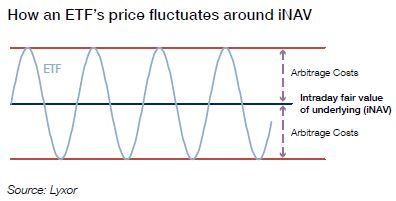
The secondary market price of an ETF typically fluctuates
freely within a so-called “fair value band” around the fund’s
indicative net asset value (iNAV). The iNAV measures the
fair value of an ETF share during continuous trading.

The fair value band reflects the cost to the AP of
creating and redeeming fund units. For example, when
accumulating the shares to place a creation in an equity
ETF, the AP will pay what we call arbitrage costs: part of
the bid-offer spread on the underlying shares, plus any
applicable commissions and taxes. The upper limit of the
fair value band exceeds the ETF’s iNAV by a margin that
reflects these creation costs. Similarly, the lower limit of the
fair value band reflects redemption costs.
What happens if transaction taxes are payable on the underlying securities?
If transaction taxes are payable on purchases of the
securities that make up the ETF’s creation basket, the
upper limit of the ETF’s fair value band will reflect the cost
of paying those taxes.
For example, an ETF owning UK shares will have a fair value
band that reflects the 50 basis point (0.5%) stamp duty
reserve tax (SDRT) payable on purchases of UK shares.
Lyxor’s ETFs tracking UK share indices typically own other
European shares, together with a performance swap,
under which a counterparty promises to pay the return on
the index. This means that creation costs in a Lyxor ETF
tracking a UK share index are relatively lower than in a fund
that owns UK shares directly.
In the chart we show the price deviations from NAV over
time of two ETFs tracking the FTSE 100 index. One ETF’s
price trades at a frequent premium to NAV, reflecting the
0.5% SDRT. The price of the Lyxor ETF stays much closer
to NAV.

Why is the secondary market bid-offer spread of an ETF often lower than
the average spread on the underlying securities?
The liquidity of an ETF consists of two layers: the first one
is the liquidity of the underlying securities, and the second
is the intrinsic liquidity of the ETF itself. As we explained
earlier, the secondary market bid-offer spread of an ETF
is set by the interactions of the many investors, traders
and arbitrageurs placing buying and selling orders. As a
result of this interaction of buying and selling demand, an
ETF’s secondary market bid-offer spread is often narrower
than the average spread payable on the full basket of index
securities.
For example, whereas a typical bid-offer spread in a
corporate bond may be a percent of the bond’s notional
value, the spread of a corporate bond ETF may be a few
basis points (hundredths of a percent).
Narrow ETF secondary market spreads reflect the inherent
efficiency of a pooled investment vehicle with a diverse
base of investors and traders. However, it’s important to
remember that, by contrast with a traditional fund, which
usually has a fixed spread between buying and selling
prices, an ETF’s spread is variable. And in stressed market
conditions spreads may widen to reflect the full cost of
trading the underlying index basket.
Why is the full liquidity of an ETF sometimes “invisible”?
Not all of the latent demand to buy or sell ETF shares is
displayed on stock exchanges’ order books. Partly, this
reflects the fragmentation of exchanges and other trading
venues in Europe – meaning that liquidity is split between
the multiple listings of the same ETF. But the widespread
practice of trading ETFs in the OTC market also leads to a
general underreporting of trading volumes.
The liquidity of an ETF is based on the liquidity of the fund’s
underlying securities. Not all that underlying liquidity may
be shown in the ETF’s own reported trading volumes. As
a result of this hidden liquidity, it may be possible to place
an order that seems large by comparison with reported
volumes, without having a significant impact on the ETF’s
price. Investors should remember that this hidden liquidity
exists.
How can liquidity be measured?
The best objective measure of an ETF’s liquidity is the data
published by Europe’s stock exchanges.
However, given the fact that part of an ETF’s liquidity
may be hidden, transaction cost analyses can also be
based on the ETFs’ underlying securities. Many market intermediaries provide such analyses and Lyxor’s capital
markets team can also help investors assess an ETF’s
fundamental liquidity.
Do competing ETF s on the same index have the same bid-offer spreads?
Not necessarily. ETFs from competing issuers that track
the same index can have different bid-offer spreads for a
variety of reasons: more or less efficient primary market
structures; differences in the number of market makers
active in a particular fund; and differences in fund size.
Other things being equal, a larger fund tends to attract
more trading volume, leading to lower spreads, in a
virtuous circle effect.
The chart below, which shows 5-day moving average bidoffer
spreads on three European ETFs tracking the MSCI
World index, illustrates that such differences exist.

How will regulatory changes affect European ETF market liquidity?
We expect ongoing regulatory changes to have a positive
effect on the ETF market’s liquidity.
Currently, for example, the reporting of OTC transactions
in ETFs is voluntary in many European markets. However,
under the second version of the Markets in Financial
Instruments Directive (MiFID II), which was passed in April
2014, a “consolidated tape” of trades in shares, depositary
receipts, ETFs, certificates and other similar financial
instruments is due to be introduced by the end of 2016.
The consolidated tape will be available free of charge 15
minutes after its publication. All ETF trades, including the
ones conducted OTC, will therefore be visible. This added
transparency will show the true liquidity of ETFs.
Another regulation, the Central Securities Depositary
Regulation (CSDR), is due to harmonise settlement and
buy-in rules across Europe’s exchanges and settlement
systems. This should also help to reduce the current
market fragmentation in Europe.
How does ETF liquidity impact Lyxor’s efficiency measure?
Liquidity is a key part of Lyxor’s framework for evaluating
the efficiency of an ETF. An ETF’s secondary market
liquidity, measured as its exchange-based bid-offer
spread, is one of the three factors contributing to any ETF’s
efficiency score. The wider the spread of an ETF, the lower
its efficiency score.
The other two factors contributing to the efficiency score
are an ETF’s performance and its tracking error.
From where can an investor obtain advice about the best ways of executing ETF trades?
Many market makers and broking firms now have specialist
ETF advisory units, who can offer advice on the best way
to execute ETF trades: for example, how best to time
trades to source times of peak liquidity in the underlying
market, whether to place a market or limit order or to
trade by means of an algorithm. It’s worth developing
relationships with a few trusted counterparties from this
group of intermediaries.
Although Lyxor’s ETF capital markets team does not buy
and sell ETFs, we are there to offer objective guidance to
investors wishing to source ETF liquidity. We can often help
unearth market inventories or demand, enabling clients to
reduce execution costs. We encourage anyone to pick up
the phone and get in touch!


Add Comment