


This post is also available in:  Français
- We equate ‘helicopter money’ with monetary financing. On an ex
post basis, the UK, US and Japan can be thought to have
experienced de facto monetary financing already, and it didn’t come
with an explosion of inflation. The evidence doesn’t suggest that
new helicopter money, if implemented, would spark inflation either. - Monetary financing isn’t a wacky new policy and is easy to
understand once you look at ‘money’ the right way. We should treat
government debt and taxation as two forms of monetary sterilisation
rather than financing operations. - There are not clear advantages to announcing a policy of
helicopter money over announcing a traditional debt-sterilised fiscal
expansion. Indeed, it could end up being a backwards step.
Central banks in Europe and Japan have experimented in recent
quarters with slightly negative interest rates. In doing so they have
broken what many had assumed was a zero lower bound for
nominal interest rates, and also given some indication as to where
the true lower bound may lie (which is to say around where rates
now sit). The question as to how central banks will respond to the
next recession has arisen amongst academics and investors.
One option being discussed is ‘helicopter money’. Helicopter money
refers to the situation where a central bank finances the fiscal
expenditure of a government. Or in common parlance, the
government prints money instead of raising taxes or debt to fund
spending. To many this evokes the sort of policy that brought hyperinflation to Zimbabwe or the Weimar Republic – and as such provokes meaningful alarm.
In this piece I will outline why the implementation of quantitative easing during periods of fiscal
expansion in the UK, US and Japan have effectively already delivered ex post helicopter
money, and why true helicopter money appears less attractive as a policy option than additional
levels of traditional debt-financed fiscal expansion, supplemented if need be by further
quantitative easing. But in order to make this clear, it is necessary to look at what money
actually is and how it works.
What is money?
We tend to think of money in the bank and money in our wallets as the same thing. That we do
so attests to the success of the monetary system in place. Rather than both being money, one
(the bank deposit) is ‘Inside Money’, while the other (the bank note) is ‘Outside Money’. These
are not fungible and are instead like oil and water. Inside (bank) Money is imagined into
existence by banks in the process of creating a loan. Outside (government) Money is imagined
into existence by the monetary sovereign (in the case of UK, the US or Japan, this is the
government).
Inside Money
Imagine that you go to your local high street bank for a loan. In granting the loan the bank
creates a deposit in your account. This deposit is a liability on the bank’s balance sheet against
which it holds an asset (a loan to you). If you choose to transfer your (borrowed) deposit to
another depositor of the same bank (let’s say, if you bought a house from me and I was also a
customer of the same bank), the liability (eg, the deposit) never leaves the bank. If you transfer
my (borrowed) deposit to a depositor of another bank, your bank would need to settle the
transfer (at the BoE) – but the liability would never leave the banking system. And so, Inside
Money exists only on a bank ledger and can never take physical form. Inside Money, to be
specific and a trifle more technical, is the short-dated liability of the banking system. Changes in
bank lending practices do not change Outside Money a jot.
Outside Money
Outside money (government money) is money that is imagined into existence not by a bank
making a loan, but by the monetary sovereign (in the case of the UK, US or Japan, this is the
government) making a payment. It is like an undated government IOU.
Imagine that a government pays a civil servant. As the monetary sovereign they can do so by
creating brand new Outside Money. The government then typically seeks to destroy an equal
amount of Outside Money to offset this monetary expansion, and this process of money
destruction is called monetary sterilisation. Why do governments sterilise their money creation?
The typical answer is to maintain confidence in the currency. After all, if a government went out
increasing the stock of outside money exponentially it is quite conceivable that recipients might
begin to become concerned that this Outside Money may not be a good store of value and so
seek to turn it into goods and services at higher prices (and so lack of confidence could show up
in the form of inflation), or they could seek to turn it into other peoples’ currency (and as such
show up in currency depreciation) or real assets (and as such show up in real asset inflation).
Figure 1: How Outside Money is created and removed from the economy

Figure 1 shows stylized balance sheets of the non-bank private sector (of which the civil servant
is part), the commercial banking system, the central bank and the government before this
hypothetical civil servant is paid (column 1), immediately after but before the money is pulled
back out of the system (column 2), and then after the two different forms of monetary
sterilisation (columns 3a and 3b).
The government has two routes to sterilise the monetary expansion. First, it can issue debt in
the form of new bonds to the private sector (column 3a). By selling bonds to the private sector
the government will successfully take the new Outside Money out of circulation, and replace this
Outside Money with bonds that cannot be so easily spent. Secondly, a government can tax
(column 3b). Taxation is a form of monetary sterilisation – with tax revenues effectively torn up
in order to maintain confidence in the currency. In the UK, by virtue of having signed the
Maastricht Treaty, the sterilisation action will always happen simultaneously or before the
payment to the civil servant. But this outline of how Outside Money works remains valid.
Figure 1 illustrates not only how Outside Money works, but also a couple of other things. Firstly,
it shows why it is peculiar to worry about debt sustainability from a fiscal (rather than a
monetary) perspective. Government debt can be seen to be no more than an instrument for
monetary sterilisation: a means by which zero-coupon perpetual government IOUs (Outside
Money) are removed from circulation and replaced with interest-bearing government IOUs with
a specified maturity (although they will at that point again become perpetual zero-coupon
government IOUs). The prospect that a monetary sovereign might be unable to sell government
bonds is real, but untroubling from a financing perspective; the prospect of a bond market strike
is instead troubling only from a monetary perspective.
Secondly it illustrates that when debt-sterilising rather than tax-sterilising, the private sector
ends up with a larger balance sheet. Government bonds are treated as assets, although they
are claims against the rest of the non-bank private sector who don’t own bonds. Given that
taxation tends to be progressive in democracies, it would appear likely that the distributional
consequences of debt sterilising rather than tax sterilising would be to leave upper deciles of the
income distribution holding more bonds and having paid fewer taxes. That is to say, that there
will likely be higher levels of wealth inequality under a government that prefers to maintain
confidence in the currency via debt sterilisation, all else equal.
Now that Outside Money has been outlined, with debt issuance and taxation explained as
instruments of monetary sterilisation, quantitative easing can be seen to be a pretty
straightforward reverse-sterilisation operation. As government bonds are bought by the central
bank, so the monetary base (in the form of Reserves and Currency, eg Outside Money)
becomes inflated. While the bonds are held by the central bank they are effectively cancelled:
they do not perform their monetary sterilisation duties and there is no net interest cost of holding
them to HM Treasury over and above the cost of remunerating holders of Reserves (which
would need to occur even if cancelled).
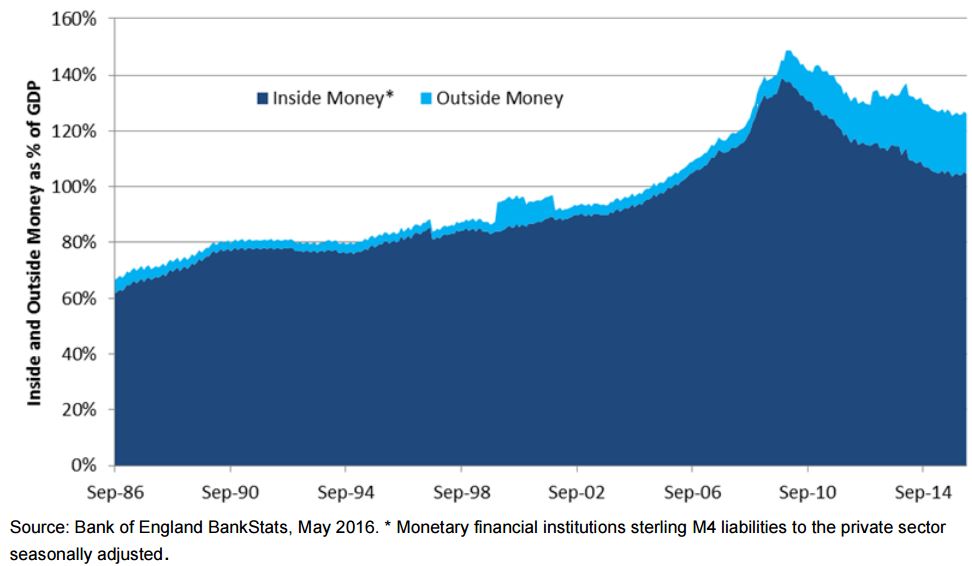
Figure 2 helps show the relative scale of Inside and Outside Money. The dark blue section
shows M4 as a percentage of GDP as a decent proxy for Inside Money and the light blue
section shows Outside Money as a percentage of GDP. Two things jump out. First, there is a lot
more Inside Money than Outside Money. Secondly, the acceleration in growth of Inside Money
was spectacular in the years leading up to the Global Financial Crisis, and the collapse
thereafter has been precipitous. The expansion of Outside Money in the form of QE has but
cushioned this contraction in the money stock.
Figure 2: UK Inside and Outside Money 1986-2016

With circa 250% debt to GDP many have asked whether Japan’s debts are too big to ever
repay (Figure 3). Government debt is rarely repaid. Bonds issued to sterilise a government’s
fiscal expenditure mature and are typically repaid by the proceeds of issuance of new bonds.
And so the debt issued by the British government to finance the Napoleonic Wars has never
been repaid. But pursuing this line is to miss the point.
We have already seen that government debt is no more than an instrument for monetary
sterilisation: it is a means of reducing the number of IOUs in the system, by replacing them with
long-dated IOUs that can’t be easily spent. As such, the issue of debt to GDP should not be
seen as a fiscal constraint: a government can’t run out of government IOUs. That said,
uncontrolled debt growth could conceivably become a medium-term threat to monetary stability
(eg, people might stop accepting government IOUs as payment). Uncontrolled debt growth
comes with the uncontrolled growth in debt service obligations. And these debt service
obligations come in the form of the creation of more Outside Money which in turn needs to be
sterilised.
Figure 3: UK government debt to GDP / Japan government debt to GDP

Despite high levels of debt to GDP, Japan’s debt service costs are today amongst the lowest in
the world, owing to low interest rates. In a scenario where inflation rises and policymakers want
interest rates to rise, the stock of debt could become problematic (as maturing debt is
refinanced with bonds carrying higher coupons) if nominal GDP growth is sufficiently absent (so
that debt-to-GDP rises ever-higher). Essentially, the threat to Japanese monetary sustainability
from its stock of government debt is the threat that people will stop accepting yen from the
government as payment. As long as the government has the power to enforce demand for yen
in the form of a requirement to pay taxes, this possibility appears de minimis.
We have seen that when a central bank purchases government debt it unwinds past monetary
sterilisations. Debt bought by the central bank is effectively cancelled for the duration of the QE
programme. In the two charts within Figure 3 we can see the degree to which these QE
programmes have impacted the UK and Japanese government’s debt to GDP metrics. In the
case of the UK, the QE programme (running contiguously with fiscal expansion) had the effect
of helicopter money. This can be seen from Figure 4.
The table outlines the impacts of QE, of helicopter money (where debt is purchased by the
central bank and written-off), and a combination of QE and fiscal expansion. Given that debt is
effectively cancelled from the moment it is bought by the central bank from a monetary and
fiscal perspective, the debt service and monetary effects of QE and helicopter money appear
the same.
Figure 4: Comparing quantitative easing, helicopter money, and fiscal expansion
combined with quantitative easing

The big difference arises when it comes again to tighten policy. By cancelling government
bonds bought, the central bank cannot so simply resterilise the unsterilised Outside Money
stock. If it wishes to calm inflation quantitatively it can auction central bank bills, term deposits
and implement reverse repo programmes, all of which put upward pressure on shorter-term
interest rates. And so it is left with the option of either raising short-term rates by more than they
would otherwise need to rise under the QE scenario, or persuading the government to gift the
central bank with large amounts of government debt that it can then sell to the market (which
may be tricky politically).
The economic effects of quantitative easing are still being debated, but it is fair to say that they
are presumed to be positive to date. In the case of helicopter money, there would be a direct
fiscal expansion financed by central bank purchase of (and cancellation of) government bonds.
This direct fiscal spend would be economically expansionary, unless the announcement of
helicopter money represented a shock to households and firms that was sufficiently significant
to offset the fiscal stimulus. The economic effects of fiscal expansion combined with new
quantitative easing appear identical to those of helicopter money.
The market effect of the recent experience of QE has been lower discount rates, a weaker
currency, and a strong environment for risk assets. We might guess that the market’s reaction
to helicopter money would be similar, but given that past episodes of dominance by the fiscal
authority over the central bank have been associated with fiscal indiscipline and high inflation,
there is a reasonable chance that markets could react in a meaningfully different and negative
way. The truth is that we just don’t know.
Hyperinflation
Helicopter money is often associated with incidence of hyperinflation. In their study of the 56
incidents of world hyperinflation during the last 300 years, Hanke and Krus found hyperinflation
to be ‘an economic malady that arises under extreme conditions: war, political mismanagement,
and the transition from a command to market-based economy to name a few’. By contrast,
monetary financing has been used widely in the developed and developing world over time
without ending in hyperinflation.
Until the US Fed Accord in 1951 the US operated a policy of fixing long-term bond yields, and
as such expanding or contracting Outside Money depending on private sector demand for these
instruments. Canada used monetary financing for 40 years until 1975 under a free-floating
exchange rate regime without calamitous macroeconomic effects, and India operated a policy of
debt monetisation until 2006. Further examples abound. Indeed, of the 152 central bank legal
frameworks analysed by the IMF, 101 permitted monetary financing in 2012. This is not to say
that helicopter money is a desirable policy. It would be, in the opinion of this author, a
backwards step. But neither is it to be necessarily associated with hyperinflation.
Conclusion
With the unknown market impact of helicopter money, with prospective policy tools in the hands
of central banks narrowed through debt cancellation, and with the economic benefits associated
with helicopter money rather than straight fiscal expansion de minimis, it is not clear why
policymakers will choose the path of helicopter money. Perhaps the real lesson is that monetary
policy has its limits and that in the event of an economic slowdown, aggregate demand is best
supported by fiscal rather than monetary policy. In the event that new fiscal expansion requires
supplemental monetary support in the form of additional QE, that is a decision that could be
made at some point in the future.
So, in conclusion, helicopter money is not a weird and wacky new form of money. Indeed, once
we understand how money works helicopter money looks pretty straightforward. The
prospective economic, monetary and fiscal effects of helicopter money (absent the stickershock
of a new unfamiliar policy being implemented) look identical to a normal fiscal expansion
supplemented with additional QE. As such, it could be argued that the UK, US, and Japan have
all already effectively experienced helicopter money. It is harder to say the same about the
Eurozone, consisting as it does of government entities that are not monetary sovereigns. Indeed,
the Eurozone is much more complicated.



Add Comment