


This post is also available in:  Français
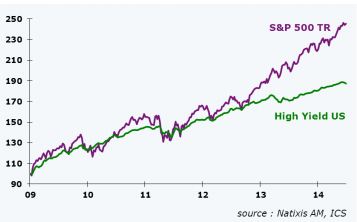
This trend is less noticeable on the graph, yet over the past few weeks of trading,
equities and high yield have even moved in opposite directions, since the S&P 500
continued to climb while America’s Citigroup high yield market index recorded a
few declining sessions.

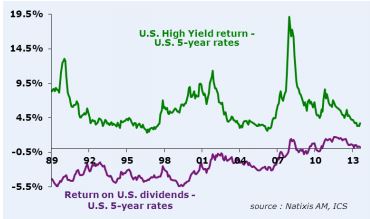
Two explanatory factors can be forwarded. The first is likely to be connected with
valuations. On the one hand, the return on stock dividends offers a consistently
more attractive remuneration than 5-year U.S. government bond rates, as
underscored by the upward trend in this spread.

On the other hand, the same spread for private bonds is seen to be continuously
narrowing, albeit in positive territory, which constitutes the very definition of high
yield. We’re also observing that the 3% level of spread is often the point where
this value has historically rebounded and would seem to form a floor that’s
difficult to penetrate. Moreover, a rise in bond rates would be proportionately
applicable on both spreads, yet its mathematical effect would be negative and
certain, whereas its effect on stocks would remain uncertain.
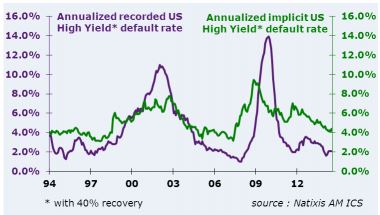
The second explanation is likely to be found in companies’ intrinsic value.
From
this perspective, the implicit high yield default rate stemming from the
instantaneous return of this asset class protects against a rise in the actual
recorded default rates.
These rates are undoubtedly at their minimum levels, though we can still notice
that the discrepancy between implicit and recorded has held, and the market has
not taken advantage of the limited number of U.S. corporate bankruptcies to
lower the return on private bonds by more than a proportional amount.

Nonetheless, another element is disturbing companies’ fundamentals, with a
significant increase in debt. As a matter of fact, while the amount of accumulated
debt had leveled off during the 2007-2008 crisis, its growth has taken off at a
good pace since then, especially over the past few years.

This re-leveraging of balance sheets may worry the markets at some point when
the issue of raising rates in the U.S. returns to the fore and when the unfavorable
spread for U.S. government bonds hits a historically low level as we’ve already
witnessed.
Obviously, it’s still too early to draw any conclusions on the divergence of these
two markets, but high yield will need to be closely monitored, given that it
remains less liquid than the equity markets.
During a correction, investors might
feel trapped and wind up accelerating this decline by running for the exits at any
price.


Add Comment